Red Light, Green Light Rules: How to Play, Variations & Other Names
- Region:
- Worldwide
- Tags:
- Medium group, Team, Tag & chase, From Japan, Kids, Family-friendly, Traditional
At a glance
- Players
- 3–30 players
- Game length
- A few minutes a round; swap the caller and play again
- Equipment
- None (a tree or wall for the caller and something to mark a start line)
- Space
- An open area with roughly 15 to 60 m (50 to 200 ft) between the start line and the caller (a 1909 US games book)
Contents (8)
What is this game?
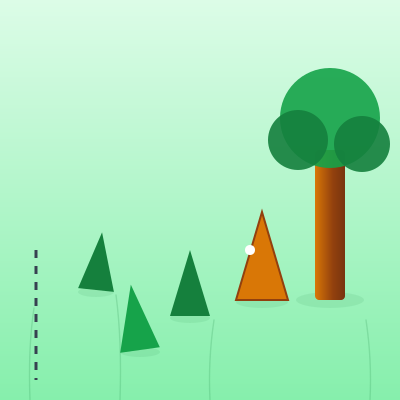
Red Light, Green Light is the game where one player, the caller, turns away and the others creep toward them, then freeze the instant the caller turns around. Anyone caught moving is out (in most English-speaking versions, back to the start), and the first player to reach and tag the caller wins the round.
The same idea turns up all over the world. In Britain it's usually Grandmother's Footsteps; in France, Un, deux, trois, soleil ("one, two, three, sun"); in South Korea, the caller chants 무궁화 꽃이 피었습니다 ("the rose of Sharon has bloomed"); and in Japan it's Daruma-san ga koronda ("the daruma doll fell over"). The Japanese chant has exactly ten syllables, and according to the Japanese dictionary Digital Daijisen it is said in place of counting to ten.
The Korean version became world-famous as the first game in the Netflix drama Squid Game, where players caught moving are shot. That violence is pure fiction: in the real game, getting caught just means going back to the start or being held by the caller, and nobody gets hurt.
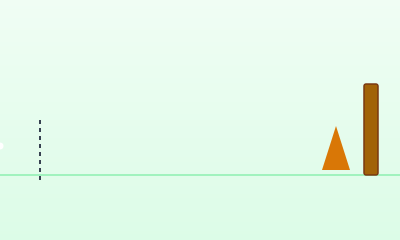
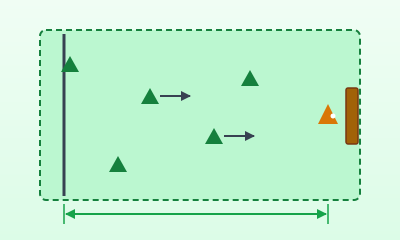
Figure: In Jessie H. Bancroft's 1909 book Games for the Playground, Home, School and Gymnasium, the two lines are 50 to 200 ft (about 15 to 60 m) apart. Go shorter for young kids.
Equipment & setup
You need no equipment, just three decisions:
- The caller's spot: a tree, wall or post to face. The middle of an open field works too
- The start line: draw a line or lay down hats or cones
- The boundaries: mark the edges so nobody runs off when the chasing starts
Check the ground for holes, rocks and roots first. In versions where everyone sprints after the tag, keep well away from playground equipment and benches.
Players & ages
| Format | Players | Notes |
|---|---|---|
| Small group | 3 to 5 | One caller plus players; the caller changes quickly |
| Class or event | 10 to 30+ | Bancroft (1909) lists 5 to 30 or more players. Split big groups and take turns |
- Freezing matters more than speed, so little kids and adults can play together
- Playworks, a US nonprofit that runs recess programs, lists it for any group size and under 10 minutes a game
Rules
The whole game rests on one rule: you may move only while the caller isn't looking. Endings differ between the English-speaking and Japanese versions, so start with the minimal rules and add your local twist.
How a round works (minimal rules)
- Pick a caller, who stands facing the tree or wall. Everyone else lines up on the start line
- With their back turned, the caller calls "Green light!" (or counts, or chants). Players may move toward the caller only while the caller is turned away
- The caller calls "Red light!" and turns around. Everyone freezes on the spot
- Anyone the caller sees moving is sent back to the start line
- Repeat until someone reaches and tags the caller
Standard rules (adding skill)
- Vary the rhythm: callers catch more players by calling slowly and then turning suddenly
- Yellow light: add "Yellow light!" for slow motion. The Playworks variations go further, with colours for walking heel to toe, hopping, skipping or tiptoeing
- The caller as the finish line: in another Playworks variation the caller is the goal and backs away when players get close
- Japan's hand-holding version: according to the Japanese encyclopedia MyPedia (Heibonsha), a player caught moving must go and hold hands with the caller instead of going back. The player who gets closest "cuts" the chain of hands to free everyone, and all the players run away. The caller counts to ten, shouts "Stop!", and anyone the caller can reach within ten steps is the next caller
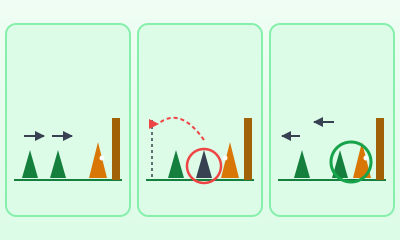
Figure: Left to right: move while the caller faces away; freeze when they turn, and anyone still moving goes back to the start; tag the caller and everyone runs.
Official competition rules
There is no single official rulebook for Red Light, Green Light; every playground has its own version. The best-documented versions are:
- United States, 1909: Bancroft describes it under the name "Step." The counter faces away and counts to ten loudly and rapidly; players seen moving go back to the start; play continues until everyone has crossed the counter's line, and the last one over becomes the next counter
- United States, today: Playworks marks a start line and a finish line; players move on "green light," stop on "red light," and go back to the start if still moving. The round ends when everyone (or most players) has crossed the finish line
- Britain: the Oxford Learner's Dictionaries define Grandmother's Footsteps as a children's game in which one player stands with their back to the others, who try to walk toward them without being heard or seen to move when the player turns round
- Japan: Japanese dictionaries describe the hand-holding version above, with the ten-syllable chant in place of counting
Scoring examples
There are no points. A round ends when someone tags the caller (or crosses the finish line), or when the caller catches everyone.
- Example 1: back to the start. Three players are halfway across. On "red light," one is still mid-step and goes back to the start line. The other two keep inching forward and one tags the caller. Agree beforehand who calls next, for example the player who made the tag
- Example 2: the Playworks finish line. Players cross the finish line one by one. When everyone, or almost everyone, is across, the round ends, and the first player across leads the next round
- Example 3: Japan's chain. Three players are holding hands with the caller. The last free player sneaks up and cuts the chain; everyone scatters. The caller counts to ten, shouts "Stop!", and walks ten steps to tag the nearest player, who becomes the next caller
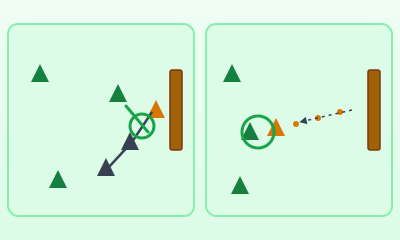
Figure: Japan's version. Left: cutting the chain of caught players frees everyone. Right: after "Stop!", the caller takes a set number of steps to tag someone.
Common fouls and tricky calls
- Blinking and breathing: usually allowed. Agree before you start how strict "moving" is
- Turning early: a caller who turns before finishing the call is cheating. Agree on a fix, such as a do-over
- Hiding: ban hiding behind things the caller can't see past; it saves arguments
- Wobbling: if someone frozen on one foot starts to tip over, let them put the other foot down. It's safer
Tips for enjoying the game
Common beginner mistakes
- Big running strides: you can't stop dead from a sprint. Small steps let you freeze cleanly
- A caller with one speed: if the rhythm never changes, players learn it. Slow, then suddenly fast
How to make it more fun
- More colours: Playworks suggests extra colours for different ways of moving, such as heel-to-toe walking for yellow and hopping for purple
- A moving finish line: let the caller be the goal and back away as players get close (Playworks)
- Big groups: split into groups and run several rounds; the first finisher in round one leads round two (Playworks)
Age variations
- Preschoolers: shorten the distance and let an adult be the caller until kids get the rhythm
- Players who are deaf or hard of hearing: use the caller's body as the signal, turning to face or away from the group, instead of calls (Playworks)
- Indoors or on rainy days: no running. Green means walk, yellow means slow motion, red means stop (Playworks)
- Seated play: for players who can't move around easily, swap walking for moving hands and arms, and freeze when the caller turns
Playing Red Light, Green Light in Japan
Local names for the chant
The ten-syllable chant changes from region to region. Japanese dictionaries give "Bōsan ga he o koita" ("the monk broke wind") as one well-known alternative, and comparing your own region's chant is half the fun.
At school and in parks
- Japan's national curriculum guidelines for elementary school PE include oni asobi (tag-style games) for the first and second grades, with running away, chasing and taking territory, and they also teach checking that the play area is safe
- In public parks, keep the start line and the running area off paths other people use
- In the Japanese version everyone sprints the moment the chain is cut. Set boundaries, and stay away from playground equipment, fences and ponds
Squid Game vs the real game
In Squid Game, players caught moving are shot, as Netflix's own episode guide describes. The real game is an old children's game where getting caught means going back to the start or holding hands with the caller. If kids want to play it after watching the show, keep the "back to the start" rule.
Frequently asked questions
Q. What is Red Light, Green Light called in other countries?
In Britain it's usually Grandmother's Footsteps. In France it's Un, deux, trois, soleil, in Korea it's 무궁화 꽃이 피었습니다 (the rose of Sharon has bloomed), and in Japan it's Daruma-san ga koronda (the daruma doll fell over).
Q. Is the Squid Game version real?
The game is real, but the violence isn't. Squid Game's first game is based on the Korean children's version, 무궁화 꽃이 피었습니다. In real play, players caught moving just go back to the start.
Q. What does "Daruma-san ga koronda" mean?
It means "the daruma doll fell over." A daruma is a round Japanese doll, and the chant is ten syllables long because it replaces counting to ten (Digital Daijisen).
Q. How many players do you need?
Three is enough: one caller and at least two players. It also works for a whole class; with very big groups, split up and take turns.
Q. What age is it good for?
There's no age rule. If a child can stop when told to stop, they can play. For preschoolers, an adult makes a good caller, with a short distance to cover.
Learn more
- Red Light, Green Light (Playworks): recess rules and variations
- Games for the Playground, Home, School and Gymnasium (Jessie H. Bancroft, 1909, Project Gutenberg): see "Step"
- Grandmother's footsteps (Oxford Learner's Dictionaries)
- Daruma-san ga koronda (Digital Daijisen and MyPedia, on Kotobank) (Japanese)
- Japan's elementary PE curriculum guidelines (MEXT, 2017) (Japanese): tag-style games for grades 1 and 2
- Squid Game games explained (Netflix Tudum)
- Related: Kabaddi, Flag Football, Tug of War, Disc Golf — more ways to get a group moving on the grass
Share this page