Disc Golf Rules: How to Play, Basket Dimensions & Scoring
- Region:
- United States
- Tags:
- Small group, Throwing, North America, Youth, Competitive
At a glance
- Players
- 1–4 players
- Game length
- A round is 9 or 18 holes; the lowest total number of throws wins
- Equipment
- One disc to start (later a putter, midrange and driver) plus a mini marker disc
- Space
- A permanent course. 18 holes total about 760 to 1,220 m (2,500 to 4,000 ft) at beginner level (PDGA guideline)
Contents (8)
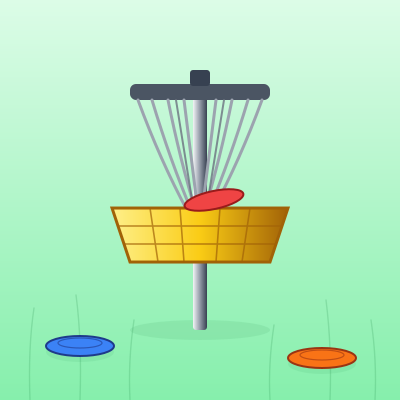
What is this game?
Disc golf is played like golf, but with a flying disc instead of a ball and club. You throw from a tee toward a chain-and-basket target, throw again from wherever your disc comes to rest, and the hole is over when the disc lands in the basket. A course has 9 or 18 holes, and the player with the fewest total throws wins.
Courses are usually laid out in parks and woods, so trees, water and slopes become part of the puzzle: half the fun is choosing a line. The Professional Disc Golf Association (PDGA), the sport's governing body, sums up the spirit in its rules: play the course as you find it, and play the disc where it lies.
The "father of disc golf" is "Steady" Ed Headrick, who, as an employee of the toy company Wham-O, patented the Frisbee in 1966. In 1975 he installed the first official course at Oak Grove Park in Pasadena, California, using poles in the ground as targets; in 1976 those were replaced by his Disc Golf Pole Hole, the basket-and-chains design behind every target today (patented in 1977). The PDGA was founded the same year. The PDGA's own history also credits a group in Rochester, New York, who had been running disc golf tournaments and leagues since 1970, and concludes that "who first played disc golf" has no clean answer.
Today the Disc Golf Pro Tour (DGPT) runs more than 25 pro events a season, and Japan has its own governing body, the Japan Disc Golf Association (JPDGA).
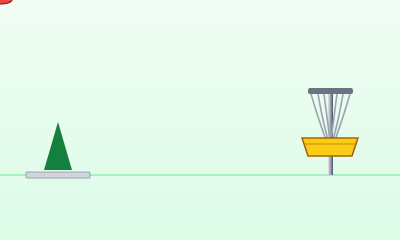
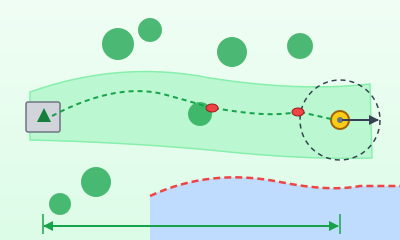
Figure: One hole seen from above. Throw from the tee, then from each spot where the disc stops (red), until it's in the basket. The pond beyond the red dashed line is out of bounds.
Equipment & setup
One disc is enough to get started. Most courses have permanent baskets, so you just show up and play. The JPDGA notes that many places rent discs and that plenty of courses are free.
- Discs: golf discs are smaller, heavier and sharper-edged than a typical recreational Frisbee. PDGA-approved discs are 21 to 30 cm across and weigh no more than 200 g (and no more than 8.3 g per cm of diameter)
- Mini marker disc: a small disc for marking where your disc landed. The PDGA standard is 7 to 15 cm in diameter and no more than 3 cm tall
- Scorecard: paper or an app; everyone keeps the score for the whole group
- What to bring: courses often run through woods, so wear good shoes and bring water and rain gear
Disc types: putter, midrange, driver
Discs fall into three broad types, chosen by distance and situation. The JPDGA recommends a putter as a first disc because it flies stably even with little power.
| Type | Shape | Typical use |
|---|---|---|
| Putter | Thick, rounded rim; flies straight | Putts and short approaches |
| Midrange | Between a putter and a driver | Mid-length, controlled shots |
| Driver | Thin, sharp, wide rim | Tee shots and long throws |
Many discs carry four flight numbers (speed, glide, turn and fade) as a guide to how they fly. These are the manufacturer's ratings, not something set by the PDGA rules.
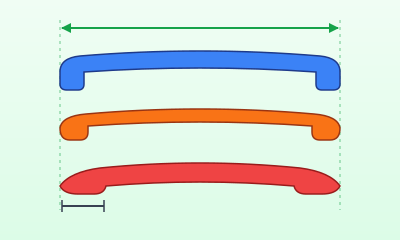
Figure: Disc cross-sections. The thinner and wider the rim, the farther a disc can fly, and the more it tends to curve.
Disc golf basket dimensions
A target is a pole with a chain support at the top, chains hanging from it, and a tray (the basket) below. PDGA technical standards for Championship and Standard level baskets set the main dimensions:
| Item | Standard (Championship and Standard level) |
|---|---|
| Basket rim height above the ground | 82 cm ±6 cm (about 32 in) |
| Inside diameter of the basket opening | 66 cm ±4 cm (about 26 in) |
| Basket depth | At least 18 cm |
| Target zone height (top of basket to bottom of chain support) | 51 cm ±3 cm (about 20 in) |
| Chain support diameter | 57 cm ±4 cm |
| Chains | At least 12 outer chains (Championship level also at least 6 inner) |
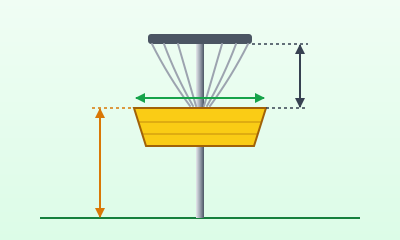
Figure: A PDGA-standard basket. The hole is complete when the disc comes to rest supported by the tray or by the chains below the chain support.
Course and hole length
Hole length varies from course to course, but the PDGA's course design guidelines give these typical figures for each skill level (by PDGA player rating):
| Level (PDGA rating) | 18-hole course length | Par 3 hole length |
|---|---|---|
| Gold (970+, top pros) | 7,000–11,000 ft (2,130–3,350 m) | 250+ ft (75+ m) |
| Blue (925+) | 5,000–8,500 ft (1,520–2,590 m) | 200+ ft (60+ m) |
| White (875+) | 4,500–7,500 ft (1,370–2,290 m) | 160+ ft (48+ m) |
| Red (825+) | 3,500–5,500 ft (1,070–1,680 m) | 140+ ft (42+ m) |
| Green (under 825, beginners) | 2,500–4,000 ft (760–1,220 m) | 100+ ft (30+ m) |
If a course has more than one tee per hole, newcomers usually have more fun from the shorter (front) tees.
Players & ages
| Format | Players | Notes |
|---|---|---|
| Individual (stroke play) | 1 or more | You can play solo; the JPDGA says groups of four are typical |
| Match play | 1 vs 1 | Holes are won and lost one at a time (PDGA rules, Appendix A) |
| Doubles | Teams of 2 | Several formats, such as Best Throw, where both throw and the team picks the better lie (Appendix B) |
- Accuracy matters more than power, so kids and seniors can play the same course. The PDGA runs age-based divisions, including juniors and masters
- The PDGA rules include an appendix of adaptive rules for players with disabilities
Rules
The core rule is simple: get the disc in the basket in as few throws as possible. Most of the detailed rules cover where you throw from (your lie) and what happens out of bounds. The summary below follows the PDGA Official Rules of Disc Golf, revision of January 1, 2026.
How a round works (minimal rules)
- Gather at the first tee and decide the throwing order (on later holes, order is set by score)
- Throw your first shot from the teeing area: the tee pad, or within 3 m behind the tee line
- Once everyone has teed off, the player farthest from the basket throws next
- From then on, throw from where your disc came to rest
- The hole is complete when your disc comes to rest in the basket or held by the chains below the chain support
- Record your throws and move to the next tee. From the second hole on, the player with the best score on the previous hole tees off first
- Add up all holes; the lowest total wins
At first, just remember two things: throw from where it stopped, and the farthest player goes next.
Standard rules (adding skill)
- Lie and marker: your lie is where you throw from. The thrown disc itself marks it, or you can place a mini marker touching the front of the disc (on the side toward the basket) and pick the disc up. The lie is a rectangle 20 cm wide and 30 cm deep behind the rear edge of the marker
- Stance: at the moment of release, at least one supporting point (usually a foot) must touch the lie, and none may be closer to the basket than the rear edge of the marker. Stepping before or after the release is fine
- Putting area: any throw from within 10 m of the basket is a putt. After a putt you must show full balance behind the marker before moving forward, so jump and step putts are not allowed inside 10 m
- Out of bounds (OB): areas such as ponds or roads, designated for the course. A disc is OB when it is clearly and completely surrounded by the OB area. It costs one penalty throw; you throw again from the previous lie, or from up to 1 m in bounds from where the disc was last in bounds
- Mandatories ("mandos"): a required route, such as "pass to the right of this tree." Missing it costs one penalty throw, and you play from the drop zone or the previous lie
- Lost disc: if your disc is not found within three minutes of searching, it is lost: one penalty throw, and you throw from the previous lie. Everyone in the group must help search
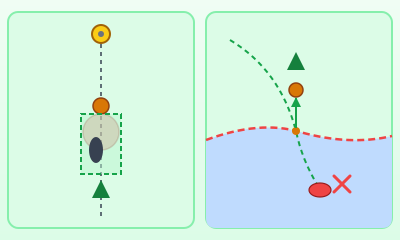
Figure: Left, where the lie is (green dashed rectangle). Right, relief after going OB: mark up to 1 m in bounds from where the disc was last in bounds, and play your next shot with one penalty throw.
Official competition rules
Events are run under the PDGA Official Rules and Competition Manual; the JPDGA publishes a Japanese translation of the rules. Key points:
- Time to throw: 30 seconds from the tee, a drop zone, or within 20 m of the basket; 45 seconds from anywhere else. The first violation is a warning; after that, one penalty throw each time in the round
- Teeing off: at release, all supporting points must be within the teeing area (a violation costs one penalty throw)
- Two-meter rule: a disc that comes to rest 2 m or more above the ground costs one penalty throw. Under the current rules it applies only when the Tournament Director declares it in effect
- Hazards: designated areas that cost one penalty throw but don't change where your lie is
- Scorecards: each player keeps an independent card for the whole group and must submit it within 30 minutes of finishing; late cards cost two penalty throws
- Provisional throws: when it's unclear whether a disc is lost or OB, the group can agree to an extra provisional throw to save time
At the top of the pro game is the DGPT, which features only the Open divisions: men's (MPO) and women's (FPO). It began with the Vibram Open in June 2016 and became the Official Pro Tour of the PDGA in September 2021. The 2025 DGPT Championship in Lynchburg, Virginia, had a combined purse of more than $300,000, split equally between the men's and women's divisions.
Scoring examples
Your score is throws plus penalty throws. Each hole has a par, the score an expert would be expected to make with errorless play; one under par is a birdie, one over is a bogey.
- Example 1: par on a par 3. Drive, approach, putt: 3
- Example 2: into the pond. The tee shot goes OB in the pond. With one penalty throw, you mark up to 1 m in bounds from where it was last in bounds and play your third shot from there, then hole out with your fourth: 4 (three throws plus one penalty)
- Example 3: a missed mandatory. Your second throw passes the wrong side of the mando tree: one penalty throw. You throw your fourth from the previous lie and hole out with your fifth: 5
- Example 4: an ace. The tee shot goes straight in: 1, a hole-in-one
Common fouls and tricky calls
- Disc stuck in a tree: unless the two-meter rule is in effect, there's no penalty; your lie is on the ground directly below the disc
- Disc on the OB line: the line is part of the OB area. The disc is OB only if it is completely surrounded by OB; if any part of it is in bounds, it's in
- Disc just inside the OB line: if your disc is in bounds but within 1 m of the line, you may move your lie up to 1 m back from the line, perpendicular to it
- Disc hits a person or animal: no penalty; play it where it comes to rest
- Disc hits your own gear: if you or your equipment interfere with your own throw, that's one penalty throw and you re-throw from the previous lie
- Disc on top of the chains or hanging off the outside of the basket: the hole is complete only when the disc is held by the tray or the chains below the support. A disc hanging on the outside is not in; your lie is on the ground directly below it
Tips for enjoying the game
Common beginner mistakes
- Starting with a driver: drivers need speed to fly straight and tend to hook into the woods for beginners. Playing a whole round with one putter teaches you how discs fly
- Throwing with your arm only: a backhand comes from turning your body. Keep the disc flat, pull straight back and release straight
- Putting too hard: a missed putt that sails far past makes the next one hard too. Up close, putt with a pace that leaves the disc near the basket if it misses
How to make it more fun
- Best Throw doubles: both partners throw and the team plays the better lie, so a beginner and an experienced player can team up happily
- CTP (closest to the pin): on a chosen hole, whoever's tee shot finishes closest to the basket wins a side bet
- Putting games: around a single basket, score how many putts you make from 5 m, 7 m and 9 m
Age variations
- Kids: light discs and short tees. Make "check that nobody is in front of you" part of every throw
- Seniors: courses involve a lot of walking, so start with 9 holes or a short course. Putting practice alone is plenty of fun
- Competitive players: in Japan, playing JPDGA events puts you on the JPDGA points ranking; local monthly events and try-it days are a good start
Playing Disc Golf in Japan
Where to play: JPDGA-certified courses
- The JPDGA's list of certified courses includes parks across the country, such as Showa Kinen Park (Tokyo), Hitachi Seaside Park (Ibaraki) and Musashi Kyuryo National Government Park (Saitama). Check opening days, check-in and disc rental with each facility before you go
- In ordinary parks, follow the park's rules on ball games and flying discs. Golf discs are hard and heavy, so don't throw them in crowded open areas
Tournaments and the governing body
- The Japan Disc Golf Association (JPDGA) traces back to an association founded on October 1, 1986, and became a general incorporated association in 2026. It works with the PDGA and has a partnership agreement with the Japan Flying Disc Association (JFDA)
- Events are tiered: the National Tournament (NT) at the top, regional Area Block Tournaments (ABT-A and ABT-B), and Local Tournaments (LT). The JPDGA's event list includes the 38th Japan Championships
- According to PDGA standards, all play in Japan required discs of 150 g or lighter ("150 Class") until 2018
Safety and etiquette
- Wait for the group ahead: don't throw while players ahead are still around the basket
- Call out on blind holes: in public parks, watch for walkers crossing the course
- Leave the course as you found it: the PDGA rules forbid damaging the course or breaking branches to make a hole easier
Frequently asked questions
Q. Is disc golf the same as Frisbee golf?
Usually, yes: they're two names for the same game. "Frisbee" is a Wham-O trademark, so the sport is officially called disc golf. Golf discs are smaller, heavier and sharper than a typical Frisbee, though, so they fly very differently.
Q. How tall is a disc golf basket?
Under PDGA standards, the basket rim is 82 cm (about 32 in) above the ground, plus or minus 6 cm. The basket opening is 66 cm (about 26 in) across, and the chain area above it, the target zone, is 51 cm (about 20 in) tall.
Q. What happens when you go out of bounds?
You take one penalty throw. Play your next shot from the previous lie, or from up to 1 m in bounds from where the disc was last in bounds. Some events also offer a drop zone, so check the course rules first.
Q. How many players do you need? Can you play alone?
You can play alone. The JPDGA says groups of four are typical, and there are doubles formats for teams of two.
Q. What age can kids start?
There's no age rule; if a child can throw a disc forward, they can play. Give young kids light discs, agree that nobody walks in front of a thrower, and have an adult keep watch.
Q. What disc should a beginner buy first?
A single putter is enough to play a whole round. The JPDGA also recommends a putter as a first disc because it flies stably with little power. Add a midrange and a driver as you improve.
Learn more
- PDGA Official Rules of Disc Golf (revision of January 1, 2026)
- PDGA technical standards for discs and targets
- PDGA course design skill level guidelines: typical hole and course lengths
- PDGA: History of Disc Golf
- Disc Golf Pro Tour: History
- Japan Disc Golf Association (JPDGA) (Japanese): rules in Japanese, certified courses and events
- Related: Spikeball, Ladder Golf, Croquet, Horseshoes — popular American lawn games, and a course game played in turns like golf
Share this page