Croquet Rules: How to Play, Scoring & Court Size
- Region:
- United Kingdom
- Tags:
- Small group, Medium group, Striking, Europe, UK, Family-friendly, Competitive
At a glance
- Players
- 2–6 players
- Game length
- A 7-point Golf Croquet game ends when a side reaches 4
- Equipment
- Mallets, four coloured balls, six hoops and a peg
- Space
- 32.0 m × 25.6 m (WCF); shrink it keeping the 5:4 proportions
Contents (8)

What is this game?
Croquet is a lawn game in which players use a wooden mallet to hit coloured balls through U-shaped metal hoops (called wickets in American play) in a set order and direction. In the full game, once a ball has run every hoop it finishes by striking the peg in the centre of the court.
The strategic core is the croquet stroke: after your ball hits another, you can send that ball far away or use it to reposition your own. This earns croquet its nickname, "chess on the lawn."
The modern game is generally traced to Ireland in the 1850s, from where it spread to England. A set of rules was registered in London in 1856, and croquet became a craze in Victorian Britain. It was also played at the 1900 Paris Olympics.
International play is governed by the World Croquet Federation (WCF), founded in London in 1989; Japan was one of its founding full members. In the beginner-friendly Golf Croquet discipline, Egyptian players are famously strong. Japan's own gateball was invented with croquet as its inspiration.
Many people first meet croquet in Lewis Carroll's Alice's Adventures in Wonderland (1865), where the Queen of Hearts' guests play with live flamingos as mallets and hedgehogs as balls. The real game is far calmer, and far more tactical.
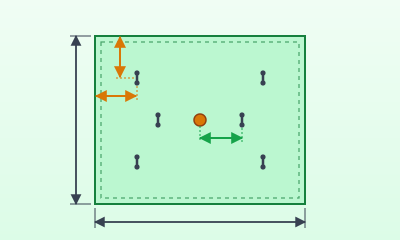
Figure: The WCF standard court. Four hoops sit near the corners and two either side of the peg. The dashed yard-line is imaginary and is not marked on the lawn.
Croquet vs gateball
Gateball was invented in Japan in 1947 with croquet as its model, so the two look alike: mallets or sticks, balls, and gates to run in order. (Cricket, despite the similar name, is a bat-and-ball game for teams of eleven and is unrelated.) The table compares the two croquet disciplines with gateball.
| Association Croquet | Golf Croquet | Gateball | |
|---|---|---|---|
| Players | Singles (2) or doubles (4) | Singles (2) or doubles (4) | Teams of 5 (10 players) |
| Balls | 4: blue, red, black, yellow | 4: blue, red, black, yellow | 10 numbered: 5 red, 5 white |
| Course | 6 hoops run twice each, then the peg | 6 hoops contested one at a time | 3 gates, then the goal pole |
| Court | 32.0 m × 25.6 m | 32.0 m × 25.6 m | 15 m × 20 m inner field |
| Hoop or gate width | 94–102 mm (ball 92 mm) | 94–102 mm (ball 92 mm) | 22 cm (ball 7.5 cm) |
| A turn | Roquets and hoop runs earn extra strokes | One stroke only | Extra stroke for a gate or a successful spark |
| Moving another ball | Croquet stroke: your ball is placed touching it, not held | You may hit it, but there is no extra stroke | Spark: you pin your own ball under your foot |
| How to win | First side to 26 points | Majority of 7, 13 or 19 points | More points when 30 minutes are up |
Gateball figures are from the World Gateball Union rules; see the Gateball article for details.
Equipment & setup
Croquet needs a modest set of gear, and once you have it, any flat lawn becomes a court. At minimum you need mallets, balls, hoops, a peg, and a level patch of grass.
- Mallet: a striking tool whose head has two flat end-faces; you hit the ball with an end-face, gripping the shaft with both hands like a putter
- Balls: the primary colours are blue, red, black and yellow, played in that order. One side plays blue and black, the other red and yellow. A second colour set of green, pink, brown and white also exists
- Hoops (wickets): U-shaped metal hoops pushed into the ground. Regulation hoops are only just wider than a ball
- Peg (stake): the white central post, which may carry blue, red, black and yellow bands near the top
- Court (lawn): a flat rectangular lawn. Closely mown grass rolls faster and truer
Start with a plastic leisure set to get a feel for the swing, then upgrade to a proper wooden mallet and regulation balls once you're hooked. Play in your own garden, or pick a flat park lawn where balls can roll safely away from other people.
Court and equipment dimensions
The table below follows the WCF Laws of Association Croquet (7th edition) and the WCF Rules of Golf Croquet (6th edition), which share the same court and equipment specifications. The rules are written in imperial units; metric figures are the equivalents given in the rules.
| Item | Standard | Tolerance / notes |
|---|---|---|
| Court | 35 yd × 28 yd (32.0 m × 25.6 m) | ±6 in (152 mm) on each side. A smaller court may keep the 5:4 proportions with a shorter unit |
| Outer four hoops | 7 yd (6.40 m) from the two adjacent boundaries | Hoops and peg may be up to 12 in (305 mm) out of position |
| Inner two hoops | 7 yd (6.40 m) north and south of the peg | As above |
| Peg | 18 in (457 mm) high, 1½ in (38 mm) diameter | Height ±1 in (25 mm); diameter ±¼ in (6 mm) |
| Hoop height | 12 in (305 mm) above ground, to the top of the crown | +½ in / −1 in (+13 mm / −25 mm) |
| Hoop inner width | 3 11/16 to 4 in (94 to 102 mm) | Tournaments may specify narrower hoops; all hoops on a court must match |
| Ball | 3⅝ in (92 mm) diameter, 16 oz (454 g) | Diameter ±1/32 in (0.8 mm); weight ±¼ oz (7 g) |
| Yard-line | Unmarked line 1 yd (0.914 m) inside the boundary | Where balls are replaced in Association Croquet |
With a 92 mm ball and a hoop no wider than 102 mm, there is barely a centimetre to spare, which is why running a hoop cleanly is so satisfying.
In the United States, the United States Croquet Association (USCA) also publishes backyard nine-wicket rules. Its full-size court is 100 ft × 50 ft, with nine wickets and two stakes laid out in a double-diamond pattern, and players are free to shrink the court to fit a garden. The nine-wicket rules include the well-known poison ball: a ball that has run every wicket but not yet hit the finishing stake may knock opponents' balls out of the game with a roquet, but it is itself removed if an opponent roquets it.
Players & ages
| Format | Players | Balls |
|---|---|---|
| Singles | 2 | Each player plays two balls (blue and black vs red and yellow) |
| Doubles | 2 pairs (4) | Each player plays one ball |
| Backyard nine-wicket (USCA) | Up to 6 | One ball each with a six-ball set |
Strategy and aim matter more than strength, so ages and body sizes mix well. There's no minimum age: if you can swing a mallet with both hands, you can play. The WCF also runs over-60 and under-21 world championships.
Rules
Croquet is about hitting your ball through a sequence of hoops with a mallet. There are two main branches, and beginners should start with Golf Croquet: everyone plays for the same hoop and the first to run it wins the point, by far the easiest way in. Learn the minimal rules below and you can play the same afternoon.
How a round works (minimal rules)
- Set out six hoops with the peg in the centre
- The playing order is blue → red → black → yellow. It's blue and black vs red and yellow; in singles each player plays two balls
- On your turn you take one stroke only (Golf Croquet has no extra strokes)
- Everyone contests the same first hoop. Each ball's first stroke is played from the start area, within one yard of a corner
- The first ball to run the hoop in the right direction scores one point for its side
- Once the point is won, everyone plays on from where their balls lie to contest the next hoop
- In a quick 7-point game, hoops 1 to 6 are contested in order, and at 3–3 hoop 1 is played again. First side to 4 points wins
At first, just focus on getting close to the next hoop and running it. Because beating your opponent to the hoop scores the point, the fun of blocking them emerges naturally. Once that clicks, add the Association Croquet techniques below.
Standard rules (adding skill)
- Roquet (hitting another ball): in the fuller Association game, when your ball strikes another ball you have made a "roquet" and earn the right to keep playing
- The croquet stroke: right after a roquet, you place your ball touching the ball you hit and strike your own ball, sending theirs away or moving yourself into position. This stroke gives the game its name and is the heart of its strategy. It is followed by one more stroke, the continuation stroke
- Running a hoop: when your ball runs its hoop in order, you earn one extra stroke. Chaining roquet → croquet → continuation lets you score several hoops in a single turn, called a break
- Order and direction: hoops must be run in the exact sequence and direction; wrong-way runs don't count
Official competition rules
The WCF governs two disciplines: Association Croquet (AC) and Golf Croquet (GC). World singles championships in each are held roughly every two years, and team championships roughly every four years.
In AC, each ball must run twelve hoops (the six hoops once each way) and then hit the peg: 12 + 1 = 13 points per ball, so a side needs 26 points to win. Time limits are common in tournaments, and a handicap system gives the weaker player extra turns called bisques.
GC is played as the best of 7, 13 or 19 points. In a 13-point game hoops 1 to 12 are contested, and at 6–6 hoop 3 is played again to decide it.
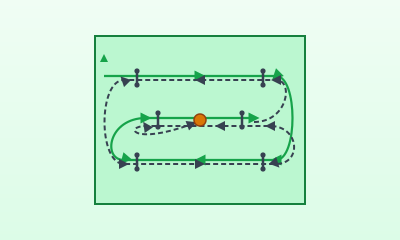
Figure: The course one ball follows in Association Croquet. The first circuit (green) runs the four outer and two inner hoops; the second (dashed grey) runs them again the other way and finishes on the peg.
Scoring examples
Example 1: a 7-point Golf Croquet game. Blue and black win hoops 1, 2, 4 and 6; red and yellow win hoops 3 and 5. That's 4–2, and blue and black win by reaching 4 first. Had it been 3–3 after hoop 6, hoop 1 would be contested again as the seventh point.
Example 2: knocking an opponent through. In Golf Croquet a point goes to the side that owns the ball that runs the hoop, even if it moved because another ball hit it. If your green ball knocks an opponent's grey ball through the hoop, the opponent scores. This is the right-hand panel of the figure below.
Example 3: an Association Croquet turn. Run a hoop: 1 point plus an extra stroke. Use that stroke to roquet another ball: a croquet stroke and another continuation stroke. Keep chaining and run two more hoops, and that one turn is worth 3 points.
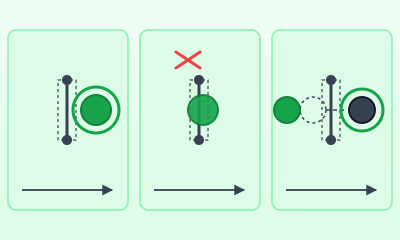
Figure: Judging a hoop run. The ball has completed the run once no part of it protrudes on the playing side (the left). Under the WCF Golf Croquet rules, a position too close to call counts as completed.
Common fouls and tricky calls
- Touching the head, double hits, pushes: touching the mallet head during the final swing, hitting the ball twice, or keeping the mallet in contact with the ball are faults. In GC, deliberately striking with any part other than an end-face is also a fault (WCF AC Law 29; GC Rule 11)
- Ball against a hoop or the peg: a ball touching a hoop upright or the peg may only be struck away from it, and you must not drive the ball into a hoop while it is still in contact with the mallet
- Touching other balls: touching any ball other than the one you're playing, with the mallet or your body, is a fault. After a GC fault, the opponent chooses whether the balls stay where they stopped or are replaced
- Balls off the court: in AC, a ball that leaves the court or stops within a yard of the boundary is placed on the yard-line (your own ball during your turn is placed at the end of the turn). In GC, it is replaced touching the boundary where it went off
- Croquet stroke off court: in AC, if either ball goes off the court in a croquet stroke, your turn ends
- Golf Croquet offside: if an opponent's ball was clearly beyond the halfway line for the next hoop when a point was scored, you may direct it to be played from one of the two penalty areas, semicircles of one-yard radius at the middle of each side boundary
Croquet terms at a glance
| Term | Meaning |
|---|---|
| Hoop (wicket) | The U-shaped metal gate a ball must pass through. "Wicket" is the usual American word |
| Peg (stake) | The post in the centre of the court; hitting it finishes a ball in Association Croquet |
| Running a hoop | Passing through a hoop in the correct order and direction; scores a point |
| Roquet | Hitting another ball with your own ball; in Association Croquet it earns a croquet stroke |
| Croquet stroke | The stroke played after a roquet, with your ball placed touching the ball you hit |
| Continuation stroke | The extra stroke earned by running a hoop or after a croquet stroke |
| Break | A chain of strokes in one turn that scores several hoops |
| Bisque | An extra turn given to the weaker player in handicap play |
| Yard-line | The unmarked line one yard inside the boundary where balls are replaced in Association Croquet |
| Clip | A coloured marker moved onto the next hoop a ball must run, so nobody loses track |
Tips for enjoying the game
Common beginner mistakes
- Hitting too hard: rolling on grass needs gentle calibration; aim first, then swing softly
- Forgetting the croquet stroke: in AC, not using your extra strokes after a roquet is a big loss
- Losing track of order and direction: a hoop run in the wrong order or direction doesn't count. Get into the habit of moving your clip
How to make it more fun
- Aggressive croquet strokes that send opponents to the far end guarantee laughs
- In doubles, deciding "which ball, which target" together is half the fun
- British garden-party style: sandwiches, tea, and no hurry
Age variations
- Kids: four hoops, a smaller court, and Golf Croquet rules with no croquet stroke
- Seniors: a gentle standing swing with no need for strength; shrink the court to reduce walking
- Competitive: a full-size court with regulation balls, a 13-point GC game or a timed AC game
Playing Croquet in Japan
- Equipment: plastic and wooden sets are sold online. If your set is a nine-wicket version, just use six hoops for the six-hoop game
- Venue: a closely mown park lawn is ideal. Shrink the court while keeping the 5:4 proportions and the layout will feel right
- Organisation: the Croquet Association of Japan has been a WCF member since the federation was founded; start there if you want to play by the full rules
Frequently asked questions
Q. How big is a croquet court?
The WCF standard court is 35 × 28 yards (32.0 × 25.6 m). If space is short, the rules allow a smaller court as long as it keeps the 5:4 proportions. The USCA's backyard nine-wicket rules give a full-size court of 100 × 50 ft.
Q. How many points do you need to win?
It depends on the discipline. Golf Croquet is played as the best of 7, 13 or 19 points, so you need 4, 7 or 10. In Association Croquet a side wins by scoring all 26 points first: twelve hoops and the peg for each of its two balls.
Q. What's the difference between Golf Croquet and Association Croquet?
In Golf Croquet each turn is a single stroke and both sides race for the same hoop. In Association Croquet, roquets and hoop runs earn extra strokes, so one turn can carry a ball several hoops around the course.
Q. How do you pronounce croquet, and what does the word mean?
It is said "KROH-kay". British English stresses the first syllable (/ˈkrəʊkeɪ/) and American English the second (/kroʊˈkeɪ/). The word comes from Norman French croquet, "hook", and is related to crochet.
Q. What should I wear to play croquet?
Flat-soled shoes are the one real requirement: Croquet England says they are all you need to try the game at a club. Heels and studs leave marks in a closely mown lawn. White clothing is a tradition at some clubs and tournaments, so check with the organiser before an event.
Q. Can I play in my garden or a park?
Yes. A flat lawn with short grass is all you need, and a smaller court works well. Hoops are pushed into the ground, so check that you're allowed to do that before setting up in a public park.
Q. Can I improvise the equipment?
For casual play, hoops bent from stiff wire work fine. Make them only just wider than the ball and you'll get close to the real challenge.
Learn more
- World Croquet Federation (WCF): rules and world championships
- WCF Laws of Association Croquet, 7th edition (PDF)
- WCF Rules of Golf Croquet, 6th edition (PDF)
- USCA nine-wicket backyard croquet rules
- The Croquet Association of Japan
- Croquet England: Play croquet: how to try the game at a club
- croquet on Wiktionary: pronunciation and etymology
- Related: Gateball, Pétanque, and Mölkky
Share this page


