Mölkky (Molkky) Rules: How to Play, Setup & Scoring
- Region:
- Finland
- Tags:
- Small group, Medium group, Throwing, Europe, Family-friendly, Nordic
At a glance
- Players
- 2–12 players
- Game length
- First to exactly 50 points wins (60 seconds per throw in official play)
- Equipment
- 12 numbered skittles, 1 Mölkky, and a Mölkkaari (or a line)
- Space
- Throw from 3–4 m (3.5 m official); about 3–4 m × 7–8 m for casual play
Contents (8)

What is this game?
Mölkky (pronounced "MOLE-koo") is a throwing game invented in Finland in 1996.
It was developed in Lahti by the company Lahden Paikka (then called Tuoterengas),
based on kyykkä, a traditional game from the Karelia region.
Players take turns throwing a wooden stick, also called the "Mölkky",
at a cluster of twelve numbered wooden pins (skittles),
trying to score exactly 50 points.
The rules are intuitive and the balance of luck and strategy is excellent, so Mölkky is popular across Europe and widely played in Japan too. Today "Mölkky" is a registered trademark of the Finnish company Tactic Games, and official tournaments are played with its official sets.
The Mölkky World Championships were originally held in Lahti, Finland. Since 2016 the host city has changed from year to year, with editions in France and the Czech Republic among others, and in August 2024 the championship came to Hakodate, Japan, the first time it was held in Japan.
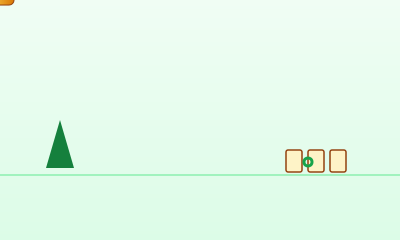
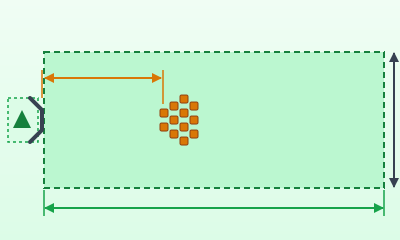
Figure: The orange arrow is the throwing distance (3.5 m), the green arrow the minimum field length (10 m from the throwing line), and the dark grey arrow the minimum width (4 m). The skittles and the Mölkkaari are drawn larger than scale.
Mölkky vs Kubb
Both are Nordic lawn games played by throwing wooden sticks, but the goal is completely different.
| Mölkky | Kubb | |
|---|---|---|
| Origin | Finland, devised in 1996 (based on the Karelian game kyykkä) | The Swedish island of Gotland; the name is first recorded in 1931 |
| What you throw | One wooden throwing pin (the Mölkky), in turn | Six wooden batons |
| Target | Twelve numbered skittles in one shared cluster | The opponent's ten kubbs, then the king in the middle |
| How you win | Reach exactly 50 points first | Topple all the opponent's kubbs, then the king |
| Field | Throw from 3.5 m; at least 4 m × 10 m outdoors | 5 m × 8 m |
| Feel | An adding-up game: pick the number you need | A territory game: field kubbs and baton count matter |
If you like arithmetic and endgame tension, start with Mölkky; if you like team tactics over a longer game, try Kubb.
Equipment & setup
Mölkky needs very little gear, and setup takes almost no time. All you really need are the twelve numbered skittles, the throwing stick, and a few metres of flat ground.
- Skittles: twelve wooden cylinders numbered 1 to 12. All twelve are the same height and thickness, with the top end bevelled at an angle. Hitting exactly the number you want is what the game turns on
- Mölkky (the throwing pin): a plain wooden stick with no number, as thick as the skittles but a little longer. You throw it to knock the skittles over
- Mölkkaari (throwing frame): a wooden frame that marks where you throw from. Its straight front section is laid across the throwing position, and its two ends are angled back toward the thrower. Touching or stepping over it makes the throw a foul. If you have no frame, a rope, tape, or a stick laid on the ground works for casual play
- Tape measure: handy for the starting distance and close calls; optional for casual play
- Ground: grass, sand, or firm dirt all work, as long as the skittles stand upright. A park or a campsite is fine
Court and equipment dimensions
The values below come from the International Mölkky Organisation (IMO) Tournament Rules (2019 edition) and the Japan Mölkky Association (JMA) Official Rules Guidebook (2024 revision). The two documents give the same figures; points the JMA adds are noted in the right-hand column.
| Item | Regulation value | Tolerance / notes |
|---|---|---|
| Skittles | 12 pins, about 15 cm tall and about 5.9 cm in diameter | Top bevelled at 45 degrees; numbered 1 to 12 |
| Mölkky (throwing pin) | About 22.5 cm long and about 5.9 cm in diameter | No weight is specified. The JMA asks that the lightest and heaviest sticks used at a tournament differ by no more than 50 g |
| Mölkkaari | About 96 cm total length | Both legs at about 45 degrees to the throwing line; may be straightened when a wheelchair user throws |
| Throwing distance | 3.5 m from the Mölkkaari to the skittles | Plus or minus 0.1 m. For casual play, 3 to 4 m is fine (JMA basic rules) |
| Outdoor field size | At least 4 m wide and 10 m long | Length is measured from the throwing line; indoor fields may be smaller |
| Field surface | Sand, gravel, or a clay-type surface | The JMA also allows grass and artificial turf |
| Time per throw | 60 seconds | The IMO default. The JMA leaves it to the organiser and cites 60 seconds as the recommended value |
How to set up the skittles (starting layout)
At the start, the twelve skittles stand packed tightly together in four rows. The numbering is fixed. Seen from the Mölkkaari:
| Row (from the Mölkkaari) | Skittles (left to right) |
|---|---|
| Row 1 (front) | 1, 2 |
| Row 2 | 3, 10, 4 |
| Row 3 | 5, 11, 12, 6 |
| Row 4 (back) | 7, 9, 8 |
The low numbers are at the front and the high numbers (10 to 12) sit in the middle. Place the front row 3.5 m from the Mölkkaari (3 to 4 m for casual play). Fallen skittles are stood up where they land, so the cluster spreads out as the game goes on.
The whole set fits in a single backpack, which is a big part of the appeal. A knocked skittle can fly a surprising distance, though, so make sure no one is standing nearby before you throw.
Players & ages
| Format | Players | Notes |
|---|---|---|
| Individuals | 2 to 4 works best | More players means a longer wait between your turns |
| Teams (casual) | 2 to 4 teams of 2 to 4 | Team members take turns, one throw each |
| Official tournaments | 2 to 4 per team | Set by each tournament. The IMO rules cover formats with 2, 3, or 4 players per team and how many substitutes each may have |
Anyone who can add up small numbers can play, from children to seniors. Mölkky rewards control over strength, so age and physical differences barely matter.
Rules
Mölkky is all about knocking down numbered skittles to be the first to land on exactly 50 points. Learn the minimal rules and the scoring below, and you can play the same afternoon.
How a round works (minimal rules)
- Set up the 12 skittles in a tight starting cluster (the number arrangement is fixed; see the dimensions section above)
- Place the Mölkkaari (or draw a line) 3 to 4 m in front of the cluster
- Decide the order (a coin toss works), and the first player throws the Mölkky underarm from behind the Mölkkaari, aiming at the skittles
- Score the throw: knock down exactly one skittle and you score that skittle's number; knock down two or more and you score the count of skittles (numbers ignored, so three skittles is 3 points, not the sum of their numbers)
- Stand each fallen skittle back up right where it came to rest, so with every round the cluster spreads out and the skittles get harder to isolate
- Play passes to the next player (or team), and everyone keeps taking turns
- The first player or team to reach exactly 50 points wins
- But go over 50 and your score drops back to 25, so in the endgame you have to work out how many points you need and pick your target accordingly
- A player or team that scores zero three times in a row is eliminated
At first, just focus on hitting the number you're aiming for. Once that feels natural, the tactical race to land exactly on 50 becomes the real fun.
Standard rules (adding skill)
- The throw: in Japan the underarm throw is the standard way to play. A little spin steadies the flight and improves your aim
- One skittle or many: take a single high number cleanly, or topple several at once and score the count. That trade-off is the heart of the strategy: pile up points early with multi-skittle throws, then switch to precise single hits near the finish
- Mind the Mölkkaari: touching the frame, stepping over it, or putting a foot down on the ground in front of it makes the throw void (0 points). After throwing, take one step back before you walk away
- Raising skittles: a fallen skittle is stood up by pivoting it on the spot where its base touches the ground, then turned so its number faces the Mölkkaari. The JMA guidebook says to raise the skittles closest to the Mölkkaari first
- Read the spread: as the game goes on, gaps open up between the skittles. When the number you need drifts off on its own, that's your chance to knock it down alone
Official competition rules
Official tournaments follow the IMO Tournament Rules and the JMA guidebook based on them. The key points:
- Throwing distance is 3.5 m (plus or minus 0.1 m) from the Mölkkaari to the skittles
- Throwing style: the JMA guidebook limits throws to underarm, unless the organiser allows other styles. The IMO rules (2019) instead allow all kinds of throws in general, but let the organiser restrict styles, for example to avoid damage. Check your event's regulations
- When is a skittle down? A skittle counts as fallen when it lies on the ground. One that rests on another skittle or on the Mölkky, and so is not entirely on the ground, has not fallen
- Three zeros in a row: a team that scores 0 three times in a row is out of the set with 0 points. If only one team is left, that team receives 50 points and the set ends
- The 37-point rule: if a team with 37 points or more commits a fault such as stepping over the Mölkkaari or throwing out of turn, the throw scores 0 and the team also drops back to 25 points
- Time limit: exceeding the 60-second limit earns a warning the first time; a second time in the same game costs the throw (0 points)
- Mölkk-Out: a tiebreaker used to rank teams. Skittles 6, 4, 12, 10, and 8 are set in a straight row, one Mölkky length apart, and teams throw a set number of times for the highest total
Joining a local club or a taster session is the easiest way to play by the full rules.
Scoring examples
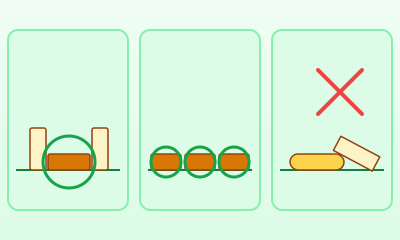
Figure: White skittles are standing, orange ones have fallen, and yellow is the Mölkky. Left: exactly one skittle is down, so you score its number. Middle: three are down, so you score 3. Right: the skittle leaning on the Mölkky is not entirely on the ground, so it has not fallen (red cross).
- Example 1: on 38, you knock down skittle 12 alone. One skittle means you score its number: 38 + 12 = 50, and you win
- Example 2: on 45, you knock down three skittles. You score the count, 3 points, whatever the numbers, for a total of 48. Next turn you need skittle 2 on its own, or exactly two skittles
- Example 3: on 47, you knock down skittle 5 alone. 47 + 5 = 52 is over 50, so your score drops back to 25. From 47 the right move was skittle 3 alone, or exactly three skittles
- Example 4: on 40, you step on the Mölkkaari (official rules). Trespassing makes the throw score 0, and because you had 37 or more you also drop back to 25
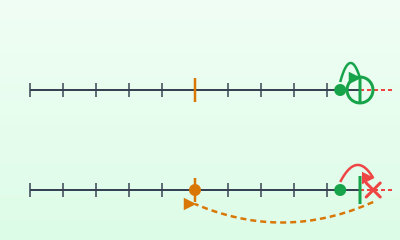
Figure: Top: landing exactly on 50 wins (green ring). Bottom: going over 50 (red cross) sends the score back to 25, as the orange arrow shows.
Common fouls and tricky calls
- Trespassing on the Mölkkaari: from entering the throwing area until leaving it, the thrower may not move or touch the frame, or touch the ground beyond the frame or the sidelines with any part of the body or shoes. The throw counts as a misthrow, 0 points (IMO and JMA). Putting a hand down in front after the throw counts too
- Leaning skittles: a skittle held up by another skittle or by the Mölkky has not fallen. If one leans against a fixed object such as a wall, it is moved away so that a Mölkky fits lengthwise between it and the object, and it counts as not fallen (IMO and JMA)
- Skittles moved by something else: a skittle moved by anything other than direct or indirect contact from the thrown Mölkky, such as wind or someone's foot, is put back in its original position and does not count as fallen
- Dropping the Mölkky: dropping it while standing in the throwing area counts as a misthrow (0 points). Dropping it while picking it up from the ground or while handing it to someone is excused
- Throwing out of turn: if the wrong team member throws, it counts as a misthrow and the order continues as if the right player had thrown. If a whole team throws out of turn, its points are cancelled and it also loses its next regular throw (IMO and JMA)
Tips for enjoying the game
Common beginner mistakes
- Don't power-throw. Precision beats strength; the harder you throw, the more it wobbles
- Decide your target before throwing. Ask "how many points do I want?" first
- Multi-skittle scores are double-edged. They only give you the count of skittles, not their numbers, so accidentally toppling extras can ruin a finish
- Play safe after two zeros. With two misses in a row, aim to knock down anything at all rather than chase points, so you avoid elimination
Throwing styles
The Japan Mölkky Association describes four ways to throw. Start with the basic underarm throw, then add the others for particular situations.
| Style | Grip and flight | When it helps |
|---|---|---|
| Basic underarm | Hold the Mölkky so its weight is balanced and throw in a gentle arc | Nothing is in the way and you want a sure score |
| Lahti throw | Set low and throw fast, so the Mölkky flies almost straight at the skittles | Sending skittles far away to make things awkward for the opponent; very sensitive to the ground |
| Reverse-grip throw | Hold it with a reverse grip and add backspin; it lands in an arc and barely rolls on | Toppling just one skittle from a front-to-back line |
| Vertical throw | Hold the Mölkky upright, land it just short of the skittles and let it carry into the target | Toppling just one skittle from a side-by-side row |
Which styles are allowed in a tournament depends on the rules and the event regulations (see "Official competition rules" above).
How to make it more fun
- Early on, target high-value skittles (10, 11, 12) to build a lead
- The endgame is where the magic happens: "I need 7, so I have to hit skittle 7 alone." Pure tension
- The classic "blew past 50, back to 25" plot twist gets huge laughs
Age variations
- Kids: shorter distance (2 m), spread the skittles wider
- Seniors: seated throwing is fine; this is a game of aim, not strength
- Competitive: regulation 3.5 m distance, a proper Mölkkaari, and a 60-second timer per throw
Playing Mölkky in Japan
- Official sets are sold online and in outdoor and sporting goods shops
- In parks, choose an open area where ball games are allowed and keep away from other visitors
- The Japan Mölkky Association (JMA) publishes an official rules guidebook and runs tournaments including a national championship and the Mölkky Japan Open
- The 2024 World Championships in Hakodate in August drew teams from many countries
Frequently asked questions
Q. How big a court do I need?
Under the IMO and JMA rules, an official outdoor field is at least 4 m wide and 10 m long, measured from the throwing line. For casual play, shorten the throwing distance to about 3 m; a clear space roughly 3 to 4 m wide and 7 to 8 m deep is plenty.
Q. How many points do you need to win, and what happens if you go over 50?
The first player or team to reach exactly 50 points wins. Going over 50 drops your score back to 25 and the game continues. Under the official rules, a fault committed while on 37 points or more also sends you back to 25.
Q. What happens if you miss three times in a row?
Three throws in a row that knock nothing down eliminate you, with 0 points for that set (in official play this applies to the team). If everyone else is eliminated, the last remaining player or team receives 50 points and the set ends.
Q. Can you play on grass or on the beach?
Yes. The IMO rules have sand, gravel, or clay-type fields in mind, but the JMA also allows grass and artificial turf. On soft beach sand the skittles are hard to stand up, so level the surface before you start.
Q. What does "Mölkky" mean?
It is the name of the wooden throwing pin. According to the Japan Mölkky Association, "Mölkky" refers to the stick you throw, and the whole game is called by the same name. The Finnish spelling is Mölkky; in English it is often written Molkky, and the game is sometimes described as Finnish skittles.
Q. How old do kids need to be to play?
There is no age rule. If a child can add up the scores, they can join in. For small children, shorten the distance to about 2 m and let an adult keep score.
Q. Can I play with homemade equipment?
For practice, you can cut twelve pieces of the same round timber, write numbers on them, and use a slightly longer piece as the Mölkky. Official tournaments, however, are played with the official sets made by Tactic Games.
Learn more
- IMO (International Mölkky Organisation) Tournament Rules (PDF)
- Japan Mölkky Association: official rulebook download (in Japanese)
- Japan Mölkky Association: tournaments (in Japanese)
- Japan Mölkky Association: about Mölkky (in Japanese) — the meaning of the name and the four throwing styles
- Mölkky World: rules and skittle placement
- Related: Pétanque, Bocce, and Kubb, fellow throwing games
Share this page