Bocce Rules: How to Play, Scoring & Court Size
- Region:
- Italy
- Tags:
- Small group, Throwing, Ball game, Europe, Family-friendly, Competitive
At a glance
- Players
- 2–8 players
- Game length
- Games to 12 points (CBI championships: 12 points or 8 ends)
- Equipment
- 8 bocce balls in two colours, a pallino and a tape measure
- Space
- 26.5 m × 4 m (CBI); any shorter flat ground works at home
Contents (8)

What is this game?
Bocce is a ball game thought to have developed from games played in Ancient Rome,
and today it is Italy's quintessential lawn leisure game. The name is the plural of the Italian
boccia, meaning "bowl" or "ball". An early written set of rules appeared in Raffaele Bisteghi's
1753 book Gioco delle bocchie.
Like Pétanque, the goal is to land your team's balls closest to a small target ball
(pallino). But Bocce uses:
- Larger balls (~11 cm diameter)
- A rolling motion (more than throwing)
- A flat court enclosed by boards
- Aggressive bumping shots as a regular tactic
Its international governing body is the Confederazione Boccistica Internazionale (CBI), and it is an official Special Olympics sport — friendly across ages, body sizes, and abilities.
Note that the Paralympic sport boccia is a separate game derived from bocce, with different rules and equipment.
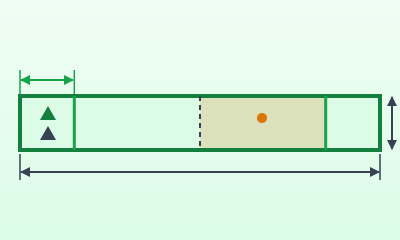
Figure: A CBI court drawn close to scale. Players throw from behind the green throwing line, and the pallino must stop in the orange band past the centre line. The pallino is drawn larger than scale.
Bocce vs pétanque vs lawn bowls
All three games are won by getting your balls closest to a small target ball, and they score the same way: one point for each ball closer than the opponent's best. The equipment and the way you deliver the ball are what set them apart.
| Bocce | Pétanque | Lawn bowls | |
|---|---|---|---|
| Ball | Synthetic, 106–107 mm, 900–920 g | Hollow metal, 70.5–80 mm, 650–800 g | 112–131 mm, up to 1.59 kg, shaped with a bias so it curves |
| Target ball | Pallino, 40 mm | Cochonnet, 30 mm | Jack, 63–64 mm (outdoor grass) |
| Delivery | Mostly rolled; raffa and volo hit other balls | Thrown from a small circle with both feet inside, often lofted | Always rolled from a mat, curving in on the bias |
| Playing area | Board-enclosed court, 26.5 m × 4 m (CBI) | Any firm ground; lanes at least 15 m × 4 m for championships | A flat green 31–40 m long, split into rinks |
| Game length | 12 points (CBI championships: 12 points or 8 ends) | 13 points | World events: singles to 21 shots, pairs and fours 18 ends |
| International body | CBI | FIPJP | World Bowls |
Figures come from each body's rules; see the Pétanque and Lawn Bowls articles for details.
Equipment & setup
Bocce needs very little gear, and setup takes almost no time. All you really need are two colours of bocce balls, a target ball, and a flat patch of ground.
- Bocce balls — synthetic balls about 107 mm across and about 920 g. They come in two colours; in singles each side plays four
- Pallino — the small target ball, about 40 mm across (also called the "jack" or "boccino"). Getting close to it is the whole game
- Court — a regulation court is a flat strip about 26.5 m long and 4 m wide, enclosed by boards. Home games work fine on any flat ground and can be much smaller
- Tape measure — essential for close calls, since a few centimetres often decides the end
Starter sets are affordable and plenty to begin with; regulation competition balls cost more, so upgrade only once you're hooked. Because bocce is a rolling game, pick the flattest, most even spot you can.
Court and equipment dimensions
The table combines the CBI Technical Rules of Play (in force from January 2023, raffa discipline) and the United States Bocce Federation (USBF) Open Rules.
| Item | Regulation value | Tolerance and notes |
|---|---|---|
| Court length | 26.5 m | CBI; 24.5 to 28 m may be allowed with approval. USBF: 86.92 ft (26.5 m) |
| Court width | 4 to 4.5 m | CBI (3.8 m may be tolerated). USBF: 13.12 ft (4 m) |
| Board height | 25 cm | CBI, plus or minus 2 cm |
| Throwing line | 4 m from the end board | CBI line B, used for the pallino, pointing and raffa. USBF recommends a single foul line 13 ft (about 4 m) from the back wall |
| Valid pallino zone | past the centre line and short of the far line B | CBI; also invalid if within 13 cm of a side board. USBF: past the centre line and not touching the back wall |
| Ball diameter | 106 to 107 mm | CBI, plus or minus 0.5 mm. USBF recommends 107 mm |
| Ball weight | 900 to 920 g | CBI, plus or minus 5 g. USBF recommends 920 g |
| Pallino | 40 mm, 90 g | CBI; tolerance plus or minus 1 mm and 7 g |
Players & ages
| Format | Players | Balls each |
|---|---|---|
| Singles | 1 vs 1 | 4 |
| Pairs | 2 vs 2 | 2 |
| Triples | 3 vs 3 | 2 |
| Fours (USBF) | 4 vs 4 | 2 (two players at each end of the court) |
The CBI recognises singles, pairs and triples; fours is a format in the USBF Open Rules. Bocce is friendly for children, seniors, and wheelchair players alike.
Rules
Bocce is all about getting your balls closer to the pallino than your opponent does. Learn the minimal rules below and you can play the same afternoon.
How a round works (minimal rules)
- Choose the first team (a coin toss works)
- A player from that team tosses the pallino down the court, past the centre line
- That team then rolls or throws its first bocce ball, aiming to stop it right next to the pallino
- The other team then plays; if their ball is closer, they take the lead
- From here on, the team whose nearest ball is farther away keeps throwing until they get closer; the leading team waits
- Once both teams have played all their balls, count the score: the team with the closest ball scores one point for each of its balls that beats the opponent's best one
- That is one frame ("end"). Play more ends until a team reaches 12 points and wins
At first, just focus on stopping close. Once that feels natural, add the techniques below.
Standard rules (adding skill)
- Three styles of shot —
puntogently rolls a ball close,raffadrives a ball hard into an opponent's ball to knock it away, andvololofts the ball through the air to hit the target directly - Hitting is a legal tactic — knocking an opponent's leading ball (or even the pallino itself) out of position is perfectly legal, and a clean hit can swing the whole end
- Foot line — don't step over the foul (foot) line as you release
- Roles — in pairs or triples, splitting into pointers and shooters makes play far more tactical
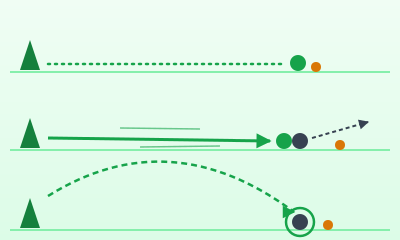
Figure: From top to bottom, punto (roll close), raffa (fast rolling hit) and volo (lofted hit). The green line is the ball's path.
Official competition rules
The Confederazione Boccistica Internazionale (CBI) sets the exact figures: court dimensions, throwing lines, the valid zone for the pallino, how out-of-bounds balls are handled, and the precise measuring procedure. Under CBI rules a player shooting raffa or volo must first declare to the referee which ball they intend to hit, and each ball must be played within 30 seconds. World and continental championship games are played to 12 points or 8 ends; if the score is level after 8 ends, one more end is played. In the United States the USBF plays games usually to 12 points and recommends 15 for finals. Bocce is also an official Special Olympics sport.
Scoring examples
Only the team with the ball closest to the pallino scores in an end.
- Example 1 (left of the figure): three green balls lie closer than grey's best ball. Green's fourth ball is outside it, so green scores 3
- Example 2 (right of the figure): the two teams' closest balls are exactly the same distance from the pallino. Under CBI rules the team that created the tie (the last to play) keeps playing until it takes the point or runs out of balls. If the tie remains when all balls are played, the end is void and replayed from the same end. Under USBF rules no points are scored and play resumes from the opposite end
- Example 3 (finishing a game): in the CBI championship format, if the score is 11 to 9 after 8 ends, the team with 11 wins. If either team reaches 12 earlier, the game ends immediately
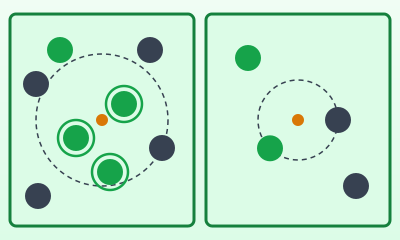
Figure: Left, the three green-ringed balls score, so green gets 3. Right, the closest balls are tied, so neither team holds the point yet.
Common fouls and tricky calls
- Crossing the line — under CBI rules, if the front foot touching the ground crosses the throwing line, the ball is void. However, the opponents may apply the advantage rule and accept the result
- No declaration — under CBI rules a raffa or volo shot is void if the player did not declare the target ball or hit a different one than declared (advantage rule applies)
- Hitting the side boards — under CBI rules a ball that touches the side boards before it has done its job is void. The USBF Open Rules say the opposite: players may use the side boards at any time. This is the clearest example of rules differing between bodies
- Hitting the back board directly — under CBI rules a pointed ball that hits the back board without touching anything else is void. Under USBF rules too, a ball that hits the backboard without first touching another ball or the pallino is dead and removed
- Pallino knocked out — if valid play knocks the pallino out of the court or back in front of the centre line, the end is void. The CBI replays it from the same end; the USBF restarts from the opposite end
- Stopping a moving ball — under CBI rules, deliberately stopping or deflecting a played ball gives the opponents the maximum points (their validly played balls plus those still to play)
Tips for enjoying the game
Common beginner mistakes
- Throwing too hard — bocce is a rolling game; read the surface
- Going only straight — read court slopes and roll lines for curve plays
- Pallino too close — placing it farther away opens up tactics
Basic tactics
- Pointers and shooters — the best pointer usually plays first to build a lead, and the best shooter clears away the opponents' balls
- Move the pallino — if opposing balls surround the pallino, knocking it toward your own balls is a valid plan
How to make it more fun
- A clean raffa that knocks out the leader can turn the whole end around
- Pair Bocce with BBQ or wine for the authentic Italian style
Age variations
- Kids: shorter court, lighter balls
- Seniors: seated/wheelchair throwing welcome
- Competitive: regulation court and balls, 30 seconds per ball
Playing Bocce in Japan
- Pick the flattest patch of park you can. Long grass stops balls quickly, so a shorter court often plays better
- A rope or a few markers laying out a strip about 4 m wide gives the feel of a real court
- Clubs and events for boccia (the Paralympic game) are for a different sport, so check the name carefully when searching in Japan
Frequently asked questions
Q. How big is a bocce court?
A CBI court is 26.5 m long and 4 to 4.5 m wide, enclosed by boards about 25 cm high. The USBF official court is essentially the same, 86.92 ft by 13.12 ft (26.5 m by 4 m). For home games any shorter flat area works.
Q. How many points do you need to win?
USBF games are usually played to 12 points, with 15 recommended for finals. CBI championship games go to 12 points or 8 ends. For casual play, 7 points is fine.
Q. Can you play bocce on grass?
Yes. Regulation courts are dirt or synthetic surfaces, but any flat lawn works. Grass slows the ball, so roll a little harder.
Q. Are bocce and boccia the same thing?
No. Boccia is a disability sport and Paralympic event derived from bocce, governed by the Boccia International Sports Federation (BISFed). Bocce's international body is the CBI.
Q. How do you pronounce bocce, and what does it mean?
In English it is usually said "BAH-chee" (/ˈbɑtʃi/); in Italian it is closer to "BOT-cheh". The word is the plural of the Italian boccia, "ball" or "bowl", so "bocce ball" literally repeats itself.
Q. How old do kids need to be to play?
There is no official minimum age. Regulation balls weigh about 900 g each, so start small children with light starter balls and short distances, with an adult nearby.
Q. What can I use if I don't have a set?
Any small ball works as the pallino, and eight balls of the same size in two colours can stand in for bocce balls. If they are all one colour, mark each team's balls with tape.
Learn more
- CBI Technical Rules of Play (Italian, PDF)
- Confederazione Boccistica Internazionale (CBI)
- USBF Open Rules (PDF)
- Special Olympics Bocce
- bocce on Wiktionary — English and Italian pronunciation
- Related: Pétanque and Lawn Bowls — fellow target-ball games
Share this page


