Lawn Bowls Rules: How to Play, Score & Green Size
- Region:
- United Kingdom
- Tags:
- UK, Ball game, Seniors, Family-friendly
At a glance
- Players
- 2–8 players
- Game length
- World events: singles to 21 shots; pairs and fours play 18 ends
- Equipment
- Bowls (2–4 per player), a jack, a mat, and a tape measure
- Space
- Green 31–40 m long (official); any flat lawn at a shorter range for fun
Contents (8)
What is this game?
Lawn bowls (Lawn Bowls) is a classic British lawn game. A rudimentary form of it was already played in 13th-century England, and the Southampton Old Bowling Green, said to have been first used in 1299, is known as the oldest surviving bowling green in the world. Today it is played across the UK and the Commonwealth — Australia and New Zealand in particular — by people of all ages. It has been on the programme of every Commonwealth Games since the first in 1930, with the single exception of 1966, including Glasgow 2026, where the bowls events were held indoors at the SEC Centre. It is not an Olympic sport.
Its defining feature is that a bowl is not a perfect sphere: its shape makes it curve to one side, giving it a "bias." Even when rolled straight, a bowl gently curves as it slows down, tracing an arc toward its target. Players read that curve to stop their bowls as close as possible to a small target ball called the jack.
Unlike petanque, where metal balls are thrown, lawn bowls are rolled along the ground. Judging the curved path created by the bias is what gives the sport its depth.
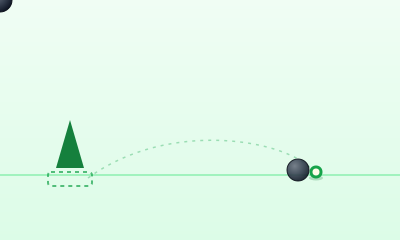
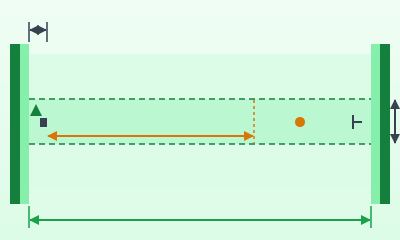
Figure: A 38 m green drawn close to scale, with the ditches and mat drawn wider than scale. A jack that stops short of the orange arrow (23 m) must be delivered again.
Lawn bowls vs bocce vs pétanque
All three are won by getting your balls closest to a small target ball, and they count the score the same way. What sets lawn bowls apart is the bias: the bowl is shaped to curve, so you aim wide and let it swing in.
| Lawn bowls | Bocce | Pétanque | |
|---|---|---|---|
| Ball | 112–131 mm, up to 1.59 kg, shaped with a bias so it curves | Synthetic, 106–107 mm, 900–920 g, rolls straight | Hollow metal, 70.5–80 mm, 650–800 g |
| Target ball | Jack, 63–64 mm (outdoor grass) | Pallino, 40 mm | Cochonnet, 30 mm |
| Delivery | Always rolled from a mat | Mostly rolled; raffa and volo hit other balls | Thrown from a small circle with both feet inside, often lofted |
| Playing area | A flat green 31–40 m long, split into rinks | Board-enclosed court, 26.5 m × 4 m (CBI) | Any firm ground; lanes at least 15 m × 4 m for championships |
| Game length | World events: singles to 21 shots, pairs and fours 18 ends | 12 points (CBI championships: 12 points or 8 ends) | 13 points |
| International body | World Bowls | CBI | FIPJP |
Crown green bowls, played mainly in northern England, uses a green that rises towards the middle instead of a flat one. See the Bocce and Pétanque articles for their rules.
Equipment & setup
Lawn bowls needs little more than the bowls, a jack, and a flat stretch of grass. Setting up is straightforward.
- Bowls — one side is more rounded than the other, and that shape creates the bias. Each player uses 2–4 bowls depending on the format. The more rounded "bias side" is identified by the small grooved rings around its centre, and the bowl curves toward that side. Sizes are chosen to suit your hand
- Jack — the small target ball, white or yellow, 63–67 mm across (also called the "kitty")
- Mat — the footing you stand on to deliver a bowl, 600 mm long and 360 mm wide. At the moment of delivery all or part of one foot must be on or above the mat
- Tape measure — for close calls; essential in competition
- Green — a flat, closely mown surface surrounded by a ditch and a bank and divided into strips called "rinks." For casual play a well-kept park lawn is plenty
Competition bowls have a precisely engineered bias that must meet World Bowls standards, but a leisure set is enough to feel the joy of "curving a bowl toward the target." Start with lighter bowls to learn the roll, then upgrade to competition bowls once you're hooked.
Court and equipment dimensions
The figures below come from World Bowls, the international governing body, in its Laws of the Sport of Bowls, Crystal Mark Fourth Edition (approved in August 2022). National associations may change some distances and standards for domestic play.
| Item | Regulation value | Tolerance and notes |
|---|---|---|
| Length of green | 31 to 40 m | Rectangular or square. Natural grass or a synthetic surface approved by the national association |
| Rink width | 4.3 to 5.8 m outdoors | 4.6 to 5.8 m indoors |
| Ditch | 200 to 380 mm wide, 50 to 200 mm deep | Surrounds the green |
| Bank | top at least 230 mm above the green | Vertical, or sloped no more than 35 degrees from vertical |
| Mat | 600 mm long by 360 mm wide | The front edge (mat line) goes at least 2 m from the rear ditch and at least 25 m from the front ditch |
| Minimum jack length | 23 m from the mat line | National associations may reduce it to 21 m for domestic play |
| Jack (outdoor natural grass) | 63 to 64 mm, 225 to 285 g | White or yellow |
| Jack (synthetic outdoor and indoor) | 63 to 67 mm, 382 to 453 g | |
| Bowls | 112 to 131 mm across, up to 1.59 kg | Rubber or plastic resin. Wooden bowls 112 to 134 mm |
Players & ages
| Format | Players | Bowls each | Game length at world events |
|---|---|---|---|
| Singles | 1 vs 1 | 4 | First to 21 shots |
| Pairs | 2 vs 2 | 2–4 | 18 ends |
| Triples | 3 vs 3 | 2–3 | 18 ends (2 bowls) or 15 ends (3 bowls) |
| Fours | 4 vs 4 | 2 | 18 ends |
Game lengths follow the World Bowls laws for world and international events; national competitions and local clubs often use other formats. In team play the players are called, in playing order, the lead, second, third and skip, and the skip, who plays last, directs the team. Because accuracy matters more than strength, everyone from children to seniors can play.
Rules
Lawn bowls is all about getting your bowls closer to the jack than your opponent does. Learn the minimal rules below and you can play the same afternoon.
How a round works (minimal rules)
- Choose who goes first (a coin toss works) and place the mat at the near end of the green
- The first player stands on the mat and rolls the jack down the green. Where it comes to rest becomes the target for that round
- The same player then rolls their first bowl toward the jack. Because the bowl curves with the bias, aim slightly to one side rather than straight at the jack so it arcs in
- The other side then rolls
- From here on, the two sides take turns, one bowl each. In team games the two leads alternate until they have played all their bowls, followed by the seconds, the thirds and finally the skips
- Once every bowl has been delivered, count the score: the team with the closest bowl scores one point for each of its bowls that beats the opponent's best one. This exchange is called an "end"
- The team that scored places the mat and the next end is played back the other way. Play a set number of ends, or until a team reaches the target score, to decide the game
At first, just focus on reading the bias and drawing close. Once that feels natural, add the techniques below.
Standard rules (adding skill)
- Bias direction — every bowl curves one way. Decide which side of the jack the bowl should swing around, then hold it with the small rings on the inside of the curve you want
- Weight — the strength of your roll is called "weight." Too little falls short; too much runs through. Because the bias only bites as the bowl slows, controlling weight is everything
- Draw vs. drive — a gentle "draw" eases a bowl close, while a hard "drive" is used to knock away an opponent's bowl or move the jack
- Foot fault — as you release, all or part of one foot must be on or above the mat
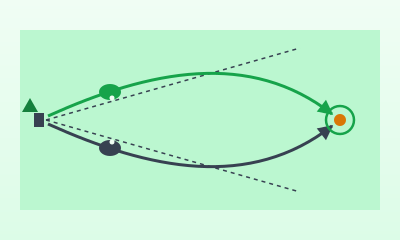
Figure: Deliver along a dashed aiming line and the bowl curves in toward the jack. The green and dark grey lines are the two ways round, one from each side. The white dot marks the bias side, which always faces the inside of the curve.
Official competition rules
World Bowls, the sport's international governing body, sets exact figures in its Laws of the Sport (the Crystal Mark editions): rink dimensions, the minimum distance the jack must travel, how out-of-bounds bowls and jacks are handled, and the precise measuring procedure. The jack must come to rest at least 23 m from the mat line, and if it stops less than 2 m from the front ditch it is moved to a spot on the centre line 2 m from that ditch. At world events singles is played to 21 shots, while pairs and fours run 18 ends.
Scoring examples
Points in lawn bowls are called "shots." They are counted the same way as in petanque or bocce: only the team with the bowl closest to the jack scores, one shot for each of its bowls that is closer than the opponent's best.
- Example 1 (left of the figure): two green bowls lie closer than grey's best bowl. Green's third bowl is outside it, so green scores 2 shots
- Example 2 (right of the figure): a drive pushes the jack into the front ditch. A jack in the ditch within the rink boundaries is still live. The green bowl touched the jack before dropping into the ditch, so it is a "toucher," chalk-marked and still in play. The grey bowl fell into the ditch without touching the jack, so it is dead. Green's toucher is closer than grey's remaining bowl, so green scores 1 shot
- Example 3 (tied end): if each team's nearest bowl is touching the jack, or the two are exactly the same distance away, no shot is scored. The end is recorded as a tied end and still counts as a completed end
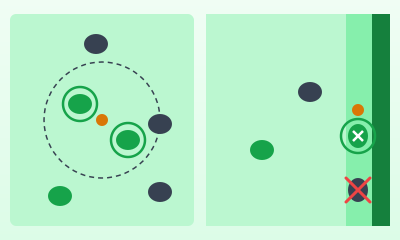
Figure: Left, green scores 2 shots. Right, the toucher in the ditch (green bowl with the white mark) is live, while the grey bowl that fell into the ditch without touching the jack (red cross) is dead.
Common fouls and tricky calls
These are the rulings under the World Bowls Laws of the Sport.
- Foot fault — at delivery one foot (or, for a wheelchair, one wheel) must be on or above the mat. The first time, the umpire gives a warning; after that the bowl is stopped and declared dead (Laws 7 and 8)
- Out and back in is fine — a bowl whose curve carries it outside the side boundary of the rink is still live if it comes to rest inside the rink. A bowl that leaves the rink on a bias that cannot bring it back is dead (Law 17)
- Marking touchers — a bowl that touches the jack is only a toucher if it is chalk-marked before the next bowl comes to rest (Law 15)
- Too short — a bowl that comes to rest less than 14 m from the mat line is dead (Law 17)
- Dead jack — if play knocks the jack completely outside the rink boundaries, or leaves it less than 20 m from the mat line, the end is a dead end and is replayed in the same direction (Laws 19 and 20)
- Improper jack delivery — if the jack ends up in the ditch, outside the rink, or less than 23 m from the mat line, the opponent re-places the mat and delivers the jack, but the original player still plays the first bowl (Law 10)
- Measuring too early — a team that measures before the last bowl of the end has come to rest loses the right to play its remaining bowls in that end (Law 23)
Lawn bowls terms at a glance
| Term | Meaning |
|---|---|
| Bias | The built-in curve of a bowl; the side with the smaller rings is the inside of the curve |
| Jack (kitty) | The small target ball |
| End | One round in which every player delivers all their bowls in one direction |
| Head | The jack and the bowls gathered around it |
| Shot | One point; also the bowl currently nearest the jack |
| Toucher | A bowl that touched the jack during its original run; it is chalk-marked and stays live in the ditch |
| Draw / drive | A gentle shot that curves in close / a fast shot to knock bowls or the jack away |
| Weight | How hard a bowl is delivered |
| Rink | One lane of the green; also a team of four |
| Lead, second, third, skip | The playing order in a team; the skip plays last and directs the team |
| Mat line | The front edge of the mat, from which jack distances are measured |
| Dead end | An end that is replayed, for example when the jack is knocked out of the rink |
Tips for enjoying the game
Common beginner mistakes
- Aiming straight and forgetting the bias. The bowl always curves — aim wide enough to let it swing in
- Holding the bowl the wrong way round. The small rings go on the inside of the curve you want. Hold it the other way and it swings away from the jack
- Rolling too hard. Too much speed runs past before the bias can bite. A bowl that just barely stops draws closest
- Ignoring the pace of the green. The laws define pace as the number of seconds a bowl takes to come to rest about 27 m from the mat; more seconds means a faster green. Faster greens also tend to make bowls swing wider
Basic tactics
- Put a bowl behind the jack. If the jack is knocked back, a bowl sitting just beyond it can suddenly become the shot
- Watch your skip. In team play the skip stands at the head and signals where to aim. Following those signals is the quickest way to improve
How to make it more fun
- A well-timed "drive" that knocks the leader out swings the whole end and thrills the crowd
- Full games can run long, so agreeing on a short number of ends keeps casual play snappy
Age variations
- Kids: lighter bowls, shorter distances, simplified "closest wins" rules
- Seniors: play standing with little movement — an ideal lifelong sport
- Competitive play: regulation mat-to-jack distances and a tape measure for exact calls
Playing lawn bowls in Japan
- Competition bowls are pricey; start with an affordable leisure set to feel the "curving bowl"
- You don't need a regulation green — a well-mown park lawn works fine. Choose a safe spot so bowls don't reach other people
- The national body is Bowls Japan, a certified non-profit organisation that is a member of World Bowls and runs national championships
- According to Bowls Japan, greens include those at Showa Kinen Park (Tokyo), Kobe Shiawase no Mura, Hyogo Prefectural Akashi Park and Nagasaki Prefectural General Sports Park
Frequently asked questions
Q. How big is a lawn bowls green?
Under the World Bowls laws a green is 31 to 40 m long, and each rink is 4.3 to 5.8 m wide outdoors. The green is surrounded by a ditch and a bank. For casual play, shorten the distance and use any flat lawn.
Q. How many points do you need to win?
At world events singles is first to 21 shots, pairs and fours are 18 ends, and triples are 18 or 15 ends; in games decided over a set number of ends, the higher total of shots wins. Club and casual games can use any agreed number of ends or shots.
Q. Can you play on something other than grass?
Yes. The laws allow approved synthetic greens, and there are indoor greens and indoor competitions too.
Q. What shoes and clothes do you need for lawn bowls?
Flat-soled, heel-less shoes are the one firm rule: the World Bowls laws require them for players, umpires and markers on the green (Appendix A.2). Clothing colours are left to national bodies and event organisers, so check the club or tournament's dress code before you go.
Q. What does the stamp on a bowl mean?
It is the World Bowls Stamp, which shows that the bowl's bias has been tested and approved. Under the laws, bowls must be re-tested and re-stamped at least once every 10 years, or earlier if the date on the stamp can no longer be read, though national bodies can set their own rules for domestic play (Law 52.2).
Q. How old do kids need to be to play?
There is no official minimum age. Competition bowls can weigh up to 1.59 kg under the laws, so start small children with light leisure bowls and short distances.
Q. What can I use if I don't have a set?
Any small ball works as a jack. Ordinary balls roll straight, though, so you will miss the curve that makes lawn bowls special. To experience the bias, use proper bowls, even a leisure set.
Learn more
- World Bowls Laws of the Sport
- Laws of the Sport of Bowls, Crystal Mark 4th edition (PDF): footwear in Appendix A.2, bowl stamps in Law 52
- Bowls Japan (Japanese)
- Match footage from the Commonwealth Games, where lawn bowls has been played at every Games but one since 1930
- Related: see also Petanque, Bocce, and Kubb
Share this page