Kubb 101 — Sweden's 'Viking Chess' on the Lawn
- Players:
- 2–12 players
- Region:
- Sweden
- Tags:
- Small group, Medium group, Throwing, Territory, Europe, Nordic, Family-friendly
What is this game?
Kubb is a throwing/territory game popularized on the Swedish island of Gotland in the 1990s.
Often called "Viking Chess" (despite its modern formalization), Kubb pits two teams against each other,
throwing wooden batons to topple the opponent's blocks (kubbs)
and ultimately the central King.
The mix of strategy and fortune earns it the "Viking Chess" reputation, yet the rules are friendly enough for the whole family. The annual Kubb World Championships are held in Rone, Gotland (Sweden), and a thriving competitive scene exists in places like Eau Claire, Wisconsin (USA).
Equipment & setup
Kubb needs almost nothing beyond a single wooden set and a flat patch of grass. Setup is just laying out the pieces and takes only a couple of minutes.
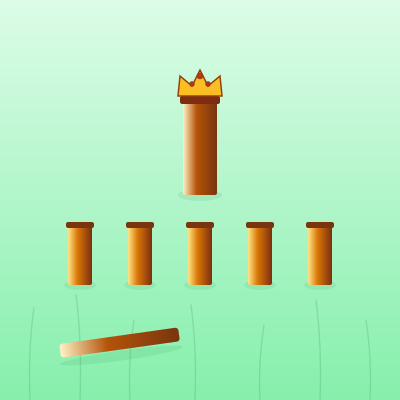
- King — the tallest block, engraved with a crown, stood upright in the center of the pitch. Toppling it last is how you win, so it really is the "king"
- Kubbs — five small rectangular wooden blocks per team, ten in total, lined up along each baseline. They're your targets, and once knocked down they get thrown into the opponent's half to become "field kubbs"
- Batons (kastpinnar) — six round throwing sticks, roughly 4.4 cm thick and 30 cm long, used to knock over the kubbs and, finally, the king
- Corner sticks — four markers that mark the corners of the pitch, making the baselines and out-of-bounds edges easy to see
- Field — a 5 m × 8 m rectangle is standard (8 m between the two baselines, 5 m wide). Grass is ideal, but dirt or sand works too
Official wooden sets cost roughly $50–80, while budget polymer sets start even cheaper. Start with an inexpensive set to get a feel for the throw, then upgrade to a hardwood competition set (birch or beech) once you're hooked. Pick a spot — a park lawn, a riverbank, or a campsite — with enough room that batons and kubbs can't hit anyone nearby.
Players & ages
| Format | Players |
|---|---|
| Small | 1 vs 1 |
| Standard | 3 vs 3 |
| Party | 6 vs 6 |
Kids from ~8 and adults can play together. Control matters more than strength.
Rules
Kubb is all about clearing the opponent's kubbs and then toppling the central king last — knock the king too early and you lose on the spot. That blend of a simple goal and careful sequencing is what earns it the "Viking Chess" nickname. Learn the minimal rules below and you can play the same afternoon.
How a round works (minimal rules)
- Set out a 5 m × 8 m field and stand the King upright in the center
- Line up five kubbs per team, evenly spaced, along each baseline
- Choose the first team (a coin toss works) and have them share out the six batons and throw them one at a time
- Throws must be underhand with end-over-end rotation only; a sideways "helicopter" spin is a foul
- First, aim to knock down the kubbs on the opponent's baseline
- On the other team's turn, they throw your knocked-down kubbs back into your half and stand them up where they land — these are "field kubbs"
- From the next turn on, you must topple the field kubbs in your half first before you're allowed to target the opponent's baseline kubbs
- Once every opposing kubb (field and baseline) is down, the team that topples the King wins
- Knock the King over before clearing all the kubbs and you lose instantly (!). Always respect the order
At first, just remember the order: opponent's kubbs first, king last. Once that feels natural, add the techniques below.
Standard rules (adding skill)
- Throwing in field kubbs — knocked-down kubbs are tossed into the opponent's half. If a field kubb can't be stood within two throws, the opponent gets to plant it near the king (a disadvantageous spot for you)
- Field kubbs come first — hitting a baseline kubb or the king while field kubbs still stand in your half doesn't count. Clear the field kubbs first, always
- Use all six batons — a turn ends only after all six batons have been thrown
- King only at the end — targeting the king while even one baseline kubb remains is a foul; clear everything first
- Advantage line — if a field kubb is left unstood, it can create a forward line your team is allowed to throw from, opening up an attacking chance
Official competition rules
The annual World Championship in Kubb (Rone, Gotland) fixes exact pitch dimensions, the type and size of the woods, and throwing distances. Matches are timed, refereed, and run as formal tournaments. In Japan the Japan Kubb Association hosts taster sessions and World Cup qualifiers, so joining a local club is the easiest way to play by the full rules.
Tips for enjoying the game
Common beginner mistakes
- Helicopter throws — vertical end-over-end is required. Avoid wrist snap
- Hitting the King too soon — accidental King hit = immediate loss
- Bad field-kubb placement — where you stand them up changes the entire game
How to make it more fun
- Cluster opponents' field kubbs near the front to clear them in one turn next round
- Mid-game tactical huddles add to the fun
- Long-shot King attempts make for memorable comebacks
Age variations
- Kids: half-size pitch (4 m), lighter batons
- Seniors: seated or wheelchair-friendly
- Camping vibe: classic alongside BBQ or campfire
Playing Kubb in Japan
- Sets available on Amazon, Rakuten, and outdoor stores
- Pick a park with enough space; mind nearby users
- The Japan Kubb Association runs beginner sessions and World Cup qualifiers
Learn more
- World Championship in Kubb — Rone, Gotland, Sweden (every July)
- US National Kubb Championship — Eau Claire, Wisconsin
- Related: see also Pétanque, Mölkky, Bocce — fellow lawn throwing games