Kyykkä Rules: How to Play Finnish Skittles, Court Size & Scoring
- Region:
- Finland
- Tags:
- Small group, Medium group, Throwing, Europe, Nordic, Traditional
At a glance
- Players
- 2–8 players
- Game length
- A game is two halves. In team play each player throws 2 karttu per turn
- Equipment
- 80 kyykkä (wooden cylinders) and throwing clubs (karttu), about 4 per team
- Space
- Two 5 m × 5 m squares 10 m apart; about 7 m × 22 m including margins (Finnish Kyykkä Federation)
Contents (8)
What is this game?
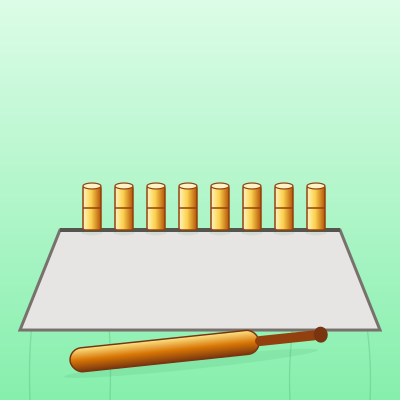
Kyykkä is a throwing game from Karelia, the region that straddles the Finnish-Russian border. Pairs of small wooden cylinders (the kyykkä) stand stacked along the front line of a 5 m square drawn on the ground, and players throw wooden clubs called karttu from 10 m or more away to knock them out of the square. Kyykkä left in the square cost minus points, clubs you didn't need to throw earn plus points, and the higher total wins. In English it's sometimes called Finnish skittles.
According to the Finnish Kyykkä Federation (Suomen Kyykkäliitto), kyykkä has been played for centuries as a contest between villages. In 1894 the writer I. K. Inha noted that in White Sea Karelia the game was fading away. In 1951 a Karelian cultural society set out to revive it, and so many teams took part that it had to write down rules and a scoring system. The Karelian Kyykkä Federation was registered in 1986 and renamed the Finnish Kyykkä Federation in 1993. The first European Championships were held in Helsinki in August 2025, with players from Finland, Ukraine and Estonia.
Today kyykkä is also a big student game in Finland: every February more than 5,000 students gather in Hervanta, Tampere, for the Academic Kyykkä World Championships.
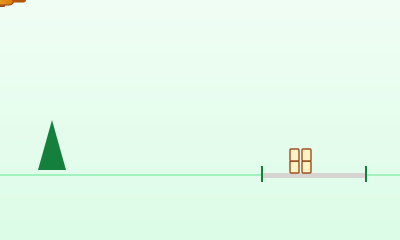
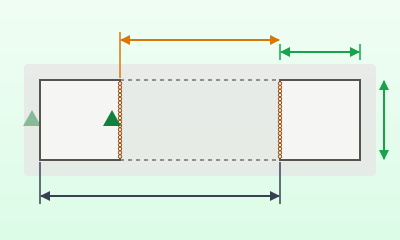
Figure: The square your team throws from (left) is the square the other team is clearing. Men open from 15 m (dark grey) and then throw from 10 m, on the front line of their own square.
Equipment & setup
- Kyykkä: birch cylinders 100 mm long and 65 to 80 mm thick, with edges rounded by about 5 mm. A team game uses 20 pairs (40 pieces) per square, 80 in all
- Karttu (throwing clubs): wooden, round, with a handle. No longer than 850 mm and no thicker than 80 mm, with no weight limit; painting is allowed
- Court: for summer events, as level a gravel area as possible, with lines scratched in using a pointed stick (not chalk). Winter games are played on ice or snow
- Setting up: stand the pairs, one kyykkä on top of the other, on the front line of each square, with the line running through their centers. Team games use 20 pairs starting 10 cm in from the side lines; individual and pairs games use 10 pairs starting 125 cm in
Kyykkä court size and equipment dimensions
From the Finnish Kyykkä Federation's rulebook (May 2025) and its short guide to play:
| Item | Standard | Notes |
|---|---|---|
| Square | 5 m × 5 m (men) | Your throwing square is the other team's playing square |
| Gap between the squares | 10 m | Measured center of line to center of line |
| Space needed | About 7 m × 22 m | At least 1 m of level ground at the sides and 2 m behind |
| Small court for kids 10 and under | 3 m × 3 m squares, 6 m apart | Throwing line at 4 m |
| Kyykkä | 100 mm long, 65–80 mm thick | Birch cylinder |
| Karttu | Up to 850 mm long, up to 80 mm thick | Wood, with a handle; any weight |
| Pairs per square | 20 (team), 10 (individual and pairs) | A pair is two kyykkä stacked |
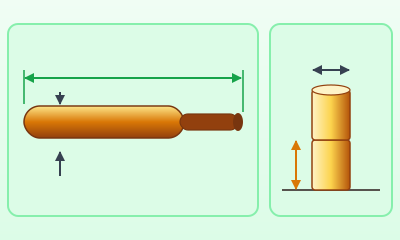
Figure: A karttu (left) and a stacked pair of kyykkä (right).
Players & ages
| Format | Players | Throws per turn |
|---|---|---|
| Individual | 1 vs 1 | 4 (up to 20 per half) |
| Pairs | 2 vs 2 | 2 per player |
| Team | 4 vs 4 (3 allowed) | 2 per player |
- Throwing distances are set by age and gender (see the table under Official competition rules), with divisions starting at age 8, so kids play the same game as adults
- Veterans over 70 throw from shorter distances
Rules
The aim: clear every kyykkä out of the square you're attacking, using fewer clubs than the other side.
How a game works (minimal rules)
- Stand the stacked pairs along the front line of both squares
- Decide who starts. Throwers stand in their own square and aim at the kyykkä in the other one
- Throw the karttu to knock kyykkä out over the side or back lines of the square
- After a turn, the other team throws the same way
- When one side clears its target square, the half ends; the other side may still throw the same number of clubs
- Switch squares, play the second half, and add both halves together. The higher total wins
Standard rules (adding skill)
- The opening throw: play starts from behind the back line of your own square (15 m for men). Once at least one kyykkä has gone out over a side or back line, the game is "open" and you throw from the front line of your square (10 m for men)
- Kyykkä knocked forward: a kyykkä that bounces out into the gap between the squares still counts against you. It has to be hit out over the side or back lines of the square, or over the dashed side-line extensions between the squares
- Foot lines: you may not step on or over the line you throw from. Leave the throwing area over the side or back lines
- Split kyykkä: if a hit splits one, it's judged by where the larger part went, and the broken piece is replaced
Official competition rules
Finnish Kyykkä Federation events are judged by a referee under the federation rulebook, who records how many kyykkä each club knocks out. Throwing distances:
| Division | Opening throw | Continuation |
|---|---|---|
| Men | 15 m | 10 m |
| Women and under-15s | 10 m | 8 m |
| 12-year-olds | 8 m | 6 m |
| 10-year-olds | 6 m | 4 m |
| 8-year-olds | 4 m | 4 m |
| Over 70 (men / women) | 10 m / 8 m | 10 m / 8 m |
- Match points: a win is worth 2, a draw 1, a loss 0
- Team games: four players a side. When one team clears its square, the other may throw the same number of clubs, and unused clubs score plus points. A half can also be capped at an agreed number of turns, such as three
- Individual games: 4 clubs per turn, 20 per half, 40 per game. Clear your square in fewer than 20 and each unused club is a plus point
- Academic Kyykkä World Championships (student event): teams of four; in each half every player throws 4 clubs (two turns of 2), and the team with fewer minus points wins. Men open from the back line and women from the front line; once open, men throw from the front line and women from 2 m in front of it
- Safety rule: when someone throws, nobody may be within about 2 m of the sides of the squares or about 5 m behind the target square. Side-by-side courts must be at least 5 m apart
Scoring examples
Kyykkä scoring (the same under the federation and student rules):
| Where the kyykkä ends up | Points |
|---|---|
| Inside the square or on its front line (akka) | −2 |
| Out in the gap between the squares (vieras) | −2 |
| On the side or back line (pappi) | −1 |
| Each unused karttu | +1 |
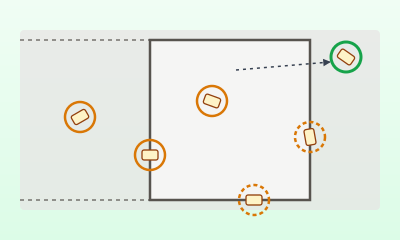
Figure: Solid orange ring −2, dashed orange ring −1, green ring: knocked out, so it doesn't count.
- Example 1: clearing the square (team game). Team A clears its square with its 16th club. Team B also throws 16 clubs but leaves three kyykkä inside the square and one on a side line. For that half, A scores 0 and B scores −2 × 3 − 1 = −7
- Example 2: clubs to spare (individual game). Clear the square with 14 of your 20 clubs and the 6 unused clubs give you +6
- Example 3: knocked forward. If a kyykkä you hit is left in the gap at the end of the turn, it counts −2, just as if it were still in the square
Common fouls and tricky calls
- Is it on the line?: the referee draws a measuring stick upright along the line; if the stick touches the kyykkä, it's a pappi (−1)
- Side line near the front: a kyykkä on the side line less than 10 cm from the front line is not a pappi
- Moving the other team's kyykkä: the referee puts them back and gives a warning. After two warnings, the player must throw the rest from behind the back line
- Overstepping: under the student rules, kyykkä knocked out by an overstepped throw go back onto the front line, any knocked over inside the square stay put, and the club counts as thrown
Tips for enjoying the game
Common beginner mistakes
- Lobbing the club high: a club that drops from above tends to knock kyykkä over inside the square. Aim for a lower line into the row, as if driving them out the back
- Leaving kyykkä in the gap: anything knocked forward stays at −2. Clear it with your next club
How to make it more fun
- Throwing order: in the student team game two players throw two clubs each per turn. Put a strong opener first and a tidy finisher after
- Short-court practice: the kids' court (3 m squares, 6 m apart) is also handy for adult practice and small spaces
Age variations
- Kids: use the small court with a 4 m throwing line and lighter, shorter clubs. Check that nobody is in front of the thrower or behind the target square before every throw
- Seniors: like the over-70 divisions, throw the opening from the same shorter distance as the rest
Playing Kyykkä in Japan
Getting equipment
- The Finnish Kyykkä Federation lists Finnish makers of clubs and kyykkä
- Otherwise you can make your own: cut birch (or similar) logs into 10 cm lengths 6.5 to 8 cm thick for the kyykkä, and use a wooden club with a handle, no longer than 85 cm, as a karttu. Sand the edges smooth
Where to play and staying safe
- A karttu is a heavy wooden club that flies a long way. Check park rules on signs or with the park office before throwing in a public park
- As in the federation rules, make sure nobody is beside the squares or behind the target square when someone throws, and keep side-by-side courts at least 5 m apart
- Official summer courts are gravel, but any level dirt ground where you can scratch lines will do
Kyykkä vs Mölkky
Mölkky, the other Finnish throwing game, was developed from kyykkä.
| Kyykkä | Mölkky | |
|---|---|---|
| What you throw | Clubs with a handle (up to 85 cm); 2 per player per turn in team play | One plain wooden stick, shared by everyone |
| Targets | Plain wooden cylinders (40 per square in team play) | 12 pins numbered 1 to 12 |
| Distance | 10 to 15 m (men) | 3.5 m (official) |
| How you win | Kyykkä you fail to clear cost points; the higher total wins | First to exactly 50 points wins |
Frequently asked questions
Q. What is kyykkä?
Kyykkä is a Finnish throwing game from Karelia in which you knock wooden cylinders out of a square with a wooden club. In English it's sometimes called Finnish skittles.
Q. What's the difference between kyykkä and Mölkky?
Mölkky was developed from kyykkä as a simpler, more casual game. Kyykkä is about clearing every cylinder out of a square 10 m or more away, while in Mölkky you knock numbered pins over from 3.5 m to reach exactly 50 points.
Q. How big is a kyykkä court?
Two 5 m × 5 m squares are drawn 10 m apart (men's court). With margins you need a level area of about 7 m × 22 m. The kids' court for ages 10 and under uses 3 m squares 6 m apart.
Q. How does kyykkä scoring work?
Each kyykkä left inside the square, on its front line or in the gap costs 2 points, one on a side or back line costs 1, and each unused club earns 1. The two halves are added together.
Q. How many people play kyykkä?
There are individual (1 vs 1), pairs (2 vs 2) and team (4 vs 4) formats. For casual play, just share out the clubs to suit your group.
Learn more
- Finnish Kyykkä Federation: short guide to play (Lyhyet peliohjeet, Finnish)
- Finnish Kyykkä Federation rulebook (Sääntökirja, Finnish): full rules for courts, equipment and scoring
- Finnish Kyykkä Federation: history (Historia, Finnish)
- Academic Kyykkä World Championships rules (Finnish, with a link to the English version)
- Related: Mölkky, Kubb, Petanque, Horseshoes — Nordic throwing games and other target-throwing lawn games
Share this page


