Horseshoes Rules: Pit Dimensions, Distance & Scoring
- Region:
- United States
- Tags:
- Small group, Throwing, North America, Family-friendly, Party
At a glance
- Players
- 2–4 players
- Game length
- Games to 40 points are the NHPA's suggestion; backyard games often go to 21
- Equipment
- Two stakes and four horseshoes (two per player, in two colors)
- Space
- 6 ft × 46 ft (1.83 m × 14.02 m, NHPA), plus about 2 ft of buffer around it
Contents (8)
What is this game?
Horseshoes (or horseshoe pitching) is a one-on-one or two-on-two American throwing game. Players pitch U-shaped steel shoes at a stake driven into the ground, scoring for "ringers" that encircle the stake and for shoes that stop close to it.
Tossing rings at a peg makes it a close cousin of the British game of quoits. According to the English Wikipedia article, early-1900s matches in the US followed rules that organizers printed in local newspapers, and details varied: the peg might stick up only 2 inches (5 cm) from the ground. By 1925, newspapers were citing rules "as adopted by the national association January 1, 1925," with stakes 40 feet apart, the distance still used today.
The governing body is the National Horseshoe Pitchers Association (NHPA), a federation of 54 charters across the US that runs the annual World Horseshoe Pitching Championships. The NHPA likes to point out that horseshoes is one of the few sports with national champions for men, women, boys, and girls that can still be played in your backyard. It has a presidential pedigree too: Harry Truman built a horseshoe pit at the White House in the 1940s, and George H. W. Bush unveiled a new one on the South Lawn in 1989 and ran staff tournaments on it.
The game also gave English a saying. "Close only counts in horseshoes and hand grenades" comes from the way a shoe near the stake still scores.
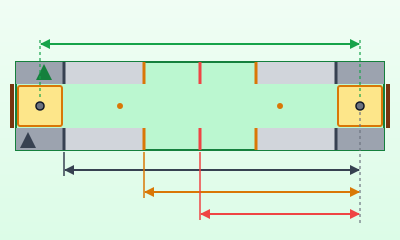
Figure: The NHPA court from above (drawn wider than scale). Foul lines are measured from the opposite stake. Men may not step over the 37 ft line; women, juniors, and Elder men observe the 27 ft line; cadets (12 and under) use the 20 ft line at mid-court.
Equipment & setup
All you need is two stakes, four horseshoes, and a strip long enough to set the stakes 40 ft (12.19 m) apart. On a regulation court each stake sits in a pit of sand or clay so the shoes do not bounce away.
- Horseshoes — not real horse shoes but pitching shoes made for the game. An NHPA-sanctioned shoe may weigh no more than 2 lb 10 oz (1.19 kg) and be no wider than 7-1/4 in (18.4 cm) or longer than 7-5/8 in (19.4 cm). Each player uses two, distinguishable from the opponent's
- Stakes — 1 in (2.5 cm) steel rods set in the center of each pit, standing 14 to 15 in (36 to 38 cm) above the pitching platform, with a 3 in (7.6 cm) lean toward the opposite stake
- Pits — rectangles filled with clay, sand, dirt, or an approved synthetic, at least 4 in (10 cm) deep; 8 in (20 cm) is recommended for in-ground pits
- Backboards — at least 3 ft (0.91 m) behind the stake and at least 1 ft (30 cm) high, to stop shoes that skid through
- Measuring tools — something to check whether a shoe is within 6 in (15 cm) of the stake, and a straightedge to check ringers
For a casual game, two stakes hammered into a lawn will do. Wikipedia notes that plenty of people still find a park, drive stakes "about thirteen strides apart," and wait for others to join.
Horseshoe pit dimensions and court size
The table follows the NHPA's Official Rules/Regulations, Guidelines and Specifications (revised January 2024).
| Item | Standard | Notes |
|---|---|---|
| Distance between stakes | 40 ft (12.19 m) | Measured from the front of each stake, level with the pitching platform |
| Court size | 6 ft wide by 46 ft long (1.83 m by 14.02 m) | 2 ft (0.61 m) of buffer recommended on each side and behind each box, for 10 ft by 50 ft (3.05 m by 15.24 m) overall |
| Pitcher's box | 6 ft (1.83 m) square | One at each end: the pit plus the pitching platforms on either side |
| Pit | 31 to 36 in wide by 43 to 72 in long (79 to 91 cm by 109 to 183 cm), inside | At least 21 in (53 cm) from the stake to the front and back of the pit |
| Pit depth | At least 4 in (10 cm) | 8 in (20 cm) recommended for in-ground pits |
| Stake | 1 in (2.5 cm) diameter, 14 to 15 in (36 to 38 cm) high | 3 in (7.6 cm) lean toward the opposite stake |
| Pitching platforms | 18 to 20-1/2 in (46 to 52 cm) wide, at least 6 ft long | Extended 10 ft (3.05 m) forward for short-distance pitchers |
| Backboard | At least 3 ft (0.91 m) behind the stake, at least 1 ft (30 cm) high | Keep 12 ft (3.66 m) of clear air above the court |
| Horseshoe | No more than 2 lb 10 oz (1.19 kg) | Max 7-1/4 in wide, 7-5/8 in long, 3-1/2 in (8.9 cm) opening |
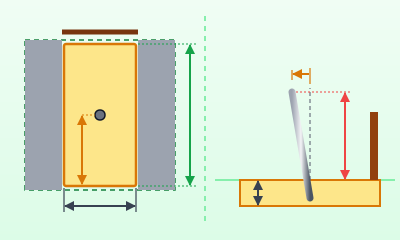
Figure: Pit and stake dimensions. Green is the pit length (43 to 72 in), dark gray the pit width (31 to 36 in), and the orange arrow on the left the stake-to-pit-edge distance (at least 21 in). On the right, red is the stake height (14 to 15 in), orange the 3 in lean toward the opposite stake, and dark gray the pit depth (at least 4 in). Not to scale.
Horseshoe distance for women, kids, and seniors
NHPA rules assign each division a foul line to stay behind. Every foul line is measured from the opposite stake.
| Division | Who | Foul line | Where you pitch from |
|---|---|---|---|
| Open Men | No age limit | 37 ft (11.28 m) | The full-distance platforms beside the pit (40 ft stake to stake) |
| Senior Men | From the year you turn 60 | 37 ft (11.28 m) | Same as Open Men |
| Elder Men | From the year you turn 65 (by declaration) | 27 ft (8.23 m) | Anywhere on the extended platforms |
| Open Women, Senior Women | No age limit / from 60 | 27 ft (8.23 m) | Anywhere on the extended platforms |
| Juniors (boys and girls) | 18 and under | 27 ft (8.23 m) | Anywhere on the extended platforms |
| Cadets (boys and girls) | 12 and under | 20 ft (6.10 m) | Behind the mid-court line |
Courts also carry "imaginary stake" marks 30 ft (9.14 m) and 23 ft (7.01 m) from the opposite stake, as a reference for where short-distance pitchers stand.
Players & ages
| Format | Players | Shoes each | Where players stand |
|---|---|---|---|
| Singles | 1 vs 1 | 2 | Both pitch from the same end, walk down to score, then pitch back |
| Doubles | 2 vs 2 | 2 | Each team puts one player at each end; you pitch against the opponent at your end |
- NHPA doubles comes in two styles: regular doubles, where partners stay at their own end and pitch the same pair of shoes back and forth, and walking doubles, where everyone pitches their own shoes and walks the court
- A regulation shoe weighs about a kilogram, which is a lot for small children. The NHPA's youngest division is cadets (12 and under); at home, rubber or plastic kids' sets and a shorter distance are the safer start
- Repeating the same smooth delivery matters far more than strength, which is why many people keep pitching well into their senior years
Rules
Horseshoes is about encircling the stake with a ringer, or at least landing closer than your opponent. Play the minimal rules first, then add cancellation scoring.
How a game works (minimal rules)
- Set the two stakes 40 ft (12.19 m) apart. Shorten the distance for kids and beginners
- Flip a coin or a shoe to decide who starts; the winner chooses to pitch first or second
- The first player pitches both shoes underhand, one at a time, at the far stake. The second player then pitches both shoes from the same end. Those four shoes make one inning
- After all four shoes are thrown, both players walk to the far stake and agree on the score before picking up any shoes. No shoe moves until it has been scored
- Per-shoe scoring:
- Ringer (a shoe that encircles the stake): 3 points
- Within 6 in (15 cm) of the stake, including a "leaner" resting against it: 1 point
- Farther than 6 in: 0 points
- Pitch the shoes back from the other end, and keep going until someone reaches the target score (the NHPA suggests 40)
Backyard games often go to 21, and simply landing near the stake is plenty of fun at the start.
Standard rules (adding skill)
- Cancellation scoring — the NHPA's standard method. Only one player can score in an inning. A ringer cancels an opponent's ringer (cancelled ringers are "dead"), and only what is left counts. With no live ringers, the closest shoe in count scores 1 point, and if the same player's other shoe is second closest, it scores 1 more
- Count-all scoring — both players keep everything they score in the inning, so each can make 0, 1, 2, 3, 4, or 6 points. Count-all games use an alternating first-pitch rotation
- Who pitches first next inning — under cancellation, the player who scored in the previous inning pitches first. If nobody scored, the player who pitched last pitches first
- The delivery — the shoe turns in flight and should arrive open end first at the stake. The NHPA's "How to Pitch" guide calls the 1-1/4 turn and the 1-3/4 turn the orthodox grips, and describes an expert's shoe floating in an arc about 8 ft (2.4 m) high
- Calling the score — the player who scored calls it to the scorekeeper, ringers first and then points: "one ringer, four points"
- Where the other player stands — when not pitching, stand still and quiet at least 2 ft (0.61 m) behind the pitcher or on the opposite platform
Official competition rules
NHPA-sanctioned tournaments and leagues add:
- Game length — a point limit (40 suggested), a shoe limit (40 or 50 suggested), or a combination such as "40 points or 50 shoes, whichever comes first," chosen by the organizers
- Time limit — both shoes within 30 seconds, timed from when the pitcher steps onto the platform in a set position
- Same platform, same hand — both shoes in an inning come from the same platform, and you pitch the whole tournament with the same hand
- Format — the standard is round-robin play within classes seeded by ringer percentage (ringers divided by shoes pitched)
- Ties — either the game stays tied (half a win and half a loss each) or two-inning tiebreakers are played until someone wins
- Conduct — the NHPA rules also cover dress code, alcohol and tobacco, and cell phones on the courts
Scoring examples
Under cancellation scoring, only one player scores per inning. Each example is a singles inning between A and B.
- Example 1 — A has a ringer, and A's other shoe is the closest shoe in count. Both of B's shoes are more than 6 in away. A scores 4 ("one ringer, four points")
- Example 2 — A and B each throw one ringer, and of the remaining shoes A's is closest (within 6 in). The ringers cancel, so A scores 1 ("two dead, one point")
- Example 3 — A throws two ringers and B throws one. B's ringer cancels one of A's, so A scores 3 ("two dead, three points")
- Example 4 — No ringers, and both of A's shoes are closer than either of B's (all within 6 in). A scores 2
- Under count-all — in example 2, A takes 3 for the ringer plus 1 for the close shoe, and B takes 3 for the ringer: A 4, B 3
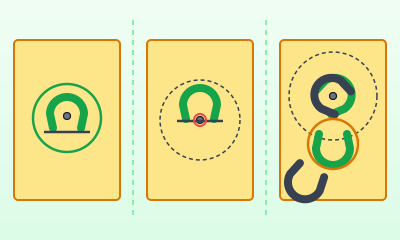
Figure: Left, a ringer: the straightedge across the heel ends does not touch the stake. Middle, the straightedge touches the stake, so it is not a ringer, but the shoe is within 6 in and scores 1. Right, example 2: the two ringers cancel and the green shoe circled in orange scores 1.
Common fouls and tricky calls
- Is it a ringer? — lay a straightedge across the two heel calks. If it clears the stake, it is a ringer. If it touches, the shoe is worth 1 point or nothing depending on whether it is within 6 in
- Leaners — worth 1 point under NHPA rules. Some backyard games count them as 2, so settle it before you start
- Foul shoes — a shoe scores nothing if the pitcher stepped on or over the foul line, started or stepped completely outside the platform, ran over the 30-second limit, or if the shoe touched the backboard, a platform, or the ground outside the pit before coming to rest, or hit a tree limb, wire, or ceiling. Remove a foul shoe from the scoring area before the next shoe is pitched
- Live shoes moved by a foul shoe — they are scored where they end up
- Ties for closest — opposing shoes that both touch the stake, or sit exactly the same distance away, cancel each other; the next closest shoe in count scores 1
- A shoe or stake moved during measuring — if the players agree, score it; if not, a judge either scores the inning or orders a re-pitch
Tips for enjoying the game
Common beginner mistakes
- Throwing hard — the shoe is heavy; a relaxed, pendulum-like swing and a soft, high release is far more consistent
- Inconsistent turns — use the same grip and the same turn every time so the shoe opens at the same point. The NHPA's "How to Pitch" guide stresses that there is no shortcut: many hours of patient, correct practice
- Neglecting the pit — clay should be watered and turned to a soft, putty-like consistency before each game. Sand or dirt pits may be re-leveled during play
- Arguing instead of measuring — keep a 6 in measure and a straightedge by the stake and calls take seconds
How to make it more fun
- Track your ringer percentage. It is the number the NHPA uses to seed tournament classes, and watching it climb is addictive
- Play doubles and talk over each shot: cancel the opponent's ringer, or go for points?
- Change the scoring to suit the group, from backyard games to 21 to the NHPA's "ringers only" format, where each ringer counts 1 point and nothing else scores
Age variations
- Kids: use a lighter kids' set and start from about 20 ft (6 m), the same line NHPA cadets (12 and under) use
- Women and seniors: the 27 ft foul line (8.23 m from the opposite stake) lets you practice exactly as in sanctioned play
- Competitive: pitch on a 40 ft regulation court with cancellation scoring and games to 40
Playing Horseshoes in Japan
- A regulation shoe is roughly a kilogram of steel. Check that nobody is in the line of fire or behind the pit before you pitch, and have waiting players stand beside or behind the platform. The NHPA itself requires backboards and a protective barrier around court complexes for safety
- Some parks restrict throwing games or driving stakes into the ground. Check with the park office, or choose a campground, private land, or a field where you have permission
- Pitching straight onto a lawn tears up the turf, so set a sand-filled frame around each stake or shift the landing spot from game to game
- In Japan, the game is usually called hōsushū or teitetsu-nage (horseshoe throwing). Regulation sets are mostly imported; rubber or plastic leisure sets are an easy alternative
Frequently asked questions
Q. How far apart are horseshoe stakes?
Regulation horseshoe stakes are 40 ft (12.19 m) apart under NHPA rules. Men pitch from behind a foul line 37 ft from the opposite stake, women, juniors, and Elder men from behind 27 ft, and cadets (12 and under) from behind the 20 ft line at mid-court.
Q. How many points is a ringer? What about a leaner?
A ringer is worth 3 points, and any other shoe that stops within 6 in (15 cm) of the stake is worth 1. A leaner, a shoe resting against the stake, also counts 1 point under NHPA rules.
Q. What score wins a game of horseshoes?
The NHPA suggests games to 40 points, though organizers can also set a shoe limit. Backyard games often go to 21, so agree on the target before the first pitch.
Q. What does "close only counts in horseshoes and hand grenades" mean?
It means that being close is usually worth nothing, except in horseshoes, where a shoe near the stake still scores, and with a hand grenade, which works if it lands nearby. People say it when a near miss does not count.
Q. How many people can play?
Horseshoes is played one on one (singles) or two on two (doubles). With a bigger group, run a round robin of singles games or rotate the doubles pairs so everyone gets to pitch.
Q. How old do kids need to be to play?
The NHPA has a cadet division for players 12 and under, who pitch from the 20 ft line at mid-court. Regulation shoes weigh around a kilogram, so young children should use a lighter kids' set with an adult watching the throwing lane.
Learn more
- NHPA Official Rules/Regulations, Guidelines and Specifications for the Sport of Horseshoe Pitching (revised January 2024, PDF) — the primary source for dimensions, scoring, and fouls
- National Horseshoe Pitchers Association (NHPA) — World Championships, leagues, and court construction plans
- NHPA: How to Pitch Horseshoes (Internet Archive copy) — grips, turns, and the delivery
- Horseshoes on Wikipedia — how the rules changed in the early 1900s
- White House horseshoe pit on Wikipedia — the Truman and Bush pits
- Related: Cornhole, Ladder Golf, Wanage, and Lawn Darts, fellow backyard toss games
Share this page