Washers Game Rules: Distance, Scoring & Box Dimensions
- Region:
- United States
- Tags:
- Small group, Throwing, North America, Family-friendly, Party
At a glance
- Players
- 2–4 players
- Game length
- Games to 21 are the norm (some rules end early at 11-0 or 17-1)
- Equipment
- About two metal washers per player, plus two targets: boxes with a cup, or cups sunk in the ground
- Space
- A flat strip with the targets about 20 ft (6.1 m) to 25 ft (7.62 m) apart, and clear space behind them
Contents (8)
What is this game?
Washers is an American backyard throwing game: players pitch metal hardware washers underhand at a box or hole some distance away, scoring for washers that drop into the cup or land close to it. It also goes by washer pitching, washer toss, and "washoes," a nod to horseshoes.
The scoring is close enough to horseshoes that the game gets teased as "poor-man's horseshoes." A 2004 feature in the Lawrence Journal-World (Kansas) found that most players build their own sets, and that no two look alike: square boxes with PVC pipe in the middle, inclined boards with a hole cut out, versions with two or more holes. Setups and scoring change from yard to yard. Origin stories vary too, from pioneers pitching washers into the hub of a wagon wheel to rural families who simply had washers lying around, but none of them is documented.
There is no national governing body. The same article noted that organizations and leagues were rare, though tournaments were frequently organized in the St. Louis area. Some groups publish their own rules, such as the International Association of Washer Players (IAWP) in Birmingham, Alabama.
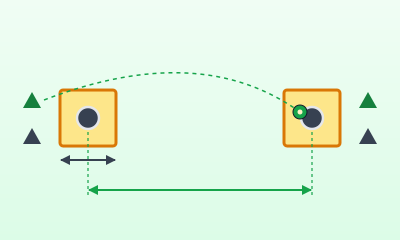
Figure: A box-style washers setup from above. The green arrow is the distance between cup centers: about 20 ft (6.1 m) in the box style described on Wikipedia, and 25 ft (7.62 m) under the IAWP rules. In doubles, teammates stand at opposite ends.
Equipment & setup
Everything you need is in a hardware store, and building your own set is half the fun.
- Washers — about two per player (or team), all the same size and weight. The IAWP recommends steel washers 2.5 in (6.4 cm) across with a 1 in (2.5 cm) hole, weighing about 4 oz (113 g), painted in bright colors so each side can tell them apart
- Cups — the target. The IAWP cup is 4 in (10 cm) across and about 5 in (13 cm) deep. A 32 oz tin can works, but thick-walled white PVC lasts longer because it does not dent
- Boxes or pits — box-style sets put the cup in the middle of a wooden box. The IAWP style sinks the cup into the ground inside a timber-framed "pit" of soil
- Something to measure with — a tape or a string tied between the boxes. Without one, Wikipedia says 10 paces is roughly 20 ft
Washers game dimensions and distance between boxes
With no single rulebook, here are the two setups most often described. Pick one before the first throw.
| Item | Box style (as described on Wikipedia) | In-ground pit style (IAWP rules) |
|---|---|---|
| Distance between targets | About 20 ft (6.1 m) between boxes | 25 ft (7.62 m) from cup center to cup center |
| Box or pit | 16 by 16 in, 4 in high (41 by 41 cm, 10 cm high) | A frame about 5 by 3 ft (1.5 by 0.9 m) filled with soil |
| Cup | 4-1/2 in (11.4 cm) across, 5 in (12.7 cm) high | 4 in (10 cm) across, about 5 in (13 cm) deep |
| Cup position | Center of the box top | 31 in (79 cm) from the front of the pit, set toward the far end to leave room for sliders |
| Washers | Often about 2 in (5 cm) across and 1/8 in (3 mm) thick | 2.5 in (6.4 cm) across, 1 in hole, about 4 oz (113 g) |
| Scoring | Cup 3 points, on the box 1 point | Cup 5 points, closest washer 1 point |
| Winning | 21 points | 21 points (ends early at 11-0 or 17-1; from 20, win by 2) |
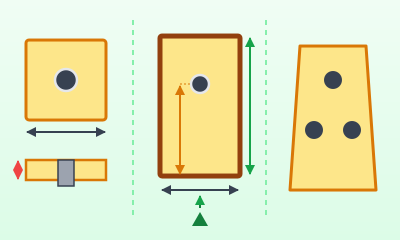
Figure: Left, the box style (dark gray is the 16 in width, red the 4 in height). Center, the IAWP pit (green is the roughly 5 ft length, dark gray the roughly 3 ft width, orange the 31 in from the front edge to the cup). Right, a three-hole board, whose size and scoring vary by set.
Washers vs horseshoes vs cornhole
| Washers | Horseshoes | Cornhole | |
|---|---|---|---|
| What you throw | Metal washers | Steel horseshoes (up to 1.19 kg) | Fabric bean bags (about 450 g) |
| Target | A cup in a box or in the ground | A steel stake | An angled board with a hole |
| Distance | About 20 to 25 ft (by setup) | 40 ft (12.19 m) stake to stake | 27 ft (8.23 m) board front to board front |
| Standard rules | None | NHPA official rules | ACL and ACO official rules |
Players & ages
| Format | Players | Where players stand |
|---|---|---|
| Singles | 2 | Throw from the same end in turn, then throw back from the other end |
| Doubles | 4 | Teammates stand at opposite ends and throw against the opponent at their end (IAWP) |
| Three or more, every player for themselves | 3+ | Under IAWP rules everyone throws in turn, and only one player scores per round |
- The IAWP points out that the game needs very little strength, which makes it a good fit for people with physical limitations or hearing and vision impairments as well as for any age
- In the 2004 article, a mother who played with her sons, 10 and 5, said it is hard to find something that appeals to all age groups
Rules
Since there is no single rulebook, start with the minimal rules and layer on the IAWP details once everyone is comfortable.
How a round works (minimal rules)
- Set the two targets 20 to 25 ft (6 to 7.6 m) apart. Move them closer for kids
- Agree on the setup and the winning score (21 is usual)
- Each player takes two washers and, from the same end, pitches them underhand, one at a time, at the far target. Under IAWP rules the first player throws both washers before the next player throws
- When everyone has thrown, count the round. A washer in the cup is worth the most; after that, washers on the box, or closest to the cup, score
- Cancellation: matching scores cancel out, and only the side that comes out ahead scores
- Whoever scored throws first next round, back from the other end
Standard rules (adding skill)
The IAWP rules (in-ground pit style) add:
- The diddle — to decide the order, each player throws one washer; in the cup or closest goes first. After that, the player who scored last throws first
- Scoring — a washer in the cup (a "cupper") is worth 5 points. The single washer closest to the cup, if not in it, scores 1. Washers completely outside the pit cannot score. Only one player scores per round
- Capping — landing your own washer in the cup on top of an opponent's cupper cancels it, and the round is decided by the remaining washers. If the opponent has two cuppers and you cap only one, they still score 5
- Knock-ons — if you hit an opponent's washer and push it closer to the cup than yours, the opponent benefits
- Where to stand — anywhere inside a framed pit. Without a frame, no closer than one normal step in front of the cup
- Ending the game — 11-0 is a "skunk" and 17-1 a "whitewash," and either ends the game. Otherwise the first to 21 wins, but a player who reaches 20 first is "at add," throws last, and must win by at least 2
Official competition rules
Washers has no single official rulebook or national governing body. The IAWP calls its rules official and says distances other than 25 ft between cups are not certified for official competition, but other events are not bound by them. Before a tournament, ask the organizer which setup and scoring they use.
Scoring examples
- Example 1 (box style, cup 3, box 1) — A lands one in the cup (3) and one on the box (1) for 4. B has one on the box (1) and one on the ground (0). After cancellation, A scores 3
- Example 2 (IAWP) — B caps A's cupper, so A's cupper is cancelled. Of the remaining washers, B's is closest to the cup, so B scores 1
- Example 3 (IAWP) — A has two cuppers and B has one. B can cancel only one of them, so A scores 5
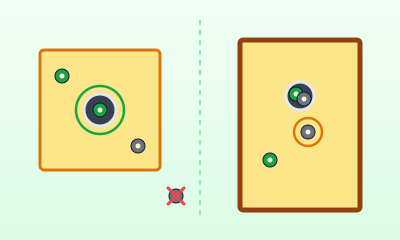
Figure: Left, example 1 (A 4, B 1, so A scores 3). The red X marks a washer that does not count. Right, example 2: the two washers in the cup cancel, and the gray washer circled in orange scores 1.
Common fouls and tricky calls
- Hangers — a washer hanging over the lip of the cup but not in it (an IAWP term). It is not a cupper, so it competes on distance like any other washer
- Ties for closest — under IAWP rules, if the two closest washers are the same distance from the cup, nobody scores and the round is re-thrown in the same order
- The throw — the IAWP glossary says throws are always underhand
- Mixed-up house rules — cup values (3 or 5), box points, and three-hole scoring all differ from set to set. Settle them before you start
Tips for enjoying the game
Common beginner mistakes
- Letting the washer flip — the IAWP suggests resting the washer on your middle finger, curling the index finger around the edge, and placing your thumb on top, so it rolls off the index finger and flies roughly parallel to the ground. Washers that tumble end over end rarely stay put
- Ignoring the ground — on a dry pit, washers slide, so land them flat just in front of the cup. When the ground is damp, throw higher and go straight for the cup
- Not grooming the pit — if the lip of the cup sticks up, sliders hit it and stop. Smooth the soil around the cup every round
Ways to play
- Shorter games — play to 11 or 15 to keep things moving when a crowd is waiting
- Double washers — throw both washers at once (an IAWP variation)
- Wrong hand — righties throw left-handed and lefties right-handed (another IAWP variation)
- Three-hole boards — score each hole differently, following the set's instructions
Running a game (numbers, referee, venue, rain, safety)
- A big group — play two-on-two and rotate: the losing team sits out and the next team comes in, so everyone gets about the same number of throws
- A referee — name one person to measure close calls and hand them the tape measure
- Venue — choose flat grass with open space behind the targets. Washers are small and vanish in long grass, so the IAWP's advice to paint them bright colors pays off
- After rain — wet ground stops slides, so switch to a higher throw aimed straight at the cup
- Safety — washers are metal. Make sure nobody is in the throwing line or behind the target, keep waiting players beside or behind the thrower, and have an adult manage the turn order when small children play
Playing Washers in Japan
- Large flat washers are sold in the hardware aisle of Japanese home centers. Buy one size and grade so every washer matches in weight
- For cups, cut short lengths of PVC pipe about 10 cm across inside. Build boxes from boards, or simply sink the cups into the ground
- Some Japanese parks restrict throwing games or digging holes. Check with the park office, or play at a campground or in a garden where it is allowed
Frequently asked questions
Q. How far apart are the boxes in washers?
There is no fixed distance, but 20 ft (6.1 m) to 25 ft (7.62 m) is typical. Wikipedia describes boxes placed about 20 ft apart, and the IAWP rules put the cups 25 ft apart, center to center.
Q. What score wins a game of washers?
Most games go to 21. Under IAWP rules a game also ends at 11-0 or 17-1, and a player who reaches 20 first must win by 2.
Q. What size washers do you use?
The IAWP recommends steel washers 2.5 in (6.4 cm) across with a 1 in hole, weighing about 4 oz (113 g). For backyard play, the most important thing is that every washer is the same size and weight.
Q. How many people can play?
Washers is usually one on one or two on two. The IAWP rules also allow three or more players each playing for themselves, with only one player scoring per round.
Learn more
- International Association of Washer Players (IAWP): Game Rules — in-ground pit rules (25 ft, cup worth 5)
- IAWP: Equipment — washer, cup, and pit sizes
- IAWP: Terms — cupper, cap, hanger, and other terms
- Lawrence Journal-World: "Washers gaining popularity as 'poor-man's horseshoes'" (August 13, 2004) — setups and origin stories
- Washer pitching on Wikipedia — box-style dimensions and scoring
- Related: Horseshoes, Cornhole, Ladder Golf, and Wanage, fellow target-tossing games
Share this page