Wanage: Japanese Ring Toss Game Rules & Scoring
- Region:
- Japan
- Tags:
- From Japan, Throwing, Family-friendly, Seniors, Party
At a glance
- Players
- 1–8 players
- Game length
- 9 rings per player; international rules allow 1 minute for all 9
- Equipment
- A 9-peg board (60 cm square) and 9 rings per player
- Space
- Throw line 2 m (Japan Wanage Association) or 5 m (international, adults)
Contents (8)
What is this game?
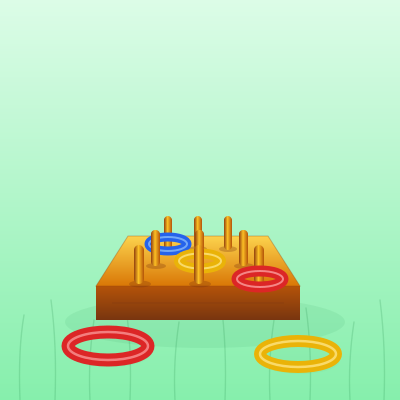
Wanage (literally "ring throwing") is Japan's classic ring-toss game:
you throw rings and try to loop them over numbered pegs.
It's a fixture of summer festival (ennichi) stalls, school and community field days,
and, above all, recreation and rehabilitation programmes at senior centres,
enjoyed across every generation.
The idea couldn't be simpler. Stand behind a line, toss your rings at a board studded with numbered pegs, and add up the numbers on the pegs your rings land on. Because aim and control matter far more than strength, kids, adults, and seniors can all compete on equal terms, even seated, which is exactly why it has stayed popular for so long.
Its origins are debated. One account traces it to a game played in Europe around 200 BC, tossing horseshoes at a stake (the ancestor of horseshoes).
Deck quoits, in which sailors threw rope rings at a target on a ship's deck, is also said to be one of its forerunners.
In Japan, shortly after the Second World War, a competitive version was devised under the guidance of Taizo Aoki, with the peg numbers arranged as a magic square so that any three in a row, column or diagonal add up to 15.
The Japan Wanage Association (Nihon Wanage Kyokai) was founded in 1967, and its rules were revised in 2002 to make the game more competitive.
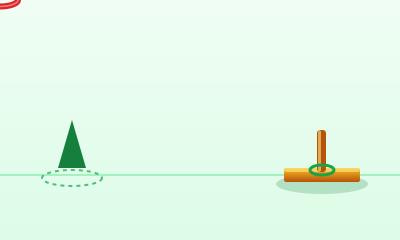
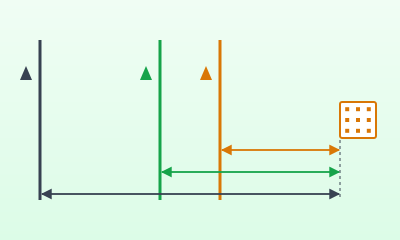
Figure: Throwing distances by association. Distances and board size are drawn to scale. Each coloured triangle is a thrower standing behind the line of the same colour.
Equipment & setup
Wanage needs very little gear, and setup takes almost no time. All you really need are the board with its pegs, a handful of rings, and a few metres of flat ground.
- The board: a stand holding nine numbered pegs. Competition boards are 60 cm square, with the nine pegs in a 3×3 grid
- Rings: nine per player is standard. They are made of rubber or plastic and come in colours such as red, yellow and blue; how many of each colour you get depends on the association
- Pegs: the target posts on the board, all the same shape. Each peg's value (1 to 9) is written at its base or on the board
- Throw line: a marker for where you throw from, set a fixed distance from the board. Rope, tape or chalk all work
- Ground: grass, dirt, a gym floor or an indoor floor all work, as long as the board sits level. A park or an indoor room is equally fine
Home sets are easy to find in toy shops and online, and they're plenty to begin with. You can also make your own, with a board from cardboard or plastic bottles and rings from rolled newspaper, which is part of wanage's charm. Just pick a flat, roomy spot where a stray ring won't hit anyone.
Court and equipment dimensions
There is no single international standard for wanage: each association sets its own equipment and throwing distance. The table compares the three sets of rules we could confirm. The Japan Wanage Association figures come from a sports guide published by Anjo City in Aichi Prefecture, the International Wanage Association figures from an article introducing its official rules, and the Japan Recreation Association figures from its own games page.
| Item | Japan Wanage Association | International Wanage Association | Japan Recreation Association guide |
|---|---|---|---|
| Board | 60 × 60 cm white wooden board | 60 cm square | 60 × 60 cm |
| Pegs | 9, every line of three sums to 15 | 9 (top 2, 9, 4 / middle 7, 5, 3 / bottom 6, 1, 8) | 9, 18 cm tall |
| Rings | Special rubber, 16.5 cm outer (±1 mm), 13.5 cm inner (±1 mm) | Resin, 19 cm outer, 15 cm inner, 110 g | Rubber, 17 cm across, 150 g |
| Rings and colours | 9 (4 red, 4 yellow, 1 blue) | 9 (3 each of red, yellow and blue) | 9 |
| Throwing distance | 2 m (may be changed by agreement) | 5 m for adults, 3 m for juniors aged 12 and under | Not stated |
| Time limit | Not stated | All 9 rings within 1 minute | Not stated |
For family play, start about 1.5 to 2 m from the board and step back as everyone improves.
Players & ages
| Format | Players | Rings each |
|---|---|---|
| Solo throw (one at a time) | 1 or more | 9 |
| Alternating throw (head-to-head) | 2 | 4 each plus 1 anchor ring |
| Teams | 2 to 4 teams | Split by colour |
Everyone from small children to seniors in wheelchairs can play by the same rules. You can throw sitting down, and physical differences barely matter; that's the beauty of wanage. Some associations, such as the International Wanage Association, shorten the distance for children aged 12 and under.
Rules
Wanage is all about looping rings over numbered pegs and totalling the points. Learn the minimal rules and the scoring below, and you can play the same afternoon.
How a round works (minimal rules)
- Set the board on level ground and draw a throw line a fixed distance away (2 m under the Japan Wanage Association's official rules)
- Decide the order (rock-paper-scissors works)
- The first player stands (or sits) behind the line and throws the rings one at a time, aiming to loop each over a peg. A ring thrown while stepping on or over the line doesn't count
- Once all your rings (nine is standard) are thrown, score your turn: add up the numbers on the pegs your rings landed on
- Rings that miss, or that slip back off a peg, score zero
- Play passes to the next player or team, and everyone throws the same way
- The highest total wins. Decide it in a single round, or add up several rounds
At first, just get a feel for looping rings on. Once that clicks, the tactics of hunting high-value pegs make it far more fun.
Standard rules (adding skill)
- The throw: the Japan Wanage Association describes two styles. The side flip keeps the ring parallel to the ground and throws it sidearm; it's harder to control but bounces less, so it suits short distances. The centre flip is an underarm swing straight at the middle of the board; once mastered it's more accurate, but the ring bounces more
- The number board (magic square): on a competition board the nine peg values are arranged so that any line of three, row, column or diagonal, sums to 15 (for example, top 2, 9, 4 / middle 7, 5, 3 / bottom 6, 1, 8)
- Completing a line: if all three pegs in any row, column or diagonal carry a ring, that line counts as 30 points, double its usual 15 (Japan Wanage Association and International Wanage Association)
- Perfect: a ring on every one of the nine pegs scores 300 points. In the endgame, choosing which line to complete is the key skill
- Extra throws: in the rules introduced by the Japan Recreation Association, four rings on the same peg earn one extra throw, and each further ring on that peg earns one more
Official competition rules
The Japan Wanage Association has two competition formats.
- Solo throw: throw all nine rings (4 red, 4 yellow, 1 blue) in a row and compare totals. It suits the qualifying rounds of large events. After you've thrown, the next player works out your score
- Alternating throw: a head-to-head format. The winner of rock-paper-scissors goes first with 4 red rings, the loser second with 4 yellow rings, and they throw one at a time. After four rings each, the player with the lower score earns the right to throw the blue anchor ring; if the scores are level, no anchor ring is thrown. A match is three sets and the player who wins two or more takes it. If that's level, total points decide, and if those are level too, the players throw one ring each until someone wins
Under the International Wanage Association's official rules, players throw nine resin rings within one minute from 5 m (3 m for juniors). Check the rules of whichever event or club you join.
Scoring examples
Example 1: a completed line. Rings land on all three pegs of the middle row (7, 5 and 3), plus one on the 9 in the top middle. The middle row counts as 30, and adding the 9 gives 39 points.
Example 2: a perfect. One ring on each of the nine pegs scores 300 points, not the 45 you'd get by adding up the numbers.
Example 3: a set of alternating throw. The first player scores 14 with four rings, the second only 9. The second player, being behind, throws the anchor ring; landing it on the 8 makes 17, and the set is won. Had the scores been level after four rings each, no anchor ring would be thrown.
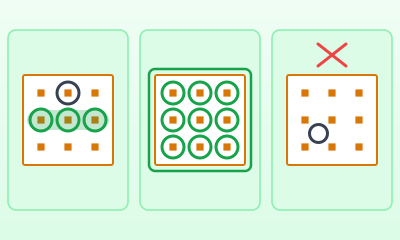
Figure: How scoring works. Left is a completed line, centre a perfect, and right a ring resting on the board without looping a peg. The peg numbers follow the layout in the text (top 2, 9, 4 / middle 7, 5, 3 / bottom 6, 1, 8).
Common fouls and tricky calls
These follow the Japan Wanage Association's solo-throw rules.
- Stepping on or over the line: a ring thrown while stepping on or over the throw line is void and removed
- Feet off the ground: both feet must be on the ground when you throw, so a jumping throw is void
- Two-handed throws: you may hold the ring however you like, but you must throw it with one hand
- Rings knocked off by a void ring: if a void ring knocks off a ring that was already on a peg, the knocked-off ring is put back on its peg
- Rings that bounce up from the floor: a ring that hits the floor and then ends up on the board is removed each time
- A ring on the board that later drops on: a ring lying on the board without looping a peg counts if later play knocks it onto a peg
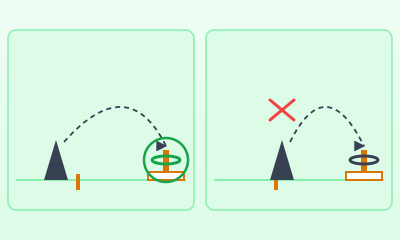
Figure: A foot fault. A ring thrown from over the line is void even if it loops a peg.
Tips for enjoying the game
Common beginner mistakes
- Don't throw hard. You're looping a ring on, not firing it. A fast throw just bounces off; a soft, high lob is the way
- Don't throw the ring on edge. A ring flying vertically slips past the peg. Keep it flat and drop it on
- Repeat one form. With the distance and height fixed, only small left-right tweaks remain, and a consistent form keeps your aim steady
How to make it more fun
- Call your target first: shouting "going for the 9!" before you throw makes a landing far more satisfying
- Split the colours: assign red, yellow and blue to people or teams so you can see at a glance whose ring landed
- Chase lines: aiming for a 30-point line adds strategy on top of simple high scoring
- Festival flavour: "a prize over X points" stall-style rules are a hit at parties and events
Age variations
- Kids: move the line to about 1 m and use bigger rings; clap for every landing
- Seniors: play seated or from a wheelchair. Adding up the scores is part of the fun, and it's a staple of rehab recreation
- Family: handicap by distance, adults farther back and kids closer, so everyone stays in the running
- Competitive: use an official board, distance and time limit, and score lines and perfects precisely
Playing wanage in Japan
- Easy to find: home sets are sold in toy shops and online, from floor-standing boards to tabletop versions
- Fine indoors: rubber rings are light and quiet, so you can play in a flat or a gym; a good rainy-day game
- Make your own: build a board from cardboard or bottles and rings from rolled newspaper or hose offcuts; it doubles as a craft activity
- Associations and events: the Japan Wanage Association, based in Osaka, publishes official rules and a handbook, and local governments feature it among their "new sports"
- Kobe's torin: Hyogo Prefecture also has a federation for
torin, a ring-throwing sport said to have been enjoyed on board by sailors of foreign ships calling at the port of Kobe. Its board is 71 cm by 61 cm, the rubber rings are 19.5 cm across and weigh 180 g, and players throw from 8.5 m, a far more serious test than everyday wanage
Frequently asked questions
Q. How far away should you throw from?
There is no worldwide standard distance. The Japan Wanage Association's official distance is 2 m, while the International Wanage Association uses 5 m for adults and 3 m for juniors aged 12 and under. For family play, start at about 1.5 to 2 m and move back as you improve.
Q. What's the highest possible score?
The pegs add up to 45, but under the Japan Wanage Association and International Wanage Association rules a ring on all nine pegs is a "perfect" worth 300 points. A completed line of three counts as 30.
Q. What age can children start?
There's no age limit. If a child can hold a ring and throw it, they can play. With a shorter distance and light rings, small children and seated seniors can play by the same rules.
Q. Can you play on grass?
Yes. Choose a spot as level as possible so the board doesn't tilt. Grass stops rings from bouncing much, which makes it good for outdoor play. On windy days light plastic rings get blown about, so shorten the distance.
Q. How do I make a homemade set?
For the board, stand cardboard tubes or plastic bottles in a 3×3 grid on a cardboard box. For rings, roll newspaper into a tube and tape it into a loop. Number the pegs as a magic square and you can play for lines as well.
Learn more
- Japan Wanage Association: equipment and competition formats (in Japanese)
- Anjo City sports guide to wanage (PDF, in Japanese): Japan Wanage Association equipment and formats
- Introduction to the International Wanage Association's official rules (in Japanese)
- Japan Recreation Association: wanage 9 and Q (in Japanese)
- Radio Kansai feature on competitive ring throwing in Kobe (in Japanese)
- Related: Ladder Golf, Cornhole, and Pétanque
Share this page