Cornhole 101 — America's Favorite Backyard Bean Bag Toss Game
- Players:
- 2–4 players
- Region:
- USA
- Tags:
- Small group, Throwing, North America, Family-friendly, Party, Youth
What is this game?
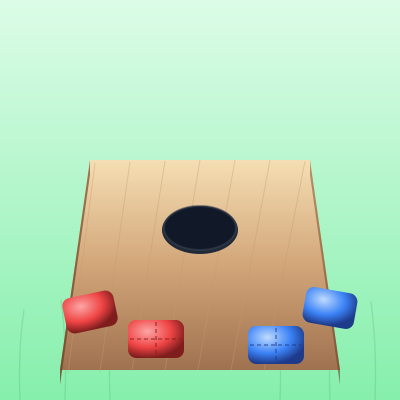
Cornhole (also called bean bag toss) is an outdoor game where two teams of two players take turns tossing fabric bags filled with corn kernels at an angled wooden board with a 15 cm hole in it.
The game's origins are debated across US states, but it exploded in popularity in the late 20th century as the go-to game for BBQs, tailgates, and camping. Today the American Cornhole League (ACL) runs a professional circuit with cash tournaments and ranked players.
The appeal: genuinely simple rules, compact setup, any surface works, and it scales from age 5 to 95.
Equipment & setup
Cornhole needs very little gear, and setup takes almost no time. All you really need are two boards, eight bean bags, and a flat strip long enough to set the boards 27 feet apart.
- Boards — a matching pair of angled wooden platforms. Regulation size is 4 ft (~122 cm) long by 2 ft (~61 cm) wide, tilted so the back edge sits about 30 cm high and the front edge rests near the ground
- The hole — a 6-inch (~15 cm) circle cut into the upper middle of each board, its center 9 inches (~23 cm) from the top edge
- Bean bags — 4 per team, 8 in all. Each is a ~6-inch (~15 cm) square fabric bag weighing about 16 oz (~450 g), filled with corn kernels or resin pellets. The two teams use different colors (red vs. blue, etc.)
- Something to measure with — set the boards 27 ft (~8.2 m) apart, front edge to front edge. A tape measure or a few paced steps keeps placement honest
- Surface — grass, dirt, sand, or a paved lot all work, as long as the boards sit flat and steady
Foldable regulation-size sets cost about $50–150, but for casual play a cheap mini set — or a DIY plywood build — is more than enough. Boards take up more room than you'd think, so folding legs or a carry handle help with storage and transport. Pick a spot with enough open space that a wayward bag on the long throw won't hit anyone or anything.
Players & ages
- 2 vs 2 (doubles) is standard; 1 vs 1 singles also works
- Kids from ~5 (shorter throw distance), through seniors — pure aim game
Rules
Cornhole is all about landing more of your bags on the board — and through the hole — than your opponent does. Learn the minimal rules below and you can play the same afternoon.
How a round works (minimal rules)
- Set the two boards facing each other, 27 ft (~8.2 m) apart from front edge to front edge
- Decide who throws first (a coin toss works); each team takes 4 bags of its color
- Opponents stand beside (or behind) their own board and toss at the far board
- Players alternate throws, one bag at a time — the rhythm keeps things moving
- Per-bag scoring:
- In the hole (a "cornhole"): 3 points
- On the board and staying there (a "boarder"): 1 point
- On the ground, or slid off the board: 0 points
- Cancellation scoring: once all 8 bags are thrown, the two teams' points for that round (an "inning") cancel out, and only the higher side scores the difference
- e.g., A=7, B=4 → A adds 3 points (B gets nothing)
- That is one round. Keep playing rounds until a team reaches 21 points and wins
At first, just focus on getting bags onto the board or into the hole. Once that feels natural, add the techniques below.
Standard rules (adding skill)
- The throw — don't fire it hard; float a soft arc and keep the bag flat so it slides toward the hole on landing
- Push shots vs. airmail — a "push" (slide shot) parks a bag short so a later throw shoves it in, while an "airmail" drops straight into the hole. Knocking an opponent's boarder off the board is a legal tactic too
- Mind the foul line — don't step past the front edge of your board as you release the bag
- Later slides count — a bag that starts on the board and gets pushed in by a later throw still scores 3. "Bag-in-bag" (using one bag to shove a lying bag into the hole) is a legal play
- Doubles formation — in 2v2, teammates split to opposite boards and take turns throwing, which opens up real strategy
Official competition rules
The American Cornhole League (ACL) and American Cornhole Organization (ACO) set the official standards: board spacing (27 ft), board size (4 × 2 ft), hole diameter (6 in), bag specs (6-inch square, ~16 oz, corn- or resin-filled), and cancellation scoring. Sanctioned events offer prize money in pro divisions, and top ranked players compete professionally.
Tips for enjoying the game
Common beginner mistakes
- Throwing too hard — cornhole rewards a soft arc, not velocity. Float it
- Ignoring the hole — aim for the hole always; board points come naturally
- Not tracking live scores — know the current differential before each throw
How to make it more fun
- Pair with BBQ or drinks for peak American tailgate energy
- Doubles rivalry: each pair cancels the other's points — reading the math is half the game
- Custom-painted boards are a US tradition — personalize yours
- LED-lit boards for nighttime play are wildly popular
Age variations
- Kids: 4 m distance, tilt boards slightly lower
- Seniors: 5–6 m is plenty. Bags are light; no strain needed
- Competitive: ACL-regulation setup, strict cancellation scoring
Playing Cornhole in Japan
- Search "cornhole" or "bean bag toss" on Amazon.co.jp or Rakuten
- Campgrounds, parks, and riverside lawns are ideal
- Increasingly seen at outdoor festivals and events
Learn more
- American Cornhole League (ACL) — official rules and pro events
- Related: see also Horseshoes, Kubb, and Ladder Golf — fellow backyard toss games