Lawn Darts (Jarts): How to Play, Scoring & Why They Were Banned
- Region:
- United States
- Tags:
- North America, Throwing, Family-friendly, 1v1, Small group
At a glance
- Players
- 2–4 players
- Equipment
- Rounded-tip safe darts (2 per team, 2 colors) and a target ring
- Space
- Rings about 35 ft (10.7 m) apart, on grass or soft ground
Contents (8)
What is this game?
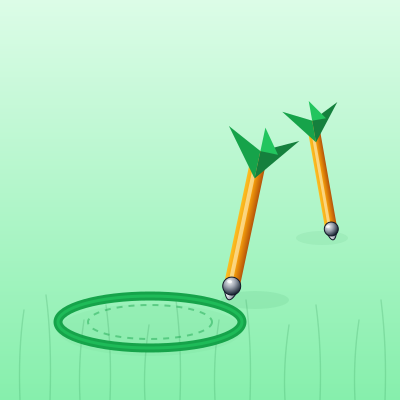
Lawn darts (also sold under the brand name Jarts) is a long-standing American backyard game. Players lob large darts, about 30 cm (12 in) long with a weighted tip and tail fins, underhand in a high arc so they land point-first inside a target ring resting on the ground, scoring points for accuracy.
The scoring and layout closely resemble horseshoes: one on one or two against two, players take turns throwing. Because control matters far more than strength, adults and kids can compete on equal footing.
But this game carries an important safety history. The old darts with long, pointed tips caused serious injuries, including skull punctures in children, and deaths. Their sale was banned in the United States in 1988, and Canada followed in 1989. Today you should only use the rounded-tip "safe" version. This article describes that modern, safe version throughout.
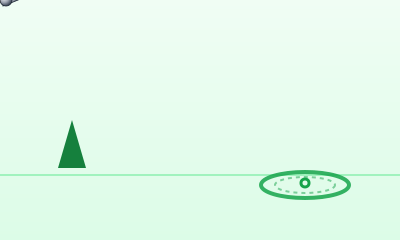
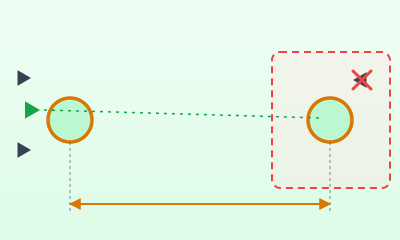
Figure: Two rings set apart, throwing from one to the other. Nobody enters the red dashed landing zone while darts are in the air. Ring size is only indicative and the drawing is not to scale.
Why lawn darts were banned: a timeline
The old pointed darts were not banned overnight. Sales to children were restricted first, and only when injuries kept happening was the product itself taken off the market. Dates come from the US Consumer Product Safety Commission (CPSC).
| Year | What happened |
|---|---|
| 1970 | The Food and Drug Administration (FDA) bars sales in toy stores and toy departments and requires warning labels; lawn darts may be sold only to adults as a game of skill |
| 1978–1986 | An estimated 6,100 injuries treated in emergency rooms; 81% of the victims under 15 and 50% under 10 |
| May 25, 1988 | The CPSC votes to propose a ban. By then it knew of three deaths, children aged 4, 7, and 13 |
| October 28, 1988 | The CPSC votes the final ban |
| December 1988 | The ban takes effect (16 CFR part 1306) |
| 1989 | Canada bans the manufacture, import, and sale of lawn darts with elongated tips |
In its 1988 announcement, the CPSC noted that despite the 1970 rules, lawn darts were still being sold in sporting goods stores, where unsuspecting parents bought them for their children.
Equipment & setup
Lawn darts needs little gear and almost no setup: a few darts, a target ring, and a large, flat, clear patch of ground. Before you play, read the safety note below.
Most important safety note — The old lawn darts with long, pointed tips (Jarts) repeatedly caused severe injuries, including punctured skulls in children, and were banned from sale in the United States in 1988 (Canada followed in 1989). If you play today, use only the rounded-tip safe version. If you find a sharp-tipped set in a garage or attic, do not play with it; dispose of it. And with any version, the absolute rule is: never throw toward people, and never let anyone stand in the throwing area.
- Darts — a large dart with a weighted tip, a slim shaft, and fins at the tail (usually three). They are typically about 30 cm (12 in) long. A set is usually 2 darts per team in 2 colors (4 total). Always choose the rounded-tip safe version
- Target ring — the ring you place on the ground. There is no standard size, and it varies by product. No ring in the box? A hula hoop, a loop of rope, or a chalk circle works
- Ground — grass or soft earth is ideal. Avoid concrete or asphalt, where darts can bounce dangerously
- Throw line (optional) — mark where players stand with tape or rope for fair play
- Plenty of space — because darts fly in a high arc, leave room overhead and around the landing area, and keep kids and pets well clear of the throwing direction
Start by lobbing at a single ring to get a feel for the arc, then add a second ring and throw back and forth between them, horseshoes-style.
Court and equipment dimensions
No governing body sets official dimensions for lawn darts. The table below lists typical values described in sources such as the English Wikipedia article, plus what US and Canadian regulations say.
| Item | Typical value / rule | Notes |
|---|---|---|
| Distance between rings | About 35 ft (10.7 m) | A common guideline, not an official standard. Shorten it for kids and beginners |
| Target ring size | No standard | Varies by product |
| Dart length | About 12 in (30 cm) | Weighted tip, usually three fins at the tail |
| Number of darts | 2 per team, 2 colors | Each side throws 2 per round |
| US regulation | Sale banned for outdoor darts with elongated tips designed to hit the ground tip-first | Federal rule 16 CFR part 1306, in effect from December 1988 |
| Canadian regulation | Lawn darts with elongated tips may not be manufactured, imported, advertised, or sold | Banned in 1989. Applies to second-hand sales too |
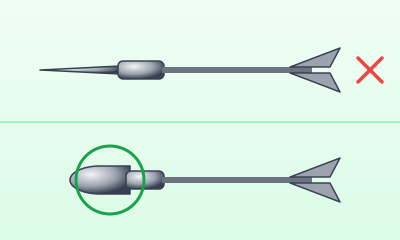
Figure: Top, with the red X, the elongated-tip type banned in the US and Canada. Bottom, with the green ring, the rounded-tip safe version.
Players & ages
| Format | Players | Darts each | How it runs |
|---|---|---|---|
| Singles | 1 vs 1 | 2 | Take turns from the same end |
| Doubles | 2 vs 2 | 2 | Alternate with your teammate; with two rings you can split between the ends |
Even with the safe version, the guideline is that players should be old enough to control the strength and direction of their throw. In the US, most people injured by lawn darts were children under 15. When younger kids join, an adult must supervise and manage the throwing area at all times.
Rules
Lawn darts is a simple target game: lob a large dart underhand in a high arc and land it in the ring on the ground. The scoring is much like horseshoes. Learn the minimal rules below and you can play the same afternoon.
How a round works (minimal rules)
- Place one target ring on flat, soft ground. For a fuller game, set out two rings about 35 ft (10.7 m) apart and throw between them
- Stand at the throwing spot and decide who goes first
- The first player lobs a dart underhand in a high arc. Never throw overhand or hard and flat; that is dangerous
- The dart turns point-down as it descends and lands tip-first. Landing inside the ring is the goal
- Throw the second dart, then the other player (or team) throws their two
- When everyone has thrown, count the score (see below)
- That's one round. Play more rounds until a team reaches 21 points and wins
At first, just focus on a soft, high lob aimed at the ring. The scoring tactics get fun once that feels natural.
Standard rules (adding skill)
A widely described way to score (horseshoes-style):
- Inside the ring (a "ringer") — 3 points per dart. If the opponent also lands ringers, they cancel out one for one
- Outside the ring but closer than any of the opponent's darts — 1 point for that dart
- Who throws first next round — some players let the side that scored more in the previous round throw first
Some people count only ringers, and some add only the difference between the two sides. Agree on which version you're using before you start.
Technique tips:
- The throw — always underhand, with a high, lofted arc. The more cleanly it drops from the top, the more the tip points straight down and settles in the ring
- Judging distance — with a lofted throw, range is set by your release angle more than by power. Keep the same motion and tweak the angle
- Consistency — repeat your stance, foot position, and arm swing to keep your landings predictable
Official competition rules
There does not appear to be any governing body that sets unified rules or dimensions for lawn darts. Rules vary between product instructions and regions, and the horseshoes-style version above (3 for a ringer, 1 for the closest dart, first to 21) is the most widely described. Some players require exactly 21 and void (or subtract) a round that overshoots, and some play on until one side leads by 2.
Above all, darts with elongated tips are banned from sale in the US and Canada, so whatever rules you play by, using the safe version is the modern baseline.
Scoring examples
These examples use the standard rules above (3 per ringer with cancellation, 1 for the closest dart).
- Example 1 — A lands one ringer and one dart well outside. B has no ringers; both B darts are outside, but one is closer to the ring than A's outside dart. A scores 3 and B scores 1. If you only add the difference, A scores 2
- Example 2 — A and B each land one ringer, and the two 3-pointers cancel. Of the remaining darts, A's is closest to the ring, so A scores 1 and nobody else scores
- Example 3 (playing to exactly 21) — A has 19 and lands a ringer for 3, which would make 22 and overshoot. Under this variant the round's points don't count, and A starts the next round still on 19
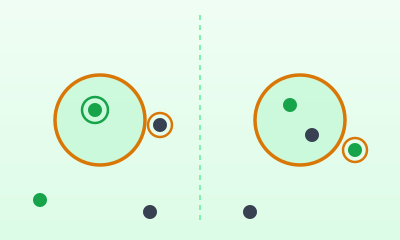
Figure: Example 1 on the left (A's ringer scores 3, B's closest dart scores 1). Example 2 on the right (the ringers cancel, and A's closest dart scores 1). A green ring marks a scoring ringer; a small orange ring marks the closest dart.
Common fouls and tricky calls
With no unified rulebook, settle these before you start to avoid arguments.
- A dart on the ring line — does it count as in or out? Judging by where the tip touches the ground is the simplest method
- A dart that lands flat instead of sticking — decide whether to judge where the tip first stopped or where the dart ended up
- Knocking an opponent's dart — moved darts are usually scored where they finally lie after everyone has thrown
- Illegal throws — overhand or hard, flat throws are dangerous; ban them and void that dart
- Stepping over the line — once you mark a throw line, a dart thrown while stepping over it doesn't count
- Entering the landing area early — nobody goes near the ring until everyone has thrown. This is less a foul than an absolute safety rule
Tips for enjoying the game
Safety first, always
- Never throw toward people. Every time, confirm no one, and no pet, is in the throwing direction, around the landing area, or overhead
- Use only the safe version. Don't use, lend, or let anyone play with the old pointed darts; if you find a set, dispose of it. Precisely because they were once sold openly, adults need to enforce this
- Take turns. While someone is throwing, no one goes near the ring or darts. Collect them only after everyone has thrown
- Stay careful when collecting. Before throwing back from the other ring, call out and make sure the other player has returned
Common beginner mistakes
- Throwing too hard. A hard, flat throw keeps the tip from pointing down, so it won't settle in the ring. A soft, high loft works better
- Using power to fix distance. Adjust range with angle, not strength
- Poor ground choice. Hard ground makes darts bounce dangerously; pick grass or soft soil
Tactics
- Use the first dart as a range-finder. If it lands short, throw the second with the same arc and just a touch more release angle
- Think about cancellation. When the opponent lands a ringer, answer with a ringer of your own, or at least go for the closest dart
How to make it more fun
- Set out two rings some distance apart and throw between them to cut waiting time and keep a good rhythm
- 21 points takes a while; try a shorter target like 11 for quick games
- True backyard style: relaxed rounds and conversation next to a BBQ or campsite
Playing lawn darts in Japan
- When buying, make sure it is the rounded, safe-tip version. Avoid importing old sets from overseas or accepting hand-me-downs
- Wide grassy areas such as parks or riverbanks are ideal. Because darts fly in a high arc, avoid crowded or cramped spots
- Some parks prohibit throwing objects like darts, so check the park's rules
- A hula hoop, a loop of rope, or a chalk circle can stand in for a target ring
- When playing with kids, an adult should manage the throwing area, and everyone but the thrower waits behind the line
Frequently asked questions
Q. Why were lawn darts banned?
Because darts with long, pointed tips repeatedly caused injuries in which children's skulls were punctured. According to the US Consumer Product Safety Commission (CPSC), an estimated 6,100 lawn dart injuries were treated in emergency rooms from 1978 to 1986, 81% of them in children under 15, and three children aged 4, 7, and 13 died. Pushed in part by a father whose 7-year-old daughter was killed in 1987, the CPSC voted to ban sales in 1988, and the ban took effect that December.
Q. Can you still play? What exactly is banned?
The US ban covers outdoor darts with elongated tips designed to hit the ground tip-first. The CPSC exempted darts without pointed tips that are not designed to stick in the ground and cannot cause puncture wounds. Play with the rounded-tip safe versions sold today. In Canada, lawn darts with elongated tips may not be manufactured, imported, advertised, or sold, and that includes second-hand sales.
Q. Are Jarts and lawn darts the same thing?
Yes. "Lawn darts" is the generic name, and "Jarts" is a brand name that became a common name for the game. People also call them yard darts or lawn jarts.
Q. When did lawn darts come out?
They were already on sale in the US by 1970, when the FDA restricted where they could be sold. The CPSC records do not give the year they first appeared. Pointed-tip lawn darts were sold until the ban took effect in December 1988.
Q. How far apart should the rings be?
There's no official standard, but about 35 ft (10.7 m) is the common guideline. Kids and beginners should shorten the distance and start from where they can reach the ring. Leave plenty of room around the landing area so nobody wanders in.
Q. What score wins?
The widely described rules play to 21. Some players require exactly 21 and void any round that overshoots. There's no unified rulebook, so decide before you start.
Q. How old do kids need to be to play?
There's no set age, but even with the safe version, players need to control the direction and strength of their throw and reliably follow "never throw toward people" and "don't approach until everyone has thrown." Most people hurt by lawn darts in the US were under 15. Kids should always play with an adult supervising.
Learn more
- CPSC: Lawn Darts — scope of the US ban (16 CFR part 1306)
- CPSC: CPSC Votes Lawn Dart Ban (1988) — background and injury data
- CPSC: CPSC Votes Final Ban On Lawn Darts (1988) — the final decision and effective date
- Health Canada: Industry Guide to Second-hand Products — products banned from manufacture, import, advertising, and sale in Canada, including second-hand
- Lawn darts on Wikipedia — history and how the game is played
- Related: Cornhole, Ladder Golf, Petanque, Molkky, and Kubb
Share this page