Petanque 101 — France's Beloved Lawn Game with Boules
- Players:
- 1–6 players
- Region:
- France
- Tags:
- 1v1, Small group, Throwing, Europe, Family-friendly
What is this game?
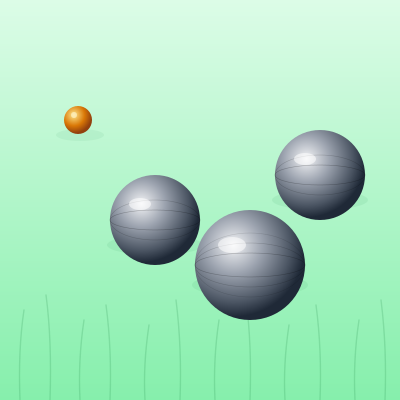
Petanque (pétanque) is a boules-style throwing game that originated in
Provence, France in the early 1900s. Players take turns tossing palm-sized
metal balls (boules) toward a small wooden target ball (cochonnet).
The team whose boule lands closest scores points.
The name comes from the Provençal phrase pieds tanqués ("feet planted"),
referring to the standing posture: both feet stay inside a small circle
during the throw.
Equipment & setup
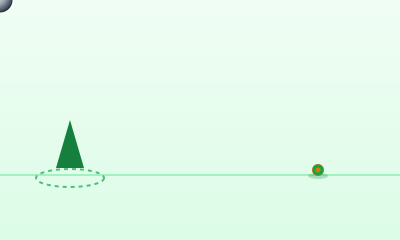
Petanque needs very little gear, and setup takes almost no time. All you really need are the balls, a target ball, and a few metres of flat ground.
- Boules — 3 per player is standard. Competition boules are metal, 70.5–80 mm in diameter and 650–800 g. The right size and weight depend on your hand and throwing style
- Cochonnet — the small wooden target ball, about 30 mm across (also called the "jack")
- Tape measure — for close calls; essential once the gap drops under 30 cm
- Something to mark the circle — chalk or a drop-down plastic throwing ring makes life easier
- Ground — grass, dirt, gravel, or sand all work. A flat strip about 12–15 m long and 3–4 m wide is plenty
A full metal set of three costs around $150, but for casual games on the lawn a plastic leisure set (from about $15) is more than enough. Start with light plastic boules to get a feel for the throw, then upgrade to metal once you're hooked. Pick a spot — a park lawn, an open field, or the beach — where balls can be thrown safely away from other people.
Players & ages
| Format | Players | Boules each |
|---|---|---|
| Singles (tête-à-tête) | 1 vs 1 | 3 |
| Doubles (doublette) | 2 vs 2 | 3 |
| Triples (triplette) | 3 vs 3 | 2 |
Anyone can play. Use lighter plastic boules for kids; full metal for adults.
Rules
Petanque is all about getting your boules closer to the cochonnet than your opponent does. Learn the minimal rules below and you can play the same afternoon.
How a round works (minimal rules)
- Choose the first team (a coin toss works) and draw a 35–50 cm throwing circle on the ground
- A player from that team stands with both feet inside the circle and throws the cochonnet 6–10 m away
- The same player throws their first boule, aiming to land it right next to the cochonnet
- The other team then throws
- From here on, the team whose nearest boule is farther away keeps throwing until they get closer; the leading team waits
- Once every boule has been thrown, count the score: the team with the closest boule scores one point for each of its boules that beats the opponent's best one
- That is one "end." Play more ends until a team reaches 13 points and wins
At first, just focus on landing close. Once that feels natural, add the techniques below.
Standard rules (adding skill)
- The throw — palm-down underhand is standard. A little backspin helps the boule stop instead of rolling away
- Pointing vs. shooting — "pointing" gently rolls a boule close, while "shooting" slams into an opponent's boule to knock it out of the way. A clean shot can swing the whole end
- Foot position — both feet stay on the ground inside the circle until your thrown boule lands. Stepping out is a foul
- Formations — in doubles (2v2) or triples (3v3), splitting into pointers and shooters makes play far more tactical
Official competition rules
The International Petanque Federation (FIPJP) sets exact figures: the throwing distance for the cochonnet (6–10 m), the size of the circle, how out-of-bounds boules and cochonnets are handled, and the precise measuring procedure. In Japan the JPBF runs official tournaments, and joining a local club or taster session is the easiest way to play by the full rules.
Tips for enjoying the game
Common beginner mistakes
- Don't throw hard. A high arc that lands gently rolls less and stays put
- Read the ground. Grass slows boules; gravel makes them roll. Adjust
- Compare distances every throw. If yours is closer, the opponent throws next
How to make it more fun
- A clean "shoot" that knocks the leader away is a guaranteed crowd pleaser. Aim slightly above the target boule for better impact
- 13 points takes a while. Try 8-point games for casual play
- True French style: long, lazy games next to a BBQ or picnic
Age variations
- Kids: plastic boules, 4–5 m throws, simplified "closest wins" rules
- Seniors: sit-down throwing or wheelchair-friendly. Indoor on carpet works
- Competitive play: painted circle, regulation tape measure, official ball weights
Playing petanque in Japan
- Official metal sets cost ~$150 (set of 3). Start with plastic ($15)
- Public park grass can be hard, making boules bounce. Keep distance from others
- The Japan Petanque & Boule Federation (JPBF) has local clubs and beginner events
Learn more
- FIPJP — International Petanque Federation
- JPBF — Japan Petanque & Boule Federation
- French film "La Boule" (the petanque ball)
- Related: see also Kubb, Bocce, and Boules