KanJam Rules: Scoring, Distance & Going Over 21
- Region:
- United States
- Tags:
- Small group, Throwing, North America, Youth, Party, Competitive
At a glance
- Players
- 4 players
- Game length
- First to exactly 21 (competition rules cap a game at 8 rounds)
- Equipment
- Two slotted goals (cans) and one flying disc
- Space
- 50 ft (15.24 m) between the fronts of the goals, with about 10 ft (3 m) clear beside and behind each goal
Contents (8)

What is this game?
Kan Jam (often written KanJam) is an American flying disc game for two teams of two. One partner throws a disc toward a cylindrical goal with a horizontal slot in the front, and the other partner, standing at that goal, deflects the disc into or against it. Points come from hitting the goal or getting the disc inside.
Kan Jam is a trademark. According to the Professional Discflect Association (PDFA), Kan Jam® is a registered trademark of Wild Sales, LLC. The brand's website (copyright Eastpoint Sports) credits founders Charles Sciandra and Paul Swisher and gives 2006 as the founding year. To keep the sport separate from the brand, the competitive community adopted the generic name discflect in 2021, and the PDFA now maintains the tournament rules. The PDFA's history notes that the game was being played with aluminum garbage cans in the early 1990s, and that an annual open World Championship using today's plastic goals has run since 1999, drawing teams from Canada and Europe.
Its closest cousin on this site is Spikeball, another two-on-two lawn game, but what makes Kan Jam distinctive is the teamwork: one partner throws and the other finishes the play.
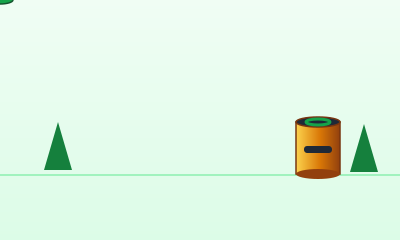
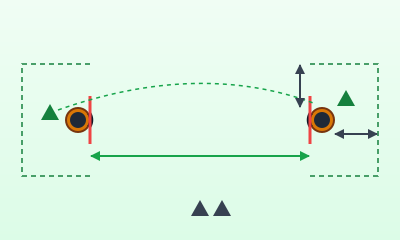
Figure: The court under PDFA rules. The green arrow is the 50 ft (15.24 m) between the front edges of the goals, and the dark gray arrows the 10 ft (3.05 m) of clear space beside and behind each goal. Throwers release from behind the red line at the front of their own goal.
Equipment & setup
All you need is two goals and one disc. Retail sets fold flat for carrying, and the brand pitches the game for the backyard, the beach, the park, or a tailgate.
- Goals — open-topped cylinders with a horizontal slot in the front. Set them so the slots face each other
- Flying disc — one. Under PDFA tournament rules, teams may bring any commercially made disc that weighs 160 to 175 g and measures 10.75 in (27.3 cm) across
- Something to measure with — 50 ft (15.24 m) from the front of one goal to the front of the other. The brand's setup guide says you can change the distance to suit different ages and skill levels
- Line markers — mark a release line at the front edge of each goal. Where paint is not allowed, the PDFA suggests masking tape or painter's tape
Kan Jam distance and goal dimensions
The values below come from the PDFA's Official Rules of Discflect.
| Item | Standard | Notes |
|---|---|---|
| Distance between goals | 50 ft (15.24 m) | Front edge to front edge. The line at each front edge is also the release line |
| Goal height | 20 in (50.8 cm) | Open-topped cylinder |
| Goal top diameter | 16 in (40.6 cm) | |
| Slot | 13 in wide by 3 in tall (33 cm by 7.6 cm) | Corners rounded to a radius of about 3/8 in |
| Disc | 160 to 175 g, 10.75 in (27.3 cm) across | Tolerance: 2 g, 1 cm. No 3D-printed discs |
| Clear space | At least 10 ft (3.05 m) beside and behind each goal | Room for the deflector to move |
| Neighboring courts | Goals 20 ft (6.10 m) apart | 15 ft (4.57 m) is acceptable in smaller venues |
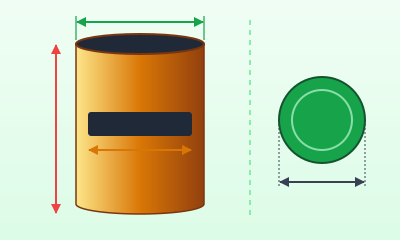
Figure: Goal and disc dimensions. Green is the 16 in top diameter, red the 20 in height, orange the 13 in slot width (the slot is 3 in tall), and dark gray the 10.75 in disc diameter. The rules do not fix how high the slot sits, so its position here is approximate.
Players & ages
| Format | Players | Where players stand |
|---|---|---|
| Official (2 vs 2) | 4 | Partners stand at opposite goals and swap between throwing and deflecting |
- Both the brand's instructions and the PDFA rules are built around four players in two teams of two. There are no official rules for two or three players
- The brand describes the game as great for players of any age or skill level. For kids, bring the goals closer together
Rules
In Kan Jam, partners trade the throwing and deflecting jobs on their way to exactly 21. Start with the brand's rules, then add the PDFA tournament rules.
How a game works (minimal rules)
- Set the two goals 50 ft (15.24 m) apart with the slots facing each other
- Form two teams of two. Partners stand behind opposite goals
- One player on the first team throws from behind their own goal toward the far goal. Their partner at the far goal deflects the disc into or against the goal
- The partners swap roles and throw back. After two throws the team's turn is over, and the other team takes its two throws
- Scoring (brand rules):
- Dinger: the deflector redirects the disc and it hits the goal — 1 point
- Deuce: the thrown disc hits the goal without help from the deflector — 2 points
- Dunk: the deflector redirects the disc and it lands inside the goal — 3 points
- Done Deal: the thrown disc lands inside the goal unassisted, through the slot or the top — instant win
- The first team to score exactly 21, or to hit a Done Deal, wins. Teams must complete the same number of turns before the game ends (except for an instant win). A tie goes to overtime rounds until one team outscores the other
Standard rules (adding skill)
- Deflecting — the brand says you may use both hands, and any body part works, feet included. But if you touch the disc twice (a double tap), the points from that throw do not count
- Watch for carries — catching, pinching, or otherwise controlling the disc while deflecting is a "carry" and scores nothing. Slamming, pushing, and slapping at the disc are the proper techniques
- Interference is worth 3 — if an opponent interferes with play to defend the goal, the throwing team gets 3 points. At 19 or 20, the throwing team wins outright
- Throws that score nothing — the thrower did not throw from behind their goal, the disc hit the ground before reaching the goal, or the deflector double-hit, caught, or carried it
- Throwing last is an advantage — the brand says so explicitly. In a series against the same team, the loser of the previous game customarily chooses whether to throw first or second
Official competition rules
Tournaments follow the PDFA's Official Rules of Discflect, which pin down several points the brand rules leave open:
- Names — the 3-point play is called a Bucket, and a disc that goes straight in is a Win Shot
- Eight rounds at most — a game ends when a team reaches exactly 21 or after eight rounds, when the higher score wins. A tie goes to overtime
- Going over 21 — points that would take a team past 21 are subtracted from its score instead: a Bucket at 19 drops the team to 16, and a Deuce at 20 drops it to 18
- Redemption rule — if the team throwing first hits a Win Shot, the team with the last turn gets two throws to answer with a Win Shot of its own and force overtime
- The Hammer — the right to throw last. Before game one, the winner of a disc flip chooses either which team throws first or which end starts
- Release and pace — both feet must be behind the front edge of the goal at release, and each throw should come within about 15 seconds
Scoring examples
- Example 1 — Team A's first throw is a Deuce (2) and the second a Dunk (3): 5 points for the round
- Example 2 (exactly 21) — at 18, Team A wins with a Dunk (3). A Deuce takes them to 20 and a Dinger to 19, and the game goes on
- Example 3 (PDFA over-21 rule) — at 20, Team A deflects a Bucket (3) and drops to 20 − 3 = 17. From 20, the only useful score is a 1-point Dinger
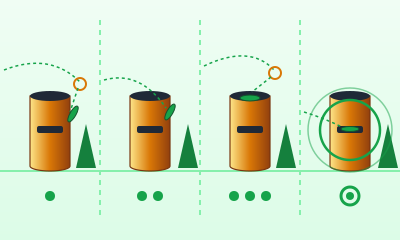
Figure: From left, a Dinger (deflected onto the goal, 1 point), a Deuce (hits the goal directly, 2), a Dunk (deflected inside, 3), and a Done Deal (straight in, instant win). The number of green dots is the number of points.
Common fouls and tricky calls
- Bounce-outs — under PDFA rules, a deflected disc that drops in through the top and bounces back out still counts 3
- In the top, out the slot — 1 point if the disc touches the goal on the way out, 0 if it passes through cleanly (PDFA)
- In the slot, out the top — if nobody deflected it and it touched the goal, it is a Deuce, not a Win Shot (PDFA). The brand rules also score a disc that enters the slot and deflects out as a Deuce
- Trapping the disc on the rim — sandwiching the disc between your hands and the top edge of the goal is a carry and scores 0 (PDFA)
- Grazing the grass — a disc that only grazes grass blades and keeps its line is still live; if the ground changes or stops its flight, the play is dead (PDFA)
- Overhanging branches — a disc whose flight is changed by a branch or leaves is dead (PDFA), so do not set up under trees
Tips for enjoying the game
Common beginner mistakes
- Curving throws — the brand notes that from 50 ft a right-hander's disc tends to start right and bend back left. Keep the disc flat at release and throw with a little more pace
- Not talking to your partner — the ideal throw is about belt-high and directly over the goal. Throwers should call what they are aiming for, and deflectors should line up directly behind the goal so they can reach either side
- Deflecting too hard — on awkward throws, act as a backboard and simply redirect the disc toward the goal
- Ignoring the score — the brand's strategy tip: play it safe with a Deuce when you are ahead, set up the Dunk when you are behind, and go for the Done Deal when you are losing big
Kan Jam vs Spikeball
| Kan Jam | Spikeball | |
|---|---|---|
| Equipment | Two goals (cans) and a flying disc | A round net (the set) and a ball |
| Players | 2 vs 2 | 2 vs 2 |
| How points come | Your own throws and deflections score 1 to 3; straight in wins instantly | Your opponents score 1 when you fail to return the ball |
| Winning | Exactly 21 | First to 21, win by 2 |
Running a game (numbers, venue, wind, safety)
- Three players — there is no official format, but you can keep one player as the permanent deflector while the other two take turns throwing and compare scores. Agree on it before starting
- Kids — halve the distance and start by celebrating Deuces and Dingers
- Windy days — the PDFA allows goals to be staked to the ground, as long as the stakes go on the inside of the goal. A heavier disc within the 160 to 175 g limit also helps
- Venue — flat grass with no branches overhead. Leave about 10 ft (3 m) beside and behind each goal so deflectors can move
- Safety — before throwing, make sure the deflector is ready and nobody else is around the goal. The waiting team stands outside the court
Playing KanJam in Japan
- If you cannot find a set, a bucket or bin with a slot cut in the front and any flying disc will do. As the PDFA notes, the game was played with aluminum garbage cans in the early 1990s
- The Japanese spelling of KanJam ("kanjamu") is also the name of a popular Japanese TV music show, so when shopping or searching in Japanese, add "Kan Jam" or the Japanese word for frisbee
- Some Japanese parks restrict frisbees and other throwing games. Check with the park office, use an open lawn, and keep your distance from other park users
Frequently asked questions
Q. What score wins, and what happens if you go over 21?
You win by reaching exactly 21. Under PDFA tournament rules, points that would take you past 21 are subtracted instead, so a Bucket (3) at 19 drops you to 16.
Q. How far apart are Kan Jam goals?
The official distance is 50 ft (15.24 m), measured from the front edge of one goal to the front edge of the other. The brand says you can shorten it for younger or newer players.
Q. What is an instant win in Kan Jam?
An instant win is a thrown disc that lands inside the goal without help from the deflector. The brand calls it a Done Deal and the PDFA a Win Shot; if the team throwing first makes one, PDFA rules give the other team two throws to answer (under the brand rules, the game simply ends).
Q. Can you play Kan Jam with two or three people?
The official game is four players in two teams of two. With two players, try taking turns throwing and counting only Deuces and Done Deals; with three, keep one person as the permanent deflector. Agree on the house rules before you start.
Q. Are Kan Jam and discflect the same thing?
Yes, they are played the same way. Kan Jam is the trademarked brand, and since 2021 the PDFA has used the generic name discflect for the sport.
Learn more
- Kan Jam: How to Play — Dinger, Deuce, Dunk, Done Deal, and how to win
- Kan Jam: Getting Started — assembly and the 50 ft distance
- Kan Jam: FAQs — legal deflections and carries
- Kan Jam: Tips & Tricks — throwing, deflecting, and strategy
- PDFA: Official Rules of Discflect and Tournament Rules — dimensions, the over-21 penalty, and the redemption rule
- PDFA: Kan Jam® or Discflect? (2021) — the trademark, the generic name, and the sport's history
- Related: Spikeball, Cornhole, Horseshoes, and Washers, fellow American backyard and tailgate games
Share this page