Spikeball (Roundnet) Rules: How to Play & Scoring
- Region:
- United States
- Tags:
- Small group, Ball game, North America, Youth, Competitive
At a glance
- Players
- 4 players
- Game length
- Games to 15 or 21, win by 2; a match is usually best of three
- Equipment
- A roundnet set and a ball; bring a pump and a spare ball
- Space
- 8.5 m radius around the set (17 m across, official); grass or sand is best
Contents (8)

What is this game?
Spikeball was invented in the United States in 1989 by Jeff Knurek, and took off after Spikeball Inc. began making and promoting the equipment in 2008. As a sport, it is called Roundnet.
Rules feel like volleyball: four players (2 vs 2) surround a trampoline-style net on the ground and slam the ball off the net back and forth. Each team has up to three touches to get the ball back onto the net, or the other team scores. Once the ball is served there are no sides, so all four players roam 360 degrees around the net.
The game spread through US college campuses, beaches, and parks, and today the International Roundnet Federation (IRF) writes the international rules. The IRF also runs a World Championship; the 2024 edition was held in Guildford, England.
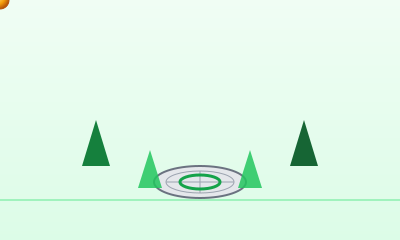
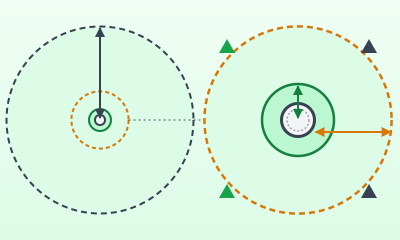
Figure: The whole court on the left, a close-up of the center on the right. The dark grey arrow is the 8.5 m to the boundary, the orange arrow the 2.13 m from the edge of the set to the service line, and the green arrow the 100 cm from the center to the No Hit Zone line.
Spikeball vs roundnet: what's the difference?
They are the same game. Spikeball is the brand of the company Spikeball Inc., whose sets made the game popular after 2008, so its name became the everyday name for the game. Roundnet is the generic name of the sport, used by its governing bodies.
| Spikeball | Roundnet | |
|---|---|---|
| What the word is | The brand of Spikeball Inc. and its sets | The generic name of the sport |
| Who uses it | Spikeball Inc., which also runs its own event series, the Spikeball Tour Series | The International Roundnet Federation (IRF), USA Roundnet, and national bodies such as Roundnet Japan |
| Rules | Spikeball Inc. publishes its own rules: games to 11, 15, or 21, won by 2; everyone but the receiver starts at least 7 ft from the net, and no boundary or No Hit Zone is mentioned | The IRF official rules: games to 15 or 21, won by 2, an 8.5 m boundary and a 100 cm No Hit Zone |
| Equipment | Spikeball-brand sets | Sets and balls from several manufacturers; tournaments use IRF-approved equipment |
In the US, Spikeball Inc. once ran the Spikeball Roundnet Association (SRA) as the de facto governing body. USA Roundnet was then set up as a national governing body separate from the company. For casual games the two rule sets play almost the same; check which one a tournament uses before you enter.
Equipment & setup
Spikeball needs very little gear, and setup takes just a few minutes. All you really need is the roundnet, a ball, and enough open space for four players to move.
- Roundnet (the set) — a circular frame on legs with a net stretched across the top. Tensioned properly, it bounces like a small trampoline, and it folds down to carry
- Ball — a soft, palm-sized ball. Inflation changes how lively it plays, so bring a pump and a spare
- Line markings — draw the service line and the No Hit Zone circles with chalk or string outdoors, or tape indoors. A few evenly spaced markers around each circle will do
- Open space and soft ground — the ball can fly in any direction. Grass or sand lets you dive for a ball without getting hurt
Official tournaments use an IRF-approved set and ball.
Court and equipment dimensions
The figures below come from the International Roundnet Federation (IRF) official rules, revised July 17, 2026.
| Item | Regulation | Tolerance / notes |
|---|---|---|
| Set inner diameter | 36 in (91.4 cm) | Measured inside the top of the rim |
| Set height | 8 in (20.3 cm) | |
| Net tension | A ball dropped from 1.5 m bounces 50 cm | Measured from the bottom of the ball |
| Ball weight | 85 g | ±5 g |
| Ball circumference | 330 mm | ±10 mm (the 2024 rules said 29–31 cm) |
| Ball pressure | 2,000–3,500 Pa (0.3–0.5 PSI) | |
| No Hit Zone | 100 cm radius from the center | The 2024 rules used 91.4 cm (3 ft) |
| Service line | 2.6 m (8.5 ft) radius from the center | 7 ft (2.13 m) from the edge of the set |
| Outer boundary | 8.5 m (27.9 ft) radius from the center | The line itself is in. Does not apply to the serve |
The outer boundary is new: the 2024 rules had no out of bounds and simply recommended at least 10 x 10 m per court. Older guides that say "there are no boundaries" are out of date, so check the current rulebook before a tournament.
Players & ages
| Format | Players | Best for |
|---|---|---|
| Official (2 vs 2) | 4 | Tournaments and serious practice |
| 1 vs 1 | 2 | Small-group practice |
The official rules set no age limits. With plenty of running, jumping, and diving, the game suits teens and adults best.
Rules
Spikeball is all about rallying the ball off the net until the other team can't return it within three touches. Learn the minimal rules below and you can play the same afternoon.
How a round works (minimal rules)
- Set the net in the middle and stand all four players around it. Teammates stand side by side, and the server faces the receiver across the net
- The server stands behind the service line, 7 ft (2.13 m) from the edge of the set
- Serve: toss the ball lightly and hit it down onto the net so it ricochets up toward the receiver. You get two tries
- Rally: the receiving team gets up to three touches to control the ball and send it back onto the net (just like a volleyball dig, set, and spike)
- Now it's the other team's turn to return it within three touches. Play alternates back and forth
- The other team scores a point when:
- the ball hits the ground, or misses the net
- a return hits the rim or legs before the net
- a team fails to return the ball within three touches
- the server faults twice in a row
- First to 21, win by 2 takes the game. Official play goes to 15 or 21, and a match is usually best of three games
At first, just focus on getting the ball back onto the net within three touches.
Standard rules (adding skill)
- Move 360 degrees — once the ball is served, you can go anywhere around the net
- Team combos — "dig, set, spike" across your three touches makes the return much harder to defend. The same player may not normally touch the ball twice in a row
- One hand at a time — hitting with both hands at once, or catching the ball, is a fault. There are exceptions on a team's first touch, such as the ball striking several parts of the body at the same moment
- Serve height — a serve may not bounce higher than the receiver's shoulders
- Don't get in the way — blocking an opponent's path or swing on their turn is a "hinder". If you made no effort to avoid it, they win the point; if you tried to get out of the way, the point is replayed
Official competition rules
The IRF sets the international rules. Spikeball Inc. used to run the Spikeball Roundnet Association (SRA) as the de facto governing body in the US; that role has since passed to the independent USA Roundnet. Key points from the IRF rules (July 2026) are:
- Serving routine: call the score, wait for the receiver to say they are ready, announce "service", and toss within three seconds. The ball must travel at least 10 cm (4 in) from your hand before you hit it, you cannot toss and strike with the same hand, and you may take only one step
- Serving order: the very first point is served by one player; after that, each team serves two points in a row, alternating regardless of who wins the rally. Under the 2024 rules, the team that won the point kept the serve
- Three touches on serve receive: the serve must be returned using all three touches; returning it in one or two is a lost point
- No Hit Zone: a team's final hit onto the net may not be made from inside the 100 cm circle
- Calls: without an observer, players make their own calls, and if they cannot agree, the point is replayed
In Japan, Roundnet Japan (the Japan Roundnet Association) runs regular tournaments.
Scoring examples
Roundnet uses rally scoring: whoever wins the rally scores a point, whether they served or not.
- Example 1: three touches were not enough — the grey team digs and sets, but the third touch falls short of the net and hits the ground. The green team scores, so 5–3 becomes 6–3
- Example 2: a rim shot — the grey team's spike hits the rim before the net. Point to green. A "pocket", where the ball clips the edge of the net and changes direction without touching the rim, is legal during a rally, so learn to tell the two apart
- Example 3: from 20–20 — in a game to 21, a 20–20 tie means play continues until one team leads by two, finishing 22–20 or even 27–25. Some tournaments set a hard cap, for example at 25, so that at 24–24 the next point wins
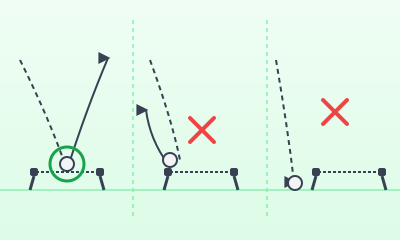
Figure: A ball that hits the net surface and rebounds is good (green ring). Hitting the rim first, or landing on the ground without reaching the net, loses the point for the hitting team (red X).
Common fouls and tricky calls
The following are rulings under the IRF official rules (July 2026).
- Pockets — legal during a rally. Only on the serve do they become faults: a ball that hits a side third of the net and cuts back across, or one that hits the back third and fails to travel forward
- Roll-ups — a ball that lands fully on the net, rolls into the rim, and then comes off is legal. That is different from a ball whose first contact is the rim
- Stepping into the No Hit Zone — if your step or follow-through on the final hit carries you into the circle, you lose the point. Anyone who has touched the zone must plant both feet outside it again before making a final hit
- Touching the set — if a player, or something that falls off a player such as a hat, touches the net, rim, or legs during a rally, that team loses the point
- Crowding the net — when an opponent is within arm's reach of the net to hit, defenders may not enter the imaginary cylinder rising from the rim. Doing so gives the hitting team the point
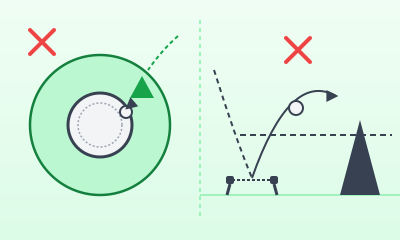
Figure: On the left, stepping into the No Hit Zone (green circle) on the final hit; on the right, a serve that rises above the receiver's shoulder height (dashed grey line).
Tips for enjoying the game
Common beginner mistakes
- Standing still — give a small hop as your opponent hits so you can push off in either direction
- Swinging too hard — muscling the ball sends it into the rim. Aim for the middle of the net first
- Panicking on the third touch — a high first touch buys time for the second and third
How to make it more fun
- Practice "set, then spike" with your partner and it instantly feels like the real sport
- On sand, you can dive for a ball without fear
- It only takes four people and one bag of gear, so it fits easily beside a picnic or barbecue
Age variations
- Kids: let a little air out of the ball to tame the bounce, and move the service line closer
- Adult beginners: start with cooperative rallies and count how many hits you can string together
- Competitive: approved gear, a marked No Hit Zone and service line, and the full rules
Playing Spikeball in Japan
- Choosing a spot — park lawns, riverside grass, and beaches all work. In busy parks, set up near the edge and let people nearby know what you are doing
- Marking the lines — cut a string to 2.6 m, hold one end at the center of the set, and walk it around to mark a neat service circle
- Summer heat — beach and lawn play is a real workout in a Japanese summer, so drink water between games
- Finding players — Roundnet Japan (the Japan Roundnet Association) holds tournaments, and there are local roundnet groups in several regions
Frequently asked questions
Q. How much space does a court need?
Under the IRF rules, the court is a circle with an 8.5 m radius around the set, which is 17 m across. You can rally in less space for fun, but the ball can fly in any direction, so choose a spot clear of people and obstacles.
Q. How many points win a game?
Official games go to 15 or 21 points and must be won by two. A match is usually the first to win two games. For casual play, shorter games let you rotate partners and play more often.
Q. Can you play on grass?
Yes, and grass is one of the best surfaces because diving doesn't hurt. Pick level ground so the legs don't sink or tilt, and check that the net is evenly tensioned before you start.
Q. What age can kids start?
There is no official age limit. If a child can hit the ball back with one hand, they can play, so primary school age is a reasonable starting point. A slightly softer ball and a shorter serve distance help rallies last longer.
Q. How many serves do you get?
Two per point. If both are faults, the receiving team scores. Only the receiving team can call a service fault, and they may choose to play on instead.
Learn more
- International Roundnet Federation (IRF) official rules — the current rulebook PDF in English
- USA Roundnet — the US governing body, and how it split from Spikeball Inc.
- Spikeball Inc.: official rules — the company's own rules
- Roundnet on Wikipedia — history and the names of the game
- Roundnet Japan — tournaments in Japan
- Related: Ladder golf, Cornhole, and Kabaddi — lively outdoor games for a group
Share this page