Kabaddi Rules: Breathing Rule, Court Size & Scoring
- Region:
- India
- Tags:
- Team, Territory, Asia, Competitive
At a glance
- Players
- 6–14 players
- Game length
- Official: two 20-minute halves, 5-minute break (women: 15-minute halves)
- Equipment
- No gear needed: rope or tape for the lines, clothes and shoes to move in
- Space
- 13 m × 10 m (men's regulation); shrink it for casual play
Contents (8)
What is this game?
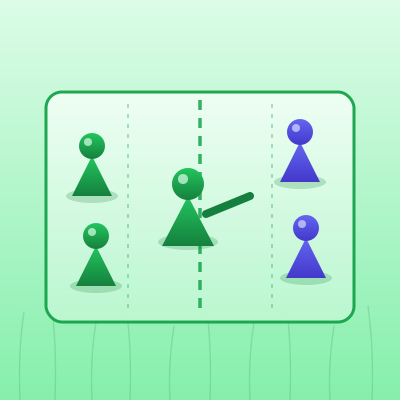
Kabaddi is a contact team sport long played across the Indian subcontinent. A rectangular court is split in two by a center line, and two teams take turns attacking and defending.
The attacking team sends in a single raider. The raider's job is to tag one or more of the opposing defenders (the "antis") and get back across the center line to their own half. Do that, and the raiding team scores one point for every defender tagged.
The raider must do all this while chanting "kabaddi, kabaddi..." without taking a breath (the "cant"). If the chant breaks, the raider is out.
The defenders, meanwhile, try to grab, hold, or trap the raider so they can't get back across the line. Stop the raider and the defending team scores instead, and the raider is "out." Kabaddi comes down to pure speed, agility, nerve, and teamwork.
The Japan Kabaddi Association describes its origin as a way of surrounding and capturing wild animals without weapons, and passes on a legend that the one-raider-against-seven format comes from a scene in the Mahabharata epic, where a hero's son is surrounded by seven enemies.
Kabaddi is regarded as a national sport in India and Bangladesh. India's professional Pro Kabaddi League launched in 2014, and kabaddi has been an Asian Games medal event since Beijing 1990 (it is not an Olympic sport); at Guangzhou 2010, Japan's men's team won bronze. At the 2026 Asian Games in Aichi-Nagoya, Japan, the kabaddi tournaments were held at the Tōkai Citizens Gymnasium in Tōkai, Aichi.
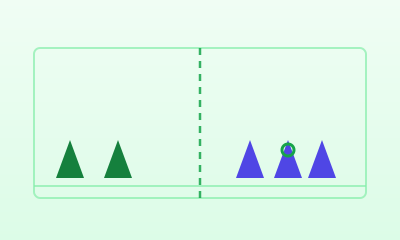
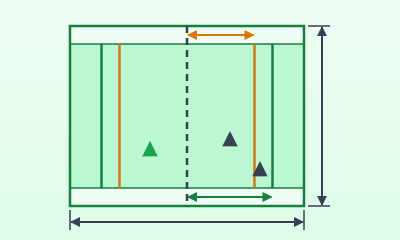
Figure: The men's regulation court (13 m x 10 m). The orange arrow is the 3.75 m from the center line to the baulk line, the green arrow the 4.75 m to the bonus line, and the pale strips at top and bottom are the 1 m lobbies.
Equipment & setup
Kabaddi needs no special gear at all: no ball, no bat, no net. A marked-out court, two teams, and a flat, safe surface are enough, so a patch of lawn will do.
- A court (just mark the lines) — set out a rectangle and draw a single center line (midline) to split it into two halves. Chalk, rope, or tape will do, as long as the line is clearly visible. For a casual game, size the court to your players
- Two teams — official play has seven players per side on court, but 3-a-side up to 7-a-side all play well casually. Use bibs or shirt colors to tell the teams apart at a glance
- Clothes you can move in — wear stretchy clothing and grippy trainers. Keep nails short and take off watches and jewelry
- A flat, safe surface — falls are part of the game, so choose a flat, forgiving surface (grass, dirt, sand, or mats) with clear space around the court
International matches are played on a purpose-made synthetic rubber mat 25–40 mm thick, or on soft soil.
Court and equipment dimensions
The figures below come from the rules of the Amateur Kabaddi Federation of India (AKFI, Version 2.1.0), which reproduce the International Kabaddi Federation (IKF) rules, and from the Japan Kabaddi Association rules. The regulation column gives the men's value; women's and youth values are in the notes.
| Item | Regulation (men) | Tolerance / notes |
|---|---|---|
| Court size | 13 m x 10 m | Women and junior girls 12 m x 8 m; under-16s 11 m x 8 m. The 10 m width includes both lobbies |
| Depth of each half | 6.5 m | Center line to end line. Women 6 m |
| Lobby width | 1 m | A strip along each side. It becomes part of the court only once a struggle begins |
| Baulk line | 3.75 m from the center line | Women and under-16s 3 m |
| Bonus line | 1 m beyond the baulk line | 4.75 m from the center line (women 4 m) |
| Line width | 3–5 cm | Lines are part of the court |
| Clear space around the court | 4 m | Outside the side lines |
| Sitting block | 8 m x 1 m | Placed 2 m from the end line, where players who are out wait. Women 6 m x 1 m |
| Match length | Two 20-minute halves, 5-minute break | Women and under-16s play 15-minute halves (the break is 5 minutes under AKFI rules and 3–5 minutes under Japanese rules) |
| One raid | 30 seconds or less | Over time, the raider is out |
| Weight limit | 85 kg or under | Women 75 kg or under |
Kabaddi court size for men, women and juniors
Court sizes differ by category. The width always includes the 1 m lobby on each side, and the bonus line is always 1 m beyond the baulk line. Feet are rounded conversions; the rules are written in metres.
| Category | Court (length × width) | Each half | Center line to baulk line | Center line to bonus line |
|---|---|---|---|---|
| Men and junior men | 13 m × 10 m (about 42 ft 8 in × 32 ft 10 in) | 6.5 m (21 ft 4 in) | 3.75 m (12 ft 4 in) | 4.75 m (15 ft 7 in) |
| Women and junior women | 12 m × 8 m (about 39 ft 4 in × 26 ft 3 in) | 6 m (19 ft 8 in) | 3 m (9 ft 10 in) | 4 m (13 ft 1 in) |
| Under-16s (sub-junior) | 11 m × 8 m (about 36 ft 1 in × 26 ft 3 in) | 5.5 m (18 ft 1 in) | 3 m (9 ft 10 in) | 4 m (13 ft 1 in) |
Players & ages
| Format | Per team | Total | Notes |
|---|---|---|---|
| Official (standard) | 7 on court | 14 | Squads of 10–12 (up to 14 at international level) |
| Casual (small-sided) | 3–5 | 6–10 | Shrink the court |
| Intro / practice | 2–3 | 4–6 | Play tag-only rules |
The official rules also have junior (20 and under) and sub-junior (16 and under) categories. Casually, anyone from upper primary age up can play, but it is a contact sport, so use tag-only rules when players differ a lot in size.
Rules
Kabaddi has a simple core: raid, tag, and get back alive for points. Learn the minimal rules below and you can play the same afternoon.
How a round works (minimal rules)
- Split the court in two with the center line; each team takes a half
- Choose which side attacks first (a coin toss works)
- The attacking team sends one raider across the center line into the opponents' half
- The raider tries to touch (tag) a defender with a hand or foot and then cross back over the center line into their own half
- Get back safely and the attacking team scores one point per defender tagged; each tagged defender goes "out" and leaves the court
- The defenders win the exchange by stopping the raider from returning, by grabbing or holding them. If they succeed, they score one point and the raider is "out"
- Teams swap roles, and now the other side sends in a raider. Keep alternating
- Players who are out come back one per point their team scores, in the order they went out (a "revival")
- Play to a set time (halves) or a target score; the highest score, or first to the target, wins
At first, just aim to nail "tag, then cross the line home."
Standard rules (adding skill)
- The cant (breath-holding chant) — from before touching the opponents' half until getting back, the raider must chant "kabaddi, kabaddi..." continuously, on a single breath. If it stops or becomes unclear, the raider is out
- Baulk line — the raider must cross this line at least once in every raid. Return without crossing it and without touching anyone, and the raider is out
- Bonus line — when six or more defenders are on court, a raider who crosses this line before any touch or struggle earns a bonus point. It counts only if the trailing foot is in the air and no part of the body is touching the ground between the center line and the bonus line
- Defensive skills (tackles) — defenders stop the raider with ankle holds, body tackles, and hand-linked "chains." Only the limbs and torso may be held; deliberately grabbing above the shoulders is a foul
- Using the lobbies — the lobbies (the side strips) come into play only after a touch or struggle begins. Step into one before that and you are out of bounds
Official competition rules
The official standard style is played on a rectangular court with seven players per side, over two 20-minute halves for men and two 15-minute halves for women. Under International Kabaddi Federation (IKF) rules the raider must keep up the cant and finish the raid within 30 seconds. The Pro Kabaddi League uses both requirements as well.
Rules designed to raise the stakes include the "do-or-die" raid: after two empty raids in a row, the third raid must score or the raider is out. Putting the whole opposing team out is an "all out" (lona), worth two extra points, after which all the out players return. If three or fewer defenders stop a raider, it is a super tackle worth two points.
In knockout matches a tie is settled by a five-raid shoot-out, with each team sending five raiders, and then by a "golden raid" if still level.
There is also a circle style (Punjabi kabaddi), played outdoors on a round ground, with different spacing and feel from the standard game. In Japan, the Japan Amateur Kabaddi Association was founded in 1981; today the Japan Kabaddi Association runs national championships and other events.
Scoring examples
- Example 1: two tags and home — the raider tags two defenders and gets back. The attacking team scores 2, the two defenders are out, and up to two of the attacking team's out players come back
- Example 2: bonus plus a tag — with seven defenders on court, the raider first crosses the bonus line (1 point), then tags one defender and returns. That makes 2 points. The bonus point does not revive anyone, so only one player comes back, for the tag
- Example 3: super tackle — only three defenders remain, and all three stop the raider. The defenders score 2, but only one of their players is revived
- Example 4: all out — two defenders remain, and the raider tags both and returns. That is 2 points for the tags plus 2 for the all out, 4 in total, and the defending team's players all return to court
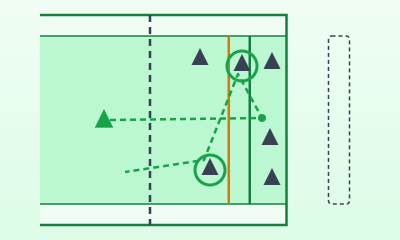
Figure: The raider (green triangle) crosses the bonus line, then tags two defenders (green rings) and returns. With six defenders on court, that is 1 bonus point plus 2 for the tags: 3 points.
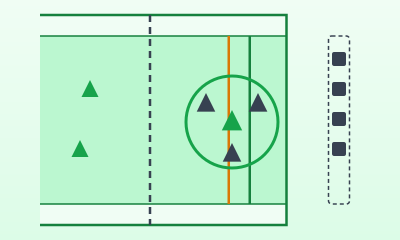
Figure: A super tackle. With only three defenders (grey triangles) left, stopping the raider (green triangle) is worth 2 points. The grey squares are out players waiting in the sitting block.
Common fouls and tricky calls
The following are rulings under the IKF rules (AKFI Version 2.1.0) and the Japan Kabaddi Association rules.
- Holding above the shoulders — deliberately grabbing the neck, hair, or collar puts the player who did it out, and the raider is not out
- Blocking the mouth or dangerous tackles — covering the raider's mouth to stop the cant, violent tackles likely to injure, or scissoring with the legs draw a warning card, and the raider is not out
- Out of bounds — a player whose body touches the ground outside the boundary is out. Once a struggle is under way, though, a player is not out as long as part of the body stays in contact with the court
- Late cant — a raider who starts chanting only after touching the opponents' half is sent back, and the opponents get a technical point. Two raiders entering at once, or raiding out of turn, also concede a technical point
- Five-second rule — the next raider must go within five seconds of the previous raid ending, or the opponents get a point
- Coaching the raider — if a teammate guides the raider during a raid, the referee may award the opponents a technical point
Tips for enjoying the game
Common beginner mistakes
- Over-committing. Chasing a tag too deep into the opponents' half gets you surrounded and stranded. Only raid as far as you can still get back from
- Losing the cant. The moment your breath, and chant, breaks, you're out. Until you're used to it, keep raids short and quick
- Scattered defense. One defender chasing alone gets dodged. Link hands into a chain to trap the raider far more reliably
- Defending too far forward. Wait in front of the baulk line and a raider can tag you and get home easily. Sit back a little and close in from both sides once the raider comes deep
- Raiding straight down the middle. Target a defender on the edge instead, tag quickly with a toe or fingertip, and turn back to the center line at once
How to make it more fun
- The magic moment is the raider stretching for a tag, then sprinting home a hair ahead of the defenders
- Call out the situations, such as "one more point and we get a player back" or "three left, super tackle chance," and the spectators join in
- Playing to timed halves keeps attack and defense flipping fast
- Pick one person to referee. Standing beside the center line, they can judge touches and line-outs and listen for a broken cant
Variations by age and level
- Kids / beginners: drop the cant and use the simple version: tag a defender, cross the line, score. Start around 3-a-side
- Wary of contact: ban grabbing and holding and play tag-only. Safe and still fun
- Competitive: draw proper baulk and bonus lines and bring in the 30-second raid limit and the do-or-die rule
Playing kabaddi in Japan
- Zero gear to start — one center line of rope or tape is all it takes, ideal for PE classes and recreation days
- Pick a soft surface — use mats in a gym, or grass or dirt outdoors; avoid hard floors and asphalt
- Shrink the court for small groups — at 3-a-side, shorten each half and draw the baulk line closer to the center so raiders have a fair chance
- Agree the contact level up front — decide "tag only" or "tackling allowed" based on players' size and experience before you begin
- Association events — the Japan Kabaddi Association runs national and student championships and recruits new players
Frequently asked questions
Q. How big is a kabaddi court?
The men's regulation court is 13 m x 10 m and the women's 12 m x 8 m, plus 4 m of clear space outside the side lines. For casual play, shrink it to fit your group.
Q. How many points win a game?
Official matches are timed rather than played to a target: two 20-minute halves for men and two 15-minute halves for women, and the higher score wins. A tie in a knockout match goes to a five-raid shoot-out and then a golden raid. For casual play, "first to 10" works well too.
Q. How many players are on a kabaddi team?
Seven players per side are on the court, so an official match is 7 vs 7. A team registers 10 to 12 players (up to 14 in international events), and the rest are substitutes. For casual games, 3 to 5 a side on a smaller court works well.
Q. Can you play on grass?
Yes. The international rules allow a mat or soft soil, and grass is kind to falls. Wear shoes that grip and check for stones first.
Q. What age can kids start?
The official rules have a sub-junior category for 16 and under, on a smaller court. Casually, upper primary children can play, but start with tag-only rules.
Q. What does "kabaddi" mean, and how do you say it?
According to the Japan Kabaddi Association, the word has no meaning of its own: it works like a mantra, chanted to keep the mind calm and body and mind together. One etymology traces it through Hindi to the Tamil for "holding hands" (hand + grasp). In South Asia it is said roughly "KUB-ud-dee" with the stress on the first syllable; many English speakers say "kuh-BAD-ee". The game comes from South Asia, including India, Pakistan and Bangladesh.
Q. Do you really have to keep saying "kabaddi"?
In official play, yes. Chanting without a breath proves the raider is holding their breath, and if it stops, the raider is out. With beginners and children, you can skip it and use a time limit instead, such as "back within ten seconds."
Learn more
- Japan Kabaddi Association rules — a rules summary (in Japanese)
- Japan Kabaddi Association: What is kabaddi? — the meaning of the word and its origins (in Japanese)
- International Kabaddi Federation (IKF)
- Amateur Kabaddi Federation of India (AKFI) rules — hosts the IKF rulebook PDF
- Pro Kabaddi League: Understanding the game of kabaddi — the pro league's rules explainer
- Kabaddi at the 2026 Asian Games (Wikipedia) — venue and schedule
- kabaddi on Wiktionary — pronunciation and etymology
- Related: Spikeball and Kubb — more active outdoor games for a group
Share this page