Flag Football Rules: How to Play 5v5, Field Size, Positions & Scoring
- Region:
- United States
- Tags:
- Team, Ball game, Territory, North America, Youth, Competitive
At a glance
- Players
- 6–14 players
- Game length
- Two 20-minute halves, 40 minutes in total (IFAF rules)
- Equipment
- One ball, a flag belt with two flags for every player, and cones
- Space
- 70 × 25 yd (about 64 × 23 m) including end zones, plus a 3-yd safety area
Contents (8)
What is this game?
Flag football is American football with the collisions taken out. Every player wears a belt with two flags hanging at the hips, and instead of tackling the ball carrier you pull off one of those flags, which ends the play. Under the rules of the International Federation of American Football (IFAF), teams have five players on the field and there is no blocking, no tackling, and no kicking. It is a fast, pass-first game in which every play is planned in the huddle.
The game is usually traced to the U.S. Army post at Fort Meade, Maryland, around 1940, where soldiers played a version of football designed to keep them from getting hurt during the Second World War. Today the NFL runs NFL FLAG, a youth program for players aged 4 to 17 with more than 2,000 leagues across all 50 states.
On October 16, 2023, the 141st IOC Session in Mumbai approved flag football as one of five additional sports for the 2028 Olympic Games in Los Angeles, with both a men's and a women's tournament. In Japan the game is a familiar part of school PE: the national curriculum guidelines list it as an example of a territory-style invasion game for primary school pupils.

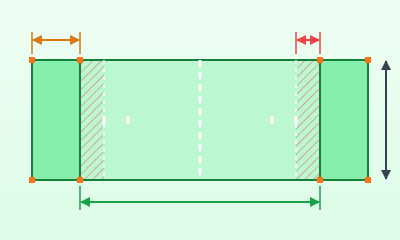
Figure: The IFAF 5v5 field. Green arrow: field of play, 50 yd (45.75 m). Orange arrow: end zone, 10 yd (9.15 m). Dark grey arrow: width, 25 yd (22.9 m). Red arrow: no-run zone, 5 yd (about 4.6 m). The dashed line in the middle is the line to gain for a first down.
Flag football vs. tackle football and tag rugby
These three games are often compared, especially in schools. The flag football column follows the IFAF rules.
| Flag football | Tag rugby | American (tackle) football | |
|---|---|---|---|
| How a play ends | When one of the ball carrier's flags is pulled | The tagged player must pass, and play carries on | When the ball carrier is tackled |
| Forward pass | One per play | Not allowed (backward passes only) | One per play |
| Contact | None: no blocking, no tackling | No tackling | Tackling and blocking |
| Protective gear | None (mouthguards strongly recommended) | None | Helmet and pads |
| Players on the field | 5 | Varies by competition | 11 |
Like tackle football, and unlike tag rugby, flag football stops after every play so the team can huddle and call the next one.
Equipment & setup
All you need is a ball and a flag belt for each player. No helmets or shoulder pads.
- Ball: the same oval ball as American football. Official games use leather, but a rubber or synthetic ball is fine for school and backyard games
- Flag belts: one per player, with one flag on each hip. The flags attach with "pop" sockets that release when pulled
- Team colors: contrasting shirts or bibs. Flags must contrast with the color of the shorts
- Cones: to mark the corners, goal lines, and the middle line
- Mouthguard: IFAF "strongly recommends" one, and some competitions require it
- Playing surface: flat and free of obstacles. Grass or artificial turf is ideal
Flag football field size and equipment dimensions
The values below come from the IFAF Flag Football Rules 2023.
| Item | Regulation | Notes |
|---|---|---|
| Field of play | 50 × 25 yd (45.75 × 22.9 m) | From goal line to goal line |
| End zones | 10 yd (9.15 m) deep | One at each end. The goal line is part of the end zone |
| Whole field | 70 × 25 yd (about 64 × 22.9 m) | Including both end zones |
| Space including the safety area | 76 × 31 yd (69.55 × 28.4 m) | Keep 3 yd (2.75 m) clear all around |
| No-run zones | The 5 yd (about 4.6 m) in front of each goal line | |
| Try spots | 5 yd (1 point) and 10 yd (2 points) from the goal line | |
| Flags | 15 to 16 in (38.1 to 40.6 cm) long | 1.8 to 2.0 in (4.6 to 5.1 cm) wide |
| Ball weight | Regular size, 400 to 425 g (14 to 15 oz) | Women and under-16s use the youth ball; under-13s use the junior ball |
Organizers may adapt the field to the venue or the players' age: the length and width of each half can be changed by up to 5 yd, from a maximum of 60 × 30 yd to a minimum of 40 × 20 yd, and end zones can be shortened to 8 yd.
Players & ages
| Format | Players on the field | Roster | Where you'll see it |
|---|---|---|---|
| Flag football (5v5) | 5 vs 5 | Up to 15 (10 substitutes) | IFAF World Championships and other international events |
| Flag 7 on 7 | 7 vs 7 | Up to 20 | Played on a field widened to 30 yd |
| Beach flag (4 on 4) | 4 vs 4 | Up to 10 | On a 25 × 25 yd sand field |
| School and backyard | 3 to 6 per side | — | Pick a team size and field to suit |
- IFAF competitions are played in men's and women's divisions; organizers may allow mixed teams
- With no collisions, children and adults of different sizes can play together. NFL FLAG is open to boys and girls from 4 to 17
- Throwing, catching, running, and play calling all matter, so there is a job for every kind of player
Rules
The aim is simple: use your downs to move the ball up the field and carry or catch it in the opponent's end zone. Start with the minimal rules, then add the official details as you get comfortable.
How a game works (minimal rules)
- Everyone puts on a flag belt, and a coin toss decides who starts on offense
- The offense starts on its own 5-yard line. The center snaps the ball from the ground back to the quarterback (QB) to start the play
- The QB either hands the ball to a teammate or throws a forward pass
- The ball carrier runs forward, dodging defenders
- When a defender pulls one of the ball carrier's flags, the play is over and the next one starts from that spot
- The offense has four downs to cross the middle line. If it does, it earns four more downs to score; if not, the ball goes to the other team
- Carrying the ball into the end zone, or catching a pass there, is a touchdown (6 points). The team with more points at the end wins
For a first game, two rules are enough: no contact, and hand pulled flags straight back.
Standard rules (adding skill)
- One forward pass per play, thrown from behind the line of scrimmage. Backward or sideways passes and handoffs are allowed any number of times, as long as the ball hasn't crossed the line
- Seven seconds to throw: if the QB hasn't passed or handed off within 7 seconds of the snap, the down is lost
- The QB can't run past the line: the QB may not carry the ball beyond the line of scrimmage. To run, hand the ball to someone else
- No-run zones: when the ball is snapped inside or on the 5-yard line going toward the opponent's end zone, the offense must pass. (Under the 2023 rules there is no no-run zone at midfield)
- The try: after a touchdown, the scoring team chooses to go for 1 point from the 5-yard line or 2 points from the 10-yard line
- Interceptions: a defender who catches a pass starts a new series for the defense from where the play ends
- Dead on the ground: a pass or fumble that touches the ground is dead. A fumble stays with the team that dropped it, at the spot of the fumble
Official competition rules
The IFAF Flag Football Rules 2023 (in force from May 1, 2023) are the international rules used at IFAF championships. The main points:
- Game length: two 20-minute halves with a 2-minute break. Each team has two 60-second timeouts per half
- Play clock: the ball must be snapped within 25 seconds of being declared ready
- The 7-yard rush: only defenders lined up more than 7 yards from the line of scrimmage at the snap may rush the QB right away. Defenders closer than 7 yards must stay behind the line until the QB hands off, fakes a handoff, or passes
- Blitzers: up to two defenders lined up beyond 7 yards may raise a hand before the snap to become "blitzers", which gives them right of way on a straight rush at the QB. The offense must not get in their way
- Change of possession: if the offense fails to score or reach the middle within its downs, the other team takes over on its own 5-yard line. After a try, the opponent also starts from its own 5-yard line
- Overtime: when a winner is needed, each team gets one series from the middle line, followed by tries if still tied
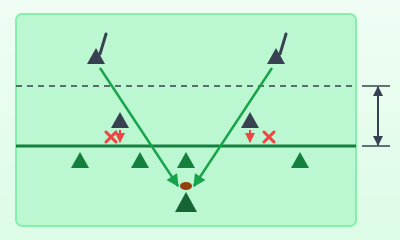
Figure: Defenders who start more than 7 yards (6.4 m, dark grey arrow) from the line may rush the QB at the snap (green arrows). Those inside 7 yards must wait for a pass or handoff (red crosses).
Scoring examples
| How you score | Points |
|---|---|
| Touchdown | 6 |
| Try from the 5-yard line | 1 |
| Try from the 10-yard line | 2 |
| Defense returns the ball for a touchdown during a try | 2 to the defense |
| Safety (the offense is stopped in its own end zone) | 2 to the defense |
| Safety during a try | 1 to the opponent |
- Example 1: Team A scores a touchdown (6) and converts the 2-point try from the 10-yard line. A scores 8
- Example 2: Team A scores a touchdown (6). On the 1-point try, Team B intercepts and runs all the way to A's end zone. A scores 6, B scores 2
- Example 3: Starting from its own 5-yard line, Team A's QB drops back into the end zone and loses a flag there. That's a safety: 2 points to B, and B then starts from its own 5-yard line
There is no field goal or extra-point kick, because flag football has no kicking at all.
Common fouls and tricky calls
- Flag guarding: covering your flags with a hand, arm, or the ball, or stiff-arming a defender. Penalty: 5 yards and loss of down
- Jumping and diving: leaping or diving to keep a flag away is illegal (5 yards and loss of down). Ducking or spinning on its own is allowed
- Shielding: an offensive player stepping into the path of a rusher or blitzer. Penalty: 5 yards. There is no blocking of any kind
- Contact: pushing, holding, or running into an opponent is a foul (10 yards). The ball carrier has no right of way and must avoid defenders
- A missing flag: a ball carrier who has fewer than two flags is down as soon as they have the ball. Return pulled flags to their owner right away
- Knee down: the play ends when any part of the ball carrier other than a hand or foot touches the ground
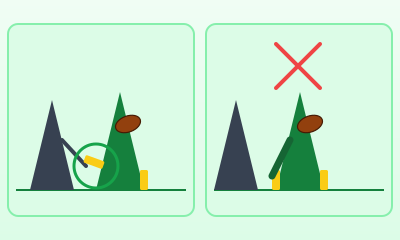
Figure: Left, a clean flag pull ends the play (green ring). Right, covering the flag with an arm is flag guarding, a foul (red cross).
Tips for enjoying the game
Common beginner mistakes
- Throwing deep every time: short 5 to 10 yard passes move the ball more reliably, and the QB only has 7 seconds
- Grabbing the player instead of the flag: keep your eyes on the hips and go for the flag only. Cutting off the runner's path works better than chasing from behind
- Everyone chasing the ball: on defense, decide in the huddle whether each player covers a receiver (man-to-man) or an area (zone)
Positions and plays
The huddle is where flag football shines: before every snap the team agrees exactly what each player will do.
- Offense: the center snaps, the quarterback throws, receivers run routes to get open, and a running back takes handoffs. In 5v5 the center can also run out for a pass after the snap
- Defense: rushers go after the QB, while the other defenders cover receivers
- Play cards: a classic school approach is to draw each receiver's route as an arrow on a card and pick one in the huddle. Two or three simple routes, such as "run and stop" or "run and cut diagonally", are plenty to start
Age variations
- Younger kids: shrink the field (say 20 × 15 m), drop forward passes, and play with handoffs and running only
- Older kids: add forward passes, then bring in the no-run zones and the 7-second rule
- Adults and competitive players: use the IFAF field and rules, and mark 7 yards with a cone so rushers know where to line up
Playing Flag Football in Japan
- Governing body: flag football in Japan is run by the Japan American Football Association (JAFA), the IFAF member federation. JAFA selects the men's and women's national teams and holds a national championship
- In schools: the Ministry of Education's commentary on the 2017 primary school curriculum (Physical Education) names "simple games based on tag rugby, flag football, and the like" as examples of territory games for grades 3 and 4, and lists flag football among the ball games that may replace basketball or soccer in grades 5 and 6
- Where to play: an official field needs about 64 × 23 m, or about 70 × 28 m with the safety area. Many Japanese parks ban ball games or limit ball sizes, so check the park rules first, and shrink the field and teams if space is tight
- Gear: flag belts and balls, including school sets, are sold at sports shops and online. In a pinch, towels tucked into the waistband work as flags
Frequently asked questions
Q. How many players are on a flag football team?
Under IFAF rules, five players per team are on the field. A roster can have up to 15, with unlimited substitutions. There are also 7-on-7 and 4-on-4 beach versions, and casual games can use any number.
Q. How big is a flag football field?
The official field is 70 × 25 yards (about 64 × 22.9 m) including the end zones. With the 3-yard safety area around it, you need 76 × 31 yards (69.55 × 28.4 m). Youth and school games often use a smaller field.
Q. How many points is a touchdown?
A touchdown is worth 6 points. The try afterward adds 1 point from the 5-yard line or 2 points from the 10-yard line, and a safety gives the defense 2 points. There are no field goals.
Q. Do you need pads, and is it safe?
No helmets or pads are needed. The rules make contact a foul specifically to reduce injuries. Players can still collide or fall while running, so IFAF strongly recommends a mouthguard.
Q. When did flag football become an Olympic sport?
The IOC approved it on October 16, 2023, for the Los Angeles 2028 Olympics, with men's and women's tournaments. It had already been played at the 2022 World Games in Birmingham, Alabama.
Q. What's the difference between flag football and tag rugby?
In flag football you may throw one forward pass per play, and every flag pull stops the play. In tag rugby forward passes are not allowed, and a tagged player passes the ball on so play keeps going.
Learn more
- IFAF Flag Football Rules 2023 (PDF): the official international rules
- NFL FLAG: the NFL's youth flag football program
- Introduction to flag football, Japan American Football Association (in Japanese)
- Primary school curriculum commentary, Physical Education (MEXT, in Japanese, PDF)
- 141st IOC Session (Wikipedia): the session that added five sports to LA28
- Flag football (Wikipedia): history and variations
- Related: Spikeball and Kabaddi, fast team games for a stretch of grass
Share this page