How to Play Ogostic: Rules, Distance & Scoring
- Region:
- United States (Brooklyn, NY)
- Tags:
- Small group, Ball game, North America, Indie, Youth
At a glance
- Players
- 2–8 players
- Game length
- No set length; try a one-minute time attack
- Equipment
- Two antler-shaped sticks and one hemp ball (the standard set)
- Space
- Stand 5–10 m apart in an open area about 12–15 m long
Contents (8)

What is this game?
Ogostic (sold as the "Ogo Stick") is an outdoor play set made by OgoSport, a sports-toy brand from Brooklyn, New York. Two players each hold an antler-shaped wooden stick with a forked tip, and use the stick to catch and throw a woven hemp ball, without touching it with their hands.
OgoSport was founded in Brooklyn in 2004 by designers Rick Goodwin and Kevin Williams, under the motto "Move. Think. Play.", making toys meant to get people moving while sparking creativity. The Ogo Stick went on sale in Japan in March 2019, and because the kit is compact and easy to carry, it has been featured as something to play on lawns, beaches, and at campsites. Think "lacrosse simplified and slowed down to a graceful exchange."
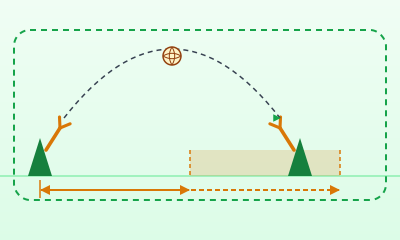
Figure: The orange band and arrow show the suggested distance between players (5 to 10 m). Tossing the ball up high is easier to catch than pushing it forward hard. The sticks and ball are drawn larger than scale.
Equipment & setup
Ogostic needs almost no gear, and setup takes seconds. All you need are two sticks, the hemp ball, and a flat, open patch of ground with room to stand a few metres apart.
- Sticks: wooden sticks with an antler-like forked tip, one per player (two in total). That forked tip is what hooks, throws, and catches the ball. According to one review, the tips are rounded off
- Ball: a single hemp ball with an open, net-like weave. The weave is what lets the stick's tip grab and release it, so you never need your hands. It is soft, so it doesn't hurt much if it hits you
- Open space: guides to the game suggest standing 5 to 10 m apart. Because the ball travels up high, pick a spot clear of tree branches, wires, and bystanders
- Comfortable clothes and shoes: moving as you throw and catch turns the game into a workout; grippy shoes help on grass or sand
Court and equipment dimensions
Ogostic is a commercial play set, and there is no governing body and no official standard, for the equipment or for the playing area. The table below lists the figures given in the Japanese launch press release and in guides to playing it.
| Item | Guide value | Notes / source |
|---|---|---|
| Set contents | 2 sticks and 1 ball | Japanese launch press release |
| Stick length | About 42.5 cm overall | Same source. One review notes the grip feels a little thick for children |
| Materials | Beech wood sticks, hemp ball | Same source |
| Recommended age | 6 and up | The maker's recommendation |
| Distance between players | 5 to 10 m | Suggested in a guide to playing; start closer |
| Size of the playing area | No rule | The ball goes high, so check the space overhead too |
We could not confirm an official figure for the ball's diameter, so it is not listed here.
At its Japanese launch the set was priced at 2,500 yen before tax. The kit is light and compact enough to carry in a backpack. Start with the players close together to get a feel for the catch, then gradually spread out.
Players & ages
| Format | Players | Notes |
|---|---|---|
| Standard | 2 | The set contains two sticks and one ball |
| Passing circle | 3 or more | With one stick per person, more people can join |
| With small children | 1 adult and children | The adult holds the stick and the children throw the ball onto it, like a ring toss |
The maker recommends it for ages 6 and up.
Rules
Ogostic is all about throwing a hemp ball back and forth with the sticks alone, no hands, and keeping the rally going. Learn the minimal rules below and you can play the same afternoon.
How a round works (minimal rules)
- Stand 5 to 10 m apart, facing your partner
- Hook the ball onto the tip of your stick and toss it toward your partner. Aim to send it up in a high arc rather than straight ahead; it is much easier to catch that way
- Your partner catches it on the forked tip of their stick, spearing the tip into the weave of the ball. No hands
- They toss it straight back the same way
- Keep going and see how many consecutive catches (the rally) you can string together. You can also play a timed version, counting how many catches you complete within a set time
At first, just focus on keeping the ball off the ground. Once that feels natural, add the movement and variety below.
Standard rules (adding skill)
- No hands: during a rally the ball is handled with the sticks only. Resisting the urge to grab it is the whole point of the game
- Drop it? Scoop and restart: if the ball lands, lift it back up with the stick's tip and start a new rally. It helps to agree that you may use your hand just to load the ball for the first throw
- Refine the throw: a soft, high arc is far easier to catch than a hard, flat throw. As you improve, throw slightly off to one side to make your partner move for it
- Keeping score: for competitive play, count consecutive catches or successes within a time limit. A simple "drop it and you swap" rule works well too
Official competition rules
Ogostic is a play set from a single toy maker, and we could not find any governing body, unified rulebook, or official tournament. Reviews of the game also say that there are no set rules. Each group sets its own house rules for the distance, how to decide a winner, and how many sticks to use. Read the scoring examples and tricky calls below as suggestions for your own house rules, not official rules.
Scoring examples
Since there is no official scoring, here are some ways to keep count that you can use among friends.
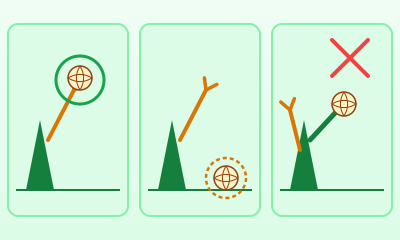
Figure: Left: a successful catch on the tip of the stick (green ring). Middle: the ball has hit the ground and the rally is over (orange dashed ring). Right: grabbing the ball by hand is a foul (red cross).
- Example 1: counting the rally. Players A and B count A, B, A, B. If B drops the throw that follows the eighth catch, the record is 8. Try to beat your personal best
- Example 2: a one-minute time attack. Count the successful catches in one minute. If you drop the ball, pick it up and keep going, adding only the successes. Even with three drops, 15 successful catches means a score of 15
- Example 3: one point per drop (circle of three). Three players pass the ball around in turn, and whoever fails to catch it gets 1 point. Agree that the first to 3 points loses, and a game takes only a few minutes
Common fouls and tricky calls
None of these are official rules; they are points worth agreeing on before you play.
- Touching the ball by hand: counting any hand contact during a rally as a failed catch keeps things clear. Allowing a hand only to load the ball for the first throw keeps the start smooth
- The ball touched the ground first: agree that scooping up a ball after a bounce does not count toward the rally
- Caught, or just deflected? Judging by whether the ball comes to rest on the stick tip (a catch) or bounces off and falls (a miss) avoids arguments
- Unreachable throws: make a throw that clearly lands out of your partner's reach count as the thrower's miss. It trains everyone to throw with the catcher in mind
- Swinging the stick: never hit anyone with the stick, and don't swing it near other people. That comes first, whatever house rules you choose
Tips for enjoying the game
Common beginner mistakes
- Wanting to grab with hands: stick only; resist the urge
- Throwing too hard: soft arcs are easier to catch and look better
- Staying still: move your feet to where the ball will come down before you catch it
How to make it more fun
- Beat the partner record for consecutive catches
- Group circle: pass around in sequence
Age variations
- Kids: shorten the distance to about 3 m. If the grip feels thick, have an adult demonstrate the throw alongside them
- Adult beginners: start with catches, build up to throws
- Active types: widen the distance or add a rule that you must catch on the move
Playing Ogostic in Japan
- Available online and in outdoor shops. Some campsites and glamping sites also lend sets out as an activity
- Park lawns, riversides, and beaches all work. Because the ball goes high, stay away from other people, tree branches, and wires
- It is still little known, so playing in a park turns heads. Inviting curious kids nearby to try it is a good way to widen the circle
Frequently asked questions
Q. How much space do I need?
There is no official standard. Guides suggest 5 to 10 m between the two players, so an open area of about 12 to 15 m long, with some margin at each end, is comfortable. Because the ball goes high, check that there are no branches or wires overhead.
Q. How do you decide who wins?
There are no official rules, so the players decide. Comparing consecutive catches, or successful catches within a time limit, is the easiest way. With three or more players, a rule like "a drop is 1 point, first to 3 points loses" also works.
Q. Can you play on surfaces other than grass?
Yes. The ball isn't meant to roll along the ground, so beaches and dirt fields work as well as grass. On a beach your footing is less stable, so shorten the distance to keep the rally going.
Q. How old do kids need to be to play?
The maker recommends ages 6 and up. With younger children who can't yet handle the stick and ball, start with the adult holding the stick while the children throw the ball onto it.
Q. How many people can play?
The set has two sticks, so two players is standard. With one stick per person, three or more can pass the ball around in a circle.
Learn more
- OgoSport official site: the maker. As of September 2026 we could not find the Ogo Stick in the product list on its official site
- Japanese launch press release (in Japanese): about OgoSport and the product specifications
- A guide to playing Ogostic on Happy Camper (in Japanese)
- Related: Ladder Golf and Spikeball, other lawn games played with gear
Share this page