Tóu Hú 101 — The 2,500-Year-Old Chinese Vase-Throwing Game
- Players:
- 2–8 players
- Region:
- China / Korea
- Tags:
- Small group, Medium group, Throwing, Asia, Traditional, Family-friendly
What is this game?
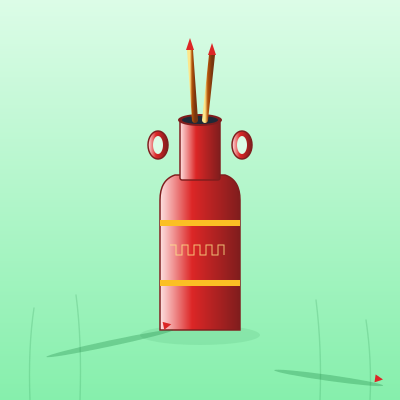
Tóu hú is a classical Chinese game dating back ~2,500 years to the Zhou dynasty. Players throw arrow-like sticks into a special vase with side handles, scoring points based on which opening the arrow enters.
Detailed rules appear in the Confucian classic Liji (Book of Rites),
and the game was a refined court pastime for ancient China's gentry.
It later spread to Korea as tuho and to Japan during the Heian period.
Today, you can still try tóu hú at sites like Gyeongbokgung Palace in Korea, and at Asian cultural festivals worldwide.
Equipment & setup
Tóu hú needs very little gear, and setup takes almost no time. All you really need are the pot, a handful of arrows, and a few metres of flat, level space.
- The pot (
tóu hú) — a special vessel with a narrow neck and a small hollow handle (an "ear") on each side. Roughly 30–50 cm tall, with a mouth about 5–6 cm across. Classical pots were heavy bronze; today ceramic, wood, or metal all work. Landing an arrow in an ear — narrower than the mouth — scores bonus points, the signature twist of the game - Arrows — slim wooden rods with no arrowhead, about 45 cm long, 4–12 per player. Bamboo or thin dowels work too; a lightweight, blunt tip is safest and easiest to handle
- Throw line — set it about two arrow-lengths back, roughly 2–2.7 m from the pot. Adjust the distance for age and skill
- Something to keep score — paper and pen, or a pile of pebbles or cards to tally the arrows that land
- Venue — indoor or outdoor both work. Pick a flat surface where the pot sits steady, with clear space so no one stands in the throwing line
Authentic tóu hú sets turn up at Chinese specialty shops, antique dealers, and online, but for casual family play a narrow-necked vase — or even a tall bottle — with chopsticks tossed into it is plenty of fun. Start with whatever container and sticks are handy to get a feel for landing them, then upgrade to a proper eared pot once you're hooked. Because a tall pot tips easily, steady its base with a sandbag or a stand.
Players & ages
- 2–8 players take turns
- Anyone from kids to seniors can play; minimal physical demand
Rules
Tóu hú is all about landing slender arrows in the pot from a set distance. Learn the minimal rules below and you can play the same afternoon.
How a round works (minimal rules)
- Place the pot in the centre of a flat area and mark a throw line about 2 m away
- Decide the order; each player takes the same number of arrows (4–12)
- Standing behind the line, players take turns tossing one arrow at a time into the pot
- Each arrow that lands in the mouth scores one point — at first, just count the arrows that go in
- Once everyone has thrown all their arrows, tally the scores; the highest total (player or team) wins
- That is one round. Play a set number of rounds, or until someone reaches an agreed target score
At first, just focus on getting arrows into the mouth. Once that feels natural, add the side "ears" and classical scoring from the standard rules below.
Standard rules (adding skill)
- Aim for the ears — the small handles on each side of the neck are worth bonus points, and because they are narrower than the mouth, landing one has always been the mark of a skilled player
- The throw — don't muscle it. Use a soft wrist and a gentle arc so the arrow drops cleanly into the mouth; a looping trajectory is far more consistent than a flat, hard toss
- Weight the scoring — once you're comfortable, give the mouth base points and the ears double, or award extra for the very first arrow, echoing the classical point tables
- Enjoy the etiquette — tóu hú was a ceremonial pastime. Bowing before you throw and taking turns politely are part of its charm
Official competition rules
Tóu hú has no single international federation or rigid, unified rulebook the way modern sports do. Its real reference point is the classical etiquette recorded in the Confucian Liji (Book of Rites), which set out the size of the pot and arrows, the throwing distance, the courtesy of host and guest yielding three times before play, detailed per-arrow scores (for example, 10 points for the first arrow and different values for later ones), and even the custom of the loser drinking a cup at banquets. Today the game survives mainly as a preserved tradition — demonstrated and played at Korean folk villages, at Chinese and Taiwanese cultural festivals, and at Chinatown events in Japan. Common conventions such as roughly two arrow-lengths' distance and 12 arrows per player are used as guidelines, but they are local customs rather than strict official standards, so the spirit is to enjoy the traditional courtesy and scoring rather than chase precise regulations.
Tips for enjoying the game
Common beginner mistakes
- Throwing too hard — the trajectory wobbles. Use a graceful wrist toss
- Trying to drop straight down — instead, arc the arrow into the mouth
- Aiming for the side handles too soon — master the central opening first
How to make it more fun
- Set classic-style rewards/penalties (drinks, prizes) for end-of-round scores
- Wear traditional clothing for festival photos
- Make the arrows by hand with kids — half the fun
Age variations
- Kids: 1 m distance, lightweight arrows
- Seniors: seated games are perfectly fine
- Events: Lunar New Year, garden parties, autumn festivals
Playing Tóu Hú in Japan
- Authentic sets at Yokohama Chinatown or specialty shops
- DIY: tall bottle + chopsticks works for casual play
- Some shrines and Asian festivals host live tuho/tóu hú booths
Learn more
- The classical Liji — Tóu Hú chapter
- Korea National Folk Museum — tuho exhibits and demos
- Beijing Palace Museum — tóu hú artifacts
- Related: see also darts, ring toss, and Pétanque — fellow target throwing games