Gateball 101 — Japan's Homegrown 5-vs-5 Team Lawn Sport
- Players:
- 6–10 players
- Region:
- Japan
- Tags:
- Medium group, Striking, Asia, From Japan, Team, Seniors, Competitive
What is this game?
Gateball is a team ball sport invented in Hokkaido, Japan in 1947 by Kazunobu Suzuki, originally inspired by Croquet. Today it has grown into a competitive sport with roughly 1.2 million players in Japan and organized play in over 50 countries under the World Gateball Union (WGU).
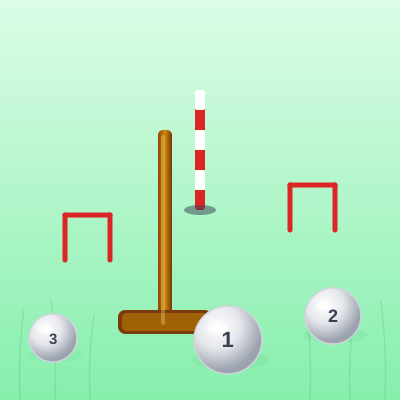
Two teams of five players each take turns hitting numbered white balls with a T-shaped mallet through three gates in sequence, then striking the goal pole in the center to complete a run.
The strategic core is the spark: when your ball touches an opponent's, you place your foot on yours and hit it, sending the opponent's ball flying. A well-executed spark can eliminate a scoring ball entirely. Gateball is often called "shogi on the lawn" for its deep tactical layers.
Equipment & setup
Gateball uses a specific set of gear, but once you have a set, setup is quick. All you really need is a flat lawn and something to mark out the court.
- Mallet — a T-shaped striking tool with a wood or synthetic head, at least 50 cm long. You hold it in both hands and push the ball rather than swing at it
- Balls — resin balls about 7.5 cm across and 230 g each, numbered 1–10; the Red team plays the odd numbers (1, 3, 5, 7, 9) and the White team the even ones (2, 4, 6, 8, 10)
- Gates — 3 U-shaped metal hoops, set at fixed positions and orientations on the court
- Goal pole — a red-and-white striped stake in the center; striking it after the third gate finishes a ball
- Court — the official size is a 15 m × 20 m rectangle of flat, well-kept grass or dirt
- Timer & scoreboard — for the 30-minute clock and the running score; referees use them in competition
A full regulation set — mallet, balls, and gates — costs about ¥20,000–30,000 ($130–200) from suppliers certified by the Japan Gateball Union (JGA). To start, borrow gear from a community center or senior club, or grab a simple recreational set, get a feel for the push-stroke, and upgrade to a certified set once you're hooked. Pick a spot — a large park lawn or a riverside field — flat and open enough that ten balls can roll around safely, away from other people.
Players & ages
- 5 vs 5 (10 total) is the official format; smaller informal games use 3 vs 3
- Popular primarily with seniors in Japan, but rules accommodate all ages
Rules
Gateball is a team game about sending your ball through three gates in order and finishing on the center goal pole. Learn the minimal rules below and your team can play the same afternoon.
How a round works (minimal rules)
- Split into two teams of five. Each player owns one numbered ball — the Red team takes the odd numbers (1, 3, 5, 7, 9) and the White team the even numbers (2, 4, 6, 8, 10)
- Play runs in number order, 1 through 10, one stroke per turn, repeating for the full 30 minutes
- Hit your ball through Gate 1 → Gate 2 → Gate 3 in sequence — 1 point for each gate cleared
- After all three gates, strike the center goal pole to "agari" (finish) for 2 more points, so a single ball can score up to 5 points (3 for the gates + 2 for the pole)
- Touch and spark — hitting another ball with yours is a "touch." A touch earns you a bonus stroke, the "spark": set your ball against the one you touched, pin yours under your foot, and strike it to send the other ball flying
- Spark an opponent's ball out of bounds and it is sidelined — it cannot score for a while
- When the 30-minute clock runs out, the team with the most points wins
At first, just focus on clearing the gates in order and finishing on the pole. Once that feels natural, add the touch-and-spark tactics in the standard rules below.
Standard rules (adding skill)
- The stroke — don't swing like golf or baseball. Push the ball straight with the mallet head; control of direction and distance matters far more than power
- Sparking with purpose — after a touch, use the spark to "feed" a teammate's ball into a better spot, or to knock an opponent's ball away. This is the tactical heart of the game
- Managing turn order — you can only play on your own number, so teammates call out "you're next" to avoid missed turns
- Formation and teamwork — deciding which balls push for gates and which play defense turns the game deeply strategic — hence the nickname "shogi on the lawn"
Official competition rules
The World Gateball Union (WGU) and the Japan Gateball Union (JGA) set the exact figures: court dimensions (15 m × 20 m), gate and ball specs, the time limit per stroke (usually 10 seconds), how out-of-bounds balls are returned, and referee procedures. The World Gateball Championships are held every year, and the JGA runs official tournaments across Japan. Joining a local club or a beginner clinic is the easiest way to play by the full rules.
Tips for enjoying the game
Common beginner mistakes
- The mallet swing — unlike golf or baseball, Gateball uses a push-through downstroke, not a swing
- Losing track of turn order — always call out the number before each shot
- Wasting the spark — failing to use your extra shot after a touch is a significant loss
How to make it more fun
- Pre-game team strategy: decide which balls go first based on gate positions
- A clean spark that eliminates an opponent's completed ball gets everyone on their feet
- The 30-minute clock creates genuine late-game tension — watch the time
Age variations
- Kids: smaller court, wider gates, skip spark rules to start
- Seniors: walking pace, minimal physical demand, ideal for older players
- Competitive: regulation court, official timer, referee
Playing Gateball in Japan
- The Japan Gateball Union (JGA) has local chapters and runs beginner clinics and tournaments
- Large park lawns are the typical venue
- Official sets (mallet + balls + gates) cost ¥20,000–30,000 from JGA-certified suppliers
- Community centers and senior citizen clubs often have free intro sessions
Learn more
- World Gateball Union (WGU) — rules and World Championships
- Japan Gateball Union (JGA) — clubs, clinics, and tournaments in Japan
- Related: see also Croquet, Cornhole, and Pétanque