Tug of War Rules: Team Size, Rope Length, the 4 m Pull & Winning Tips
- Region:
- Worldwide
- Tags:
- Team, Strength, Competitive, Traditional, Kids
At a glance
- Players
- 4–40 players
- Game length
- A pull can be over in seconds or drag on for minutes. A match is two pulls (best of three in the knockout rounds)
- Equipment
- One rope. Official outdoor rope: 36 m long, 10 to 12.5 cm around. Shoes with good grip
- Space
- The length of the rope plus room at each end. Flat grass outdoors; a mat lane indoors (recommended 36 m by 1 to 1.2 m)
Contents (8)
What is this game?
Tug of war is as simple as sport gets: two teams pull on opposite ends of a rope, and the team that drags the other a set distance wins. The only equipment is the rope, the rules are nearly the same everywhere, and yet technique, posture, and team rhythm decide far more contests than raw strength.
Rope-pulling contests are ancient and turn up all over the world, often as rituals: in Japan, villages have long pulled giant ropes to divine the coming harvest. As a modern sport, tug of war was on the Olympic program from Paris 1900 to Antwerp 1920. Today the Tug of War International Federation (TWIF) sets the international rules and holds world championships every year, and tug of war has been on the program of every World Games since the first edition in 1981. In Japan, the sport is governed by the Japan Tug of War Federation (JTWF), and tsunahiki is a fixture of school sports days.
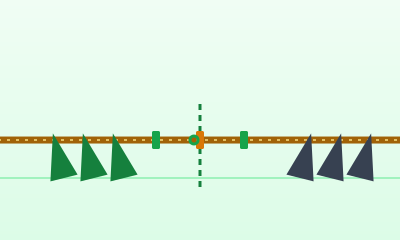
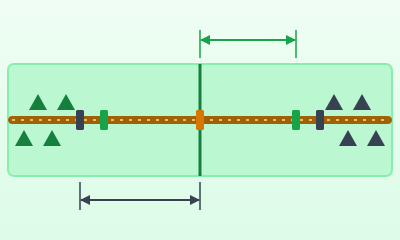
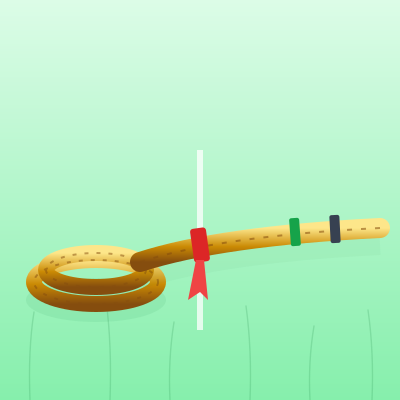
Figure: Rope markings under the TWIF outdoor rules. One mark at the center (orange), one 4 m to each side (green arrow), and one 5 m to each side (dark grey arrow). Pullers must grip the rope outside the 5 m marks.
Tug of war at the Olympics (1900–1920)
Tug of war was contested as part of athletics at five Games. The medalists, as listed by TWIF:
| Year | Host | Gold | Silver | Bronze |
|---|---|---|---|---|
| 1900 | Paris | Sweden | USA | France |
| 1904 | St. Louis | USA | USA | USA |
| 1908 | London | Great Britain | Great Britain | Great Britain |
| 1912 | Stockholm | Sweden | Great Britain | — |
| 1920 | Antwerp | Great Britain | Netherlands | Belgium |
In 1920 the IOC cut several team sports, tug of war among them, to reduce the number of participants. TWIF received provisional IOC recognition in 1999, confirmed in 2002.
Equipment & setup
- Rope: a straight rope with no knots or hand loops. For competition the ends are whipped and the rope carries colored markings at the center and on each side
- Shoes: shoes with good grip. TWIF's outdoor rules even regulate the shape and height of the heel (no more than 35 mm including the sole)
- Belt: in competition, the anchor (the last puller) wears a protective belt where the rope rests
- Clothing: in competition, matching shirts, shorts or sports leggings, and socks
- Pulling area: flat grass outdoors, with one center line marked on the ground. Indoors, teams pull on an approved friction mat
- Officials: a judge in charge and a side judge opposite. At a school or picnic, always appoint an adult to give the commands and make the calls
Tug of war rope length and markings
The table compares the TWIF international rules (Rules Manual 2026) with the domestic indoor rules of the Japan Tug of War Federation.
| Item | TWIF outdoor | TWIF indoor | JTWF (Japan, indoor) |
|---|---|---|---|
| Rope thickness | 10 to 12.5 cm in circumference | 10 to 12.5 cm in circumference | — |
| Rope length | 36 m at the start of an international championship | — | — |
| Rope markings | Center, 4 m each side, 5 m each side (three colors) | Center, 2.5 m each side (two colors) | Center mark and a "white mark" 2 m each side |
| Ground or floor markings | One center line | Center line and side lines 4 m each side | Center line and a "white line" 2 m each side |
| How a pull is won | The opponent's 4 m mark crosses the center line | The rope's center mark crosses your side's 4 m line | Pull until the white mark meets the white line, 4 m in total |
| Where you may grip | Outside the 5 m marks | — | — |
Under every set of rules, the winning distance is 4 m. At school events it's common to tie a ribbon at the middle of the rope and mark lines an equal distance either side of the center line.
Players & ages
| Format | Team size | Notes |
|---|---|---|
| TWIF international competition | 8 pullers | One substitution allowed for the whole competition. Mixed teams are four men and four women |
| JTWF competition (Japan) | 12: 8 pullers, 2 substitutes, a coach, and a trainer | The coach and trainer may also be pullers |
| School and recreational | Any number, equal on both sides | Match the number of pullers to the length and strength of the rope |
Tug of war weight classes
Competitive teams are graded by the combined weight of all eight pullers. The main TWIF classes (some differ between outdoor and indoor):
| Category | Main classes (total for 8 pullers) |
|---|---|
| Senior men | 560, 600, 640, and 680 kg |
| Senior women | 500 and 540 kg (plus 520 and 560 kg outdoors) |
| Junior (age 14 to 18) | Men 560 kg, women 480 kg |
| Mixed (4 + 4) | Junior 520 kg, under-23 560 kg |
JTWF domestic events range from a 400 kg flyweight class up to a 720 kg heavyweight class, plus an unlimited "catch" class. Pullers may enter the senior category from the start of the year in which they turn 16.
Rules
The whole game is pulling the rope a set distance toward your side. Start with the minimal rules, then learn the official posture and fouls: they make you both safer and stronger.
How a pull works (minimal rules)
- Mark a center line on the ground and line up the rope's center mark (or ribbon) directly above it
- The teams take the rope, one at each end
- On the judge's signal, both teams pull
- When the agreed mark (for example the opponent's 4 m mark) crosses the center line, the pulling team wins. Sports days sometimes use "whoever has the center mark on their side when the whistle blows" instead
- Swap ends and pull again; the team with more wins takes the match
Before the first pull, make sure everyone knows three things: never wrap the rope around a hand or body, don't pull before the signal, and don't let go suddenly when the whistle blows.
Standard rules (adding skill)
- Grip: both bare hands, palms facing up (TWIF's "ordinary grip")
- Rope under the arm: the rope runs between your body and your upper arm. No carrying it on the shoulder or holding it below the waist
- Feet forward: keep your feet out in front of your knees and lean back. Sitting down or touching the ground with anything but your feet is a foul
- The anchor: the last puller runs the rope alongside the body, diagonally across the back and over the opposite shoulder, then under the armpit and out behind. This is a specialist competition technique and has no place at a school sports day
- The front puller: grips as close as possible to the outermost mark allowed (the 5 m mark outdoors)
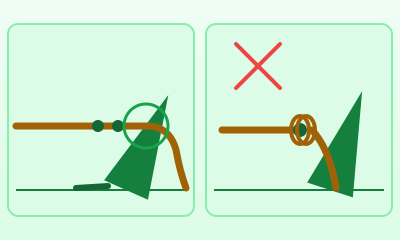
Figure: Left, correct posture: rope under the arm, palms up, feet in front of the knees. Right, rope wrapped around the hand: dangerous, and a foul under TWIF rules.
Official competition rules
Under the TWIF international rules, a contest runs like this:
- Commands: "Pick up the rope" → "Take the strain" (pull the rope taut; outdoors each puller may make one foothold with the heel) → "Steady" (the center mark is held over the center line) → "Pull". The judge also gives each command with an arm signal
- Winning a pull: outdoors, when the opponent's 4 m mark is pulled past the center line on the ground; indoors, when the rope's center mark passes the 4 m line on the floor. A team also wins if the opponent is disqualified
- Cautions: the judge gives a caution for each infringement. A team can receive two cautions in one pull; the next infringement disqualifies it. One puller's foul counts against the whole team
- Match format: in the qualifying round, every team meets every other and each match is two pulls. Semifinals and finals are best of three
- Rest: up to six minutes between matches
- No pull: if both teams keep fouling, or a long stalemate sets in, the judge can declare a "no pull"
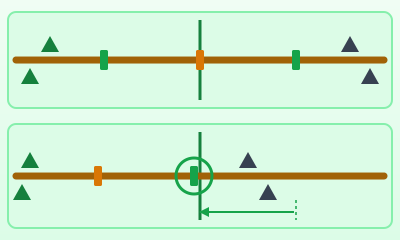
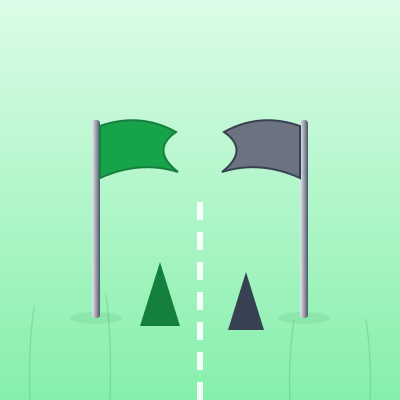
Figure: Top, the start. Bottom, the moment the left-hand team wins: the right-hand team's 4 m mark (green) has crossed the center line.
Scoring examples
In a TWIF points competition, each match (two pulls) earns points:
| Result | Winner | Loser |
|---|---|---|
| Qualifying match won 2-0 | 3 | 0 |
| Qualifying match split 1-1 | 1 | 1 |
| Knockout match won 2-0 | 3 | 0 |
| Knockout match won 2-1 | 2 | 1 |
- Example 1: Team A beats B 2-0 and splits 1-1 with C. A has 3 + 1 = 4 points
- Example 2: In a semifinal, A wins the first pull, loses the second, and wins the third. A goes through, 2-1
- Example 3: If teams finish the qualifying round level on points, they are separated by their results against each other, then matches won, then the fewest cautions
Common fouls and tricky calls
The main infringements in the TWIF rules:
- Sitting: deliberately sitting down, or not getting straight back into position after slipping
- Leaning: touching the ground with any part of the body other than the feet
- Locking: any hold that stops the rope moving freely (for example, bracing the elbow against the thigh)
- Propping: holding the rope so it doesn't pass between the body and the upper arm
- Climbing the rope: sliding the rope through your hands to gather it in
- Rowing: repeatedly sitting down while moving the feet backward
- Footholds: digging in with the heel outdoors before the "take the strain" command
- Trainer: the trainer calling instructions to the team during a pull
- Knots and loops: tying a knot or loop in the rope, or locking it across any part of the body. Crossing the rope over itself counts as a loop
Tips for enjoying the game
Tug of war safety
Tug of war looks harmless, but it puts huge forces through a rope and the people holding it, and there have been serious accidents.
- Never wrap the rope around a hand, wrist, arm, or body: a wrapped rope that tightens can cost fingers or a hand. A 2014 case report in Case Reports in Orthopedics describes a 10-year-old boy who pulled at a school picnic with the rope twisted three times around his upper arm and suffered radial nerve palsy (he recovered within three months); the authors' review notes reported injuries ranging up to amputations
- Ropes can snap: on October 25, 1997, a 5 cm nylon rope broke during a tug of war with about 1,500 people in Taipei, and the recoil tore off two men's arms. Keep the number of pullers suited to the rope
- Fingers: in February 2013, two students at a high school in El Monte, California, lost fingers in a lunchtime tug of war
- Backs take the strain: in the studies reviewed by the same paper, the back accounted for 42 to 44% of tug of war injuries, the shoulder and upper limb 23%, and the knee 17%. Warm up first
- Don't let go suddenly: if one team drops the rope, the other falls backward and can hit their heads. Hold on until the whistle and then ease off
- Bystanders: keep people away from the ends of the rope and behind the teams
When children pull, have one adult judge and another watch the teams, and blow the whistle at once if:
- someone falls or is about to be trampled
- the rope is wrapped around anyone's hand or arm, or twisting around someone
- the rope lifts off the ground to face or neck height
- the ground is wet and slippery, or someone has lost a shoe
Tug of war technique and strategy
- Get low and use your weight: don't pull with your arms. Feet forward, lean back, and let your body weight do the work, with the rope clamped under your arm
- Pull in rhythm: a shared chant or count keeps everyone pulling at the same instant. Out-of-sync pulling wastes strength
- Survive the first rush: be in position the moment the command comes so you aren't dragged in during the first seconds. If the other team is surging, dig in and hold; then pull hard together when they tire
- Lining up: alternating sides of the rope keeps it straight and stops neighbors bumping each other, and even spacing helps. A common recommendation is to put a steady, stubborn puller at the back
- Footing: on grass, drive your heels into the turf. Indoors, use a proper grip mat
Age variations
- Young children: a short, thin rope and small teams, with a single pull decided by the ribbon crossing a line
- Primary and secondary school: equal teams by class or grade, best of three. Go over "never wrap the rope" every time
- Adults and competitors: match teams by total weight and use TWIF or national rules. There are indoor mat competitions too
Playing Tug of War in Japan
- Governing body: the Japan Tug of War Federation was founded in 1980 and joined TWIF in 1985. It runs national events such as the All Japan Tug of War Championships, has a federation in each prefecture, and sets the domestic weight classes and age categories listed above
- Traditional tug of war: according to the JTWF, festivals that pull giant ropes to divine the harvest or the catch survive across the country, from the Ōmagari tug of war in Akita in the north to the Yonabaru tug of war in Okinawa in the south. The Sendai Great Tug of War in Satsumasendai, Kagoshima, is said to use a 365 m rope pulled by around 3,000 people, and the rope of the Naha Great Tug of War in Okinawa is said to be over 200 m long and over 40 tonnes. Many of these are Shinto rituals as well as contests, so join in on the community's terms
- Sports days: tug of war spread with school sports days from the Meiji era onward and remains a standard event. Ropes for school and community events can be rented
- Where to pull: any flat lawn or schoolyard long enough for the rope plus space at each end. In a public park, keep paths clear for other visitors
Frequently asked questions
Q. What are leaning, locking and propping in tug of war?
They are fouls under the Tug of War International Federation (TWIF) rules. Leaning means touching the ground with any part of the body other than the feet; locking means fixing the rope so it can't move freely (for example by bracing an elbow against the thigh); propping means holding the rope so it doesn't pass between the body and the upper arm. Other fouls include sitting (deliberately sitting down) and climbing (hand-over-hand pulling). See "Common fouls and tricky calls" above for the full list.
Q. How many people are on a tug of war team?
A competition team has eight pullers. In Japan, JTWF teams have 12 members: eight pullers, two substitutes, a coach, and a trainer. For fun, any number works as long as both sides are equal.
Q. How far do you have to pull to win?
Four meters. Under the TWIF outdoor rules, you win when the opponent's mark, 4 m from the center of the rope, crosses the center line on the ground. The JTWF indoor rules also come to 4 m: the 2 m marks on the rope must meet the 2 m lines on the floor.
Q. How long and thick is a tug of war rope?
TWIF international championships use a rope 36 m long and 10 to 12.5 cm in circumference, with no knots. National events and school games use whatever length suits the number of pullers.
Q. Was tug of war an Olympic sport?
Yes. It was held at five Olympic Games, from Paris 1900 to Antwerp 1920. It is no longer on the Olympic program, but TWIF is an IOC-recognized federation and tug of war appears at every World Games.
Q. Why can't you wrap the rope around your hand?
Because when a wrapped rope is pulled tight, it can crush or sever fingers and hands. TWIF rules also forbid loops in the rope and locking it to the body. Hold it palms up and clamp it under your arm.
Q. What's the best tug of war strategy?
Feet forward, lean back, and pull with your body weight rather than your arms. Keep the rope under your arm, pull in rhythm with a chant, line up on alternating sides, and be in position the instant the pull starts so you aren't dragged in early.
Learn more
- TWIF Rules Manual 2026 (PDF): the international rules, plus Olympic and World Games results
- Rules of tug of war, Japan Tug of War Federation (in Japanese)
- Competition categories and weight classes, JTWF (in Japanese)
- Tug-of-War Injuries: A Case Report and Review of the Literature (Case Reports in Orthopedics, 2014)
- Tug of war (Wikipedia): notable accidents and regional traditions
- Related: Kabaddi and Flag football, team contests of strength and territory
Share this page