Lawn Darts (Jarts) 101 — America's Backyard Classic, and Its Safety Story
- Players:
- 2–4 players
- Region:
- United States
- Tags:
- North America, Throwing, Family-friendly, 1v1, Small group
What is this game?
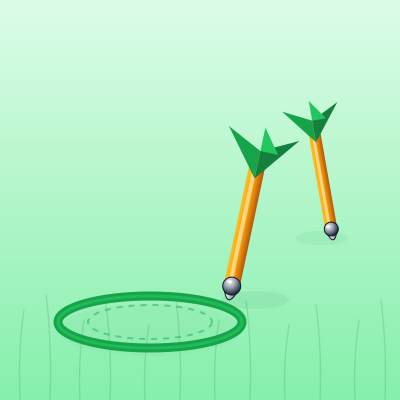
Lawn darts (also sold under the brand name Jarts) is an American backyard game that spread in the mid-20th century. Players lob large, weighted darts underhand in a high arc so they land point-first inside a target ring (about the size of a hula hoop) resting on the ground, scoring points for accuracy.
The scoring and layout closely resemble horseshoes: two players (singles) or two teams (2v2) take turns throwing. Because control matters far more than strength, adults and kids can compete on equal footing.
But this game carries an important safety history. The old metal-tipped, sharp-pointed lawn darts caused serious injuries and child deaths, and were banned from sale in the United States in 1988 (and in Canada as well). Today you should only use the soft, rounded-tip "safe" version. This article describes that modern, safe version throughout — more on this in the next section.
Equipment & setup
Lawn darts needs little gear and almost no setup — just a few darts, a target ring, and a large, flat, clear patch of ground. Before you play, read the safety note below.
⚠ Most important safety note — The old sharp, metal-tipped lawn darts (Jarts) repeatedly caused severe injuries, including punctured skulls in children, and were banned from sale in the United States in 1988 (Canada too). If you play today, use only the soft, rounded-tip "safe" version (weighted round tip). If you find a metal-tipped set in a garage or attic, do not play with it — dispose of it. And with any version, the absolute rule is: never throw toward people, and never let anyone stand in the throwing area.
- Darts — a large dart with a weighted tip, a slim shaft, and fins at the tail. A set is typically 2 darts per color in 2 colors (4 total). Always choose the safe, rounded-tip version
- Target ring — the ring you place on the ground, roughly hula-hoop sized (about 40–60 cm across). If yours didn't come with one, a loop of rope or a chalk circle works
- Ground — grass or soft earth, so the tip lands softly and stays put. Avoid concrete or asphalt, where darts can bounce dangerously
- Throw line (optional) — mark where players stand with tape or rope for fair play
- Plenty of space — because darts fly in a high arc, leave room overhead and around the landing area, and keep kids and pets well clear of the throwing direction
A safe-version set usually costs about $15–30. Start with a light plastic safe set to get a feel for the lob, and add a second ring to play horseshoes-style.
Players & ages
| Format | Players | Darts each |
|---|---|---|
| Singles | 1 vs 1 | 2 |
| Doubles | 2 vs 2 | 2 |
Even with the safe version, the guideline is that players should be old enough to control the strength and direction of their throw. When younger kids join, an adult must supervise and manage the throwing area at all times. Because aim matters more than muscle, all ages can compete evenly.
Rules
Lawn darts is a simple target game: lob a large dart underhand in a high arc and land it in the ring on the ground. The scoring is much like horseshoes. Learn the minimal rules below and you can play the same afternoon.
How a round works (minimal rules)
- Place one target ring on flat, soft ground. For a fuller game, set out two rings about 10 m (35 ft) apart and throw between them (the horseshoes layout)
- Stand at the throwing spot and decide who goes first
- The first player lobs a dart palm-down, underhand, in a high arc. Never throw overhand or hard and flat — that is dangerous
- The dart turns point-down as it descends and lands tip-first. Landing inside the ring is the goal
- Throw the second dart, then the other player (or team) throws their two
- When everyone has thrown, count the score (see below)
- That's one round. Play more rounds until a team reaches 21 points and wins
At first, just focus on a soft, high lob aimed at the ring. The scoring tactics get fun once that feels natural.
Standard rules (adding skill)
Scoring (horseshoes-style, with cancellation):
- Inside the ring (a "ringer") — 3 points per dart
- Outside the ring but closer than any of the opponent's darts — 1 point for the single closest dart
- Cancellation — matching results cancel out (for example, if both sides land a ringer), and only the difference scores. Usually only one side scores in a given round
Technique tips:
- The throw — always underhand, with a high, lofted arc. The more cleanly it drops from the top, the more the tip points straight down and settles in the ring
- Judging distance — with a lofted throw, range is set by your release angle more than by power. Keep the same motion and tweak the angle
- Consistency — repeat your stance, foot position, and arm swing to keep your landings predictable
Official competition rules
There are competition rules modeled on horseshoes. Typically two rings are set facing each other at a fixed distance (about 10 m), and players throw alternately from each end. A dart inside the ring scores 3, the closest dart outside scores 1, matching results cancel, and the first team to exactly 21 points wins (how an overshoot past 21 is handled — voided, or the turn scores nothing — varies by league or region). Because the metal-tipped version is banned as noted above, using the safe version is the modern baseline for official and casual play alike.
Tips for enjoying the game
Safety first, always
- Never throw toward people. Every time, confirm no one — and no pet — is in the throwing direction, around the landing area, or overhead
- Use only the safe version. Don't use, lend, or let anyone play with the old sharp metal-tipped darts; if you find a set, dispose of it. Precisely because they were once sold openly, adults need to enforce this
- Take turns. While someone is throwing, no one goes near the ring or darts. Collect them only after everyone has thrown
Common beginner mistakes
- Throwing too hard. A hard, flat throw keeps the tip from pointing down, so it won't stick in the ring. A soft, high loft works better
- Using power to fix distance. Adjust range with angle, not strength
- Poor ground choice. Hard ground makes darts bounce dangerously — pick grass or soft soil
How to make it more fun
- Set out two rings some distance apart and throw between them, horseshoes- style, to cut waiting time and keep a good rhythm
- 21 points takes a while; try a shorter target like 11 for quick games
- True backyard style: relaxed rounds and conversation next to a BBQ or campsite
Playing lawn darts in Japan
- The old metal-tipped version is not generally sold in Japan. When buying, make sure it is the rounded, safe-tip version
- Wide grassy areas — parks or riverbanks — are ideal. Because darts fly in a high arc, avoid crowded or cramped spots
- No ring in the box? A hula hoop, a loop of rope, or a chalk circle works. Add a second ring for horseshoes-style play
- When playing with kids, an adult should manage the throwing area, and everyone but the thrower waits behind the line
Learn more
- The U.S. Consumer Product Safety Commission (CPSC) 1988 ban on lawn dart sales (in response to injuries from metal-tipped darts)
- Horseshoes — a sister game with very similar scoring and layout
- How to choose a safe-version lawn dart set (soft / rounded tip)
- Related: see also Petanque, Mölkky, and Kubb — other aim-and-throw lawn games