Lawn Bowls 101 — Britain's Classic Game of Curving Bowls Toward the Jack
- Players:
- 2–8 players
- Region:
- United Kingdom
- Tags:
- UK, Ball game, Seniors, Family-friendly
What is this game?
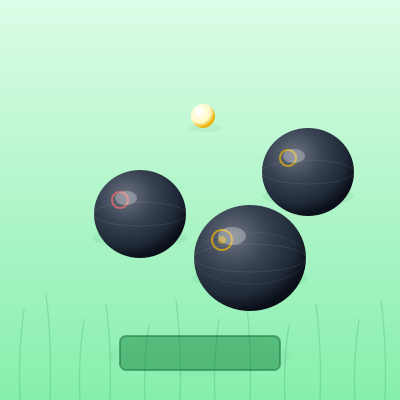
Lawn bowls (Lawn Bowls) is a classic British lawn game with roots going back to 13th-century England. Today it is played across the UK and the Commonwealth — Australia and New Zealand in particular — by people of all ages.
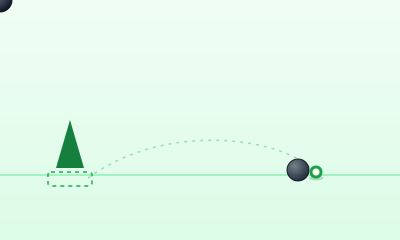
Its defining feature is that a bowl is not a perfect sphere: it is weighted on one side, giving it a "bias." Even when rolled straight, a bowl gently curves as it slows down, tracing an arc toward its target. Players read that curve to stop their bowls as close as possible to a small target ball called the jack.
Unlike petanque, where metal balls are thrown, lawn bowls are rolled along the ground. Judging the curved path created by the bias is what gives the sport its depth.
Equipment & setup
Lawn bowls needs little more than the bowls, a jack, and a flat stretch of grass. Setting up is straightforward.
- Bowls — dark, biased balls weighted on one side. Each player uses 2–4 bowls depending on the format. One face carries a large emblem disc, the other a small one; the large-disc side is the inside of the curve. Sizes are chosen to suit your hand
- Jack — the small target ball, white or yellow, 63–67 mm across (also called the "kitty")
- Mat — the footing you stand on to deliver a bowl; one foot must stay on or over the mat as you release
- Tape measure — for close calls; essential in competition
- Green — a flat, closely mown grass surface. In competition a rectangular green is divided into strips called "rinks." For casual play a well-kept park lawn is plenty
Competition bowls have a precisely engineered bias, but a leisure set is enough to feel the joy of "curving a bowl toward the target." Start with lighter bowls to learn the roll, then upgrade to competition bowls once you're hooked. Pick a flat, well-mown lawn — the smoother the surface, the more predictably the bowl rolls and curves.
Players & ages
| Format | Players | Bowls each |
|---|---|---|
| Singles | 1 vs 1 | 4 |
| Pairs | 2 vs 2 | 4 |
| Triples | 3 vs 3 | 3 |
| Fours | 4 vs 4 | 2 |
Because accuracy matters more than strength, everyone from children to seniors can play. In the UK and across the Commonwealth it is a much-loved lifelong sport, especially popular with older players.
Rules
Lawn bowls is all about getting your bowls closer to the jack than your opponent does. Learn the minimal rules below and you can play the same afternoon.
How a round works (minimal rules)
- Choose who goes first (a coin toss works) and place the mat at the near end of the green
- The first player stands on the mat and rolls the jack down the green. Where it comes to rest becomes the target for that round
- The same player then rolls their first bowl toward the jack. Because the bowl curves with the bias, aim slightly to one side rather than straight at the jack so it arcs in
- The other side then rolls
- From here on, the team whose nearest bowl is farther away keeps rolling until they get closer; the leading team waits
- Once every bowl has been delivered, count the score: the team with the closest bowl scores one point for each of its bowls that beats the opponent's best one. This exchange is called an "end"
- Move the mat and roll the jack back the other way for the next end. Play a set number of ends, or until a team reaches the target score, to decide the game
At first, just focus on reading the bias and drawing close. Once that feels natural, add the techniques below.
Standard rules (adding skill)
- Bias direction — every bowl curves one way. To aim left or right of the jack you choose which side to set the bias on, then judge how much the bowl will swing and "shape" it in
- Weight — the strength of your roll is called "weight." Too little falls short; too much runs through. Because the bias only bites as the bowl slows, controlling weight is everything
- Draw vs. drive — a gentle "draw" eases a bowl close, while a hard "drive" is used to knock away an opponent's bowl or move the jack
- Foot fault — as you release, one foot must be on or over the mat. Stepping off is a foul
Official competition rules
World Bowls, the sport's international governing body, sets exact figures in its Laws of the Sport (the Crystal Mark editions): rink dimensions, the minimum distance the jack must travel, how out-of-bounds bowls and jacks are handled, and the precise measuring procedure. Each format fixes the number of ends and bowls per player — singles is typically first to 21 points, pairs and fours run 21 ends, and triples 18 ends. Clubs and taster sessions exist in Japan too, so you can play by the full rules.
Tips for enjoying the game
Common beginner mistakes
- Aiming straight and forgetting the bias. The bowl always curves — aim wide enough to let it swing in
- Rolling too hard. Too much speed runs past before the bias can bite. A bowl that just barely stops draws closest
- Ignoring the green's pace. A dry, fast green and a damp, heavy one curve and run very differently
How to make it more fun
- A well-timed "drive" that knocks the leader out swings the whole end and thrills the crowd
- Deliberately moving the jack itself is a valid tactic — pull it off and you'll get cheers
- Full games can run long, so agreeing on a short number of ends keeps casual play snappy
Age variations
- Kids: lighter bowls, shorter distances, simplified "closest wins" rules
- Seniors: play standing with little movement — an ideal lifelong sport
- Competitive play: regulation mat-to-jack distances and a tape measure for exact calls
Playing lawn bowls in Japan
- Competition bowls are pricey; start with an affordable leisure set to feel the "curving bowl"
- You don't need a regulation green — a well-mown park lawn works fine. Choose a safe spot so bowls don't reach other people
- Clubs and taster sessions exist around the country. One try is usually enough to appreciate the charm of the bias
Learn more
- World Bowls — Laws of the Sport
- Local lawn bowls clubs and taster sessions
- Match footage from the Commonwealth Games, where lawn bowls is a core event
- Related: see also Petanque, Bocce, and Kubb