Wanage 101 — Japan's Classic Ring-Toss Game from the Festival Stalls
- Players:
- 1–8 players
- Region:
- Japan
- Tags:
- From Japan, Throwing, Family-friendly, Seniors, Party
What is this game?
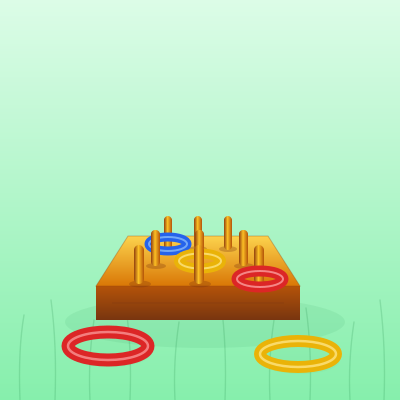
Wanage (輪投げ, literally "ring throwing") is Japan's classic ring-toss game:
you throw rings and try to loop them over numbered pegs.
It's a fixture of summer festival (縁日) stalls, school and community field days,
and — above all — recreation and rehabilitation programs at senior centers,
enjoyed across every generation.
The idea couldn't be simpler. Stand behind a line, toss your rings at a board studded with numbered pegs, and add up the numbers on the pegs your rings land on. Because aim and control matter far more than strength, kids, adults, and seniors can all compete on equal terms — even seated — which is exactly why it has stayed popular for so long.
Its roots trace back to Western deck games like deck quoits and quoits,
once played by tossing rope rings at a target on a ship's deck.
In Japan it spread from around Kobe in the Taishō era as a game called tōrin (投輪).
Equipment & setup
Wanage needs very little gear, and setup takes almost no time. All you really need are the board with its pegs, a handful of rings, and a few metres of flat ground.
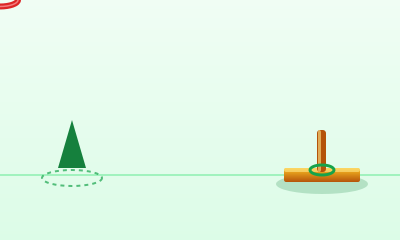
- The board — a stand holding nine numbered pegs. The standard is a square roughly 60 cm on a side, with the nine pegs set in a 3×3 grid. There are fixed outdoor stands as well as small tabletop versions
- Rings — nine per player is standard. Usually rubber or plastic, about 16–19 cm across and 110–135 g each. They come in colours — red, yellow, and blue — used to split rings between turns or to assign colours to teams
- Pegs — the target posts on the board, around 15 cm tall, all the same thickness and height. Each peg's point value (1–9) is written at its base or on a number board behind it
- Throw line — a marker for where you throw from, set a fixed distance from the board. Rope, tape, or chalk all work
- Ground — grass, dirt, a gym floor, or an indoor floor all work, as long as the board sits level. A park or an indoor room is equally fine
Retail home sets start from just a few dollars and are plenty to begin with. You can also make your own — the board from cardboard or plastic bottles, the rings from rolled newspaper or cardboard tubes — which is part of wanage's charm. Just pick a flat, roomy spot where a stray ring won't hit anyone.
Players & ages
| Format | Players | Rings each |
|---|---|---|
| Solo / take turns | 1+ | 9 |
| Head-to-head | 2 | 9 each |
| Teams | 2–4 teams | split by colour |
Everyone from toddlers (~3) to seniors in wheelchairs can play by the same rules. You can throw sitting down, and physical differences barely matter — that's the beauty of wanage.
Rules
Wanage is all about looping rings over numbered pegs and totalling the points. Learn the minimal rules and the scoring below, and you can play the same afternoon.
How a round works (minimal rules)
- Set the board on level ground and draw a throw line a fixed distance away (about 1.5–2 m for casual play)
- Decide the order (a coin toss works)
- The first player stands (or sits) behind the line and throws the rings one at a time, aiming to loop each over a peg. Stepping over the line makes the throw a foul
- Once all your rings (nine is standard) are thrown, score your turn: add up the numbers on the pegs your rings landed on
- Rings that miss, or that slip back off a peg, count as zero
- Play passes to the next player or team, and everyone throws the same way
- The highest total wins. Decide it in a single round, or add up several rounds
At first, just get a feel for looping rings on. Once that clicks, the tactics of hunting high-value pegs make it far more fun.
Standard rules (adding skill)
- The throw — a gentle underhand lob is standard. Keep the ring fairly flat and try to drop it straight down over the peg; the harder you throw, the more it bounces off
- The number board (magic square) — on a standard board the nine peg values are arranged as a magic square, so any line of three — row, column, or diagonal — sums to 15 (e.g. top 2·9·4, middle 7·5·3, bottom 6·1·8). No matter where you aim you score something, and it opens up line bonuses
- Line bonus — looping rings over three pegs in a straight line (row, column, or diagonal) usually earns a bonus (often +15 or +30 points, depending on the association or event)
- Perfect — some versions award a large bonus (up to 300 points) for getting a ring on all nine pegs. In the endgame, choosing which peg to target based on the points and lines you still need is the key skill
- Foot position — never step on or over the throw line until you've thrown; seated players line their chair up to it
Official competition rules
Several bodies publish their own official rules, and the gear, distance, and scoring differ slightly between them. The International Wanage Association uses a 60 cm square board with nine pegs, nine resin rings about 19 cm across and ~110 g (in red, yellow, blue, etc.), and a throw distance of 5 m for adults (3 m for juniors aged 12 and under). Its "solo throw" format gives one player a one-minute limit to throw all nine rings, and the score adds line and perfect bonuses to the peg totals. Meanwhile the recreational version promoted by bodies such as the Japan Recreation Association — and many local wanage associations — sets the line much closer (around 1.5–2 m) and uses rubber rings for an easier, more casual game. Check the rules of whichever event or club you join.
Tips for enjoying the game
Common beginner mistakes
- Don't throw hard. You're looping a ring on, not firing it. A fast throw just bounces off — a soft, high lob is the way
- Don't throw the ring on edge. A ring flying vertically slips past the peg. Keep it flat and drop it on
- Repeat one form. With the distance and height fixed, only small left-right tweaks remain — a consistent form keeps your aim steady
How to make it more fun
- Call your target first — shouting "going for the 9!" before you throw makes a landing far more satisfying
- Split the colours — assign red, yellow, and blue to people or teams so you can see at a glance whose ring landed; head-to-head play heats up
- Chase line bonuses — aiming to complete a straight line of three adds strategy on top of simple high-scoring
- Festival flavour — "X rings per go, a prize over Y points" stall-style rules are a hit at parties and events
Age variations
- Kids: move the line to ~1 m and use bigger rings; clap for every landing
- Seniors: play seated or from a wheelchair; it's great training for grip, focus, and quick mental math, and a staple of rehab recreation
- Family: handicap by distance — adults farther back, kids closer — so everyone stays in the running
- Competitive: use an official board, distance, and time limit, and score line and perfect bonuses precisely
Playing wanage in Japan
- Easy to find — home sets start from just a few dollars at home centres, toy shops, and online, from fixed stands to tabletop versions
- Fine indoors — rubber rings are light and quiet, so you can play in an apartment or gym; a good rainy-day game
- Make your own — build a board from cardboard or bottles and rings from rolled newspaper or hose offcuts; it doubles as a craft activity
- A recreation and care-home staple — widely used in senior facilities and children's centres, with bodies like the Japan Recreation Association sharing how to play and run events
Learn more
- International Wanage Association — official rules and events
- Japan Recreation Association — wanage as a recreation activity
- Local wanage and sports associations — taster and record-keeping sessions
- Related: see also quoits, horseshoes, and pétanque — fellow "toss it close / loop it on" games