Kabaddi 101 — India's Breath-Holding Contact Team Sport
- Players:
- 6–14 players
- Region:
- India
- Tags:
- Team, Territory, Asia, Competitive

What is this game?
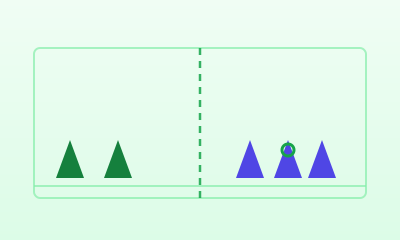
Kabaddi is a contact team sport long played across the Indian subcontinent. A rectangular court is split in two by a center line, and two teams take turns attacking and defending.
The attacking team sends in a single raider. The raider's job is to tag one or more of the opposing defenders (the "antis") and get back across the center line to their own half — safely and under control. Do that, and the raiding team scores one point for every defender tagged.
Traditionally the raider must do all this while chanting "kabaddi, kabaddi…" in a single, continuous breath (the "cant"). When the breath runs out, the raid is over — so you have to tag and return before you run out of air.
The defenders, meanwhile, try to grab, hold, or push the raider out so they can't get back across the line. Stop the raider and the defending team scores instead, and the raider is "out." With almost no equipment involved, kabaddi comes down to pure speed, agility, nerve, and teamwork.
It's a national sport in India, home to the wildly popular Pro Kabaddi League, and an official Asian Games discipline.
Equipment & setup
The best thing about kabaddi is that it needs no special gear at all — no ball, no bat, no net. All you need is a marked-out court, two teams, and a flat, safe surface to run and grapple on. A patch of lawn is enough to start right away.
- A court (just mark the lines) — set out a rectangle and draw a single center line (midline) to split it into two halves. Chalk, rope, tape, or even a stick will do, as long as the line is clearly visible. Official sizes are below, but for a casual game just size the court to your players
- Two teams — one attacks, one defends. Official teams have seven players each, but 3-a-side up to 7-a-side all play well casually. Use bibs or shirt colors to tell the teams apart at a glance
- Clothes you can move in — kabaddi involves grabbing and grappling, so wear stretchy clothing and grippy trainers (or studs) that won't slip on grass. Keep nails short and take off watches and jewelry
- A flat, safe surface — because falls and holds are part of the game, choose a flat, forgiving surface (grass, dirt, sand, or mats). Avoid hard asphalt, and leave a few metres of clear space around the court so no one collides after being pushed out
That's it. With no balls to forget, kabaddi's greatest strength is that you can play the moment enough people gather. For serious play you'll add the official lines (center, baulk, and bonus lines — see below), but a single center line is plenty to begin.
Players & ages
| Format | Per team | Total |
|---|---|---|
| Official (standard) | 7 | 14 |
| Casual (small-sided) | 3–5 | 6–10 |
| Intro / practice | 2–3 | 4–6 |
Kids from around upper primary age up to adults can play. Because it's a contact sport with grabbing and holding, keep big mismatches in mind — start with the tag-only mini-rules below (skill over strength) when in doubt.
Rules
Kabaddi has a simple core: a raider crosses into the opponent's half, tags a defender, and gets back alive for points. Learn the minimal rules below and you can play the same afternoon.
How a round works (minimal rules)
- Split the court in two with the center line; each team takes a half
- Choose which side attacks first (a coin toss works)
- The attacking team sends one raider across the center line into the opponents' half
- The raider tries to touch (tag) a defender with a hand or foot and then cross back over the center line into their own half
- Get back safely and the attacking team scores one point per defender tagged; each tagged defender goes "out" and leaves the court
- The defenders win the exchange by stopping the raider from returning — grab, hold, or push them out. If they succeed, they score one point and the raider is "out"
- Teams swap roles, and now the other side sends in a raider. Keep alternating
- Players who are out come back one at a time as their team scores (a "revival")
- Play to a set time (halves) or a target score — highest score, or first to the target, wins
At first, just aim to nail the one-two of "tag, then cross the line home." Once that clicks, layer in the standard techniques and mind games below.
Standard rules (adding skill)
- The cant (breath-holding chant) — in the traditional game the raider must chant "kabaddi, kabaddi…" continuously, on a single breath, the whole time they're in the opponents' half. Run out of breath and the raid ends, so you must be back across the line before then. Your lungs are the raid clock
- Baulk line — a line set a little inside the center line. To count as a valid raid, the raider must cross at least this line
- Bonus line — a line further back. When six or more defenders are on court, a raider who crosses it with one foot (the other foot kept in the air) and returns safely earns a bonus point
- Defensive skills (tackles) — defenders stop the raider with ankle holds, tackles, and multi-player "chains." Dangerous acts — pulling the collar, hair, or clothing, or throwing someone roughly out of bounds — are fouls
- The chain of tags and outs — a defender the raider tags is out; a raider who gets stopped is out instead. Managing outs and revivals is exactly what tips the momentum of a match
Official competition rules
The official standard style is played indoors on a rectangular court: about 13 m × 10 m for men and 12 m × 8 m for women, seven players a side (plus a few substitutes), over two halves of 20 minutes (with a 5-minute break in the pro game). The modern Pro Kabaddi League replaces the traditional cant with a roughly 30-second "raid clock" to keep the pace TV-friendly, and adds tension rules such as the "do-or-die" raid: after two empty raids in a row, the next raid must produce a point or the raider goes out.
There is also a circle style (Punjabi kabaddi), played outdoors on a round dirt ground, with different spacing and feel from the standard game. Kabaddi became an official medal event at the 1990 Beijing Asian Games, where India has since been utterly dominant. Japan has its own amateur federation running clubs and events, so a taster session is the easiest way to play by the full rules.
Tips for enjoying the game
Common beginner mistakes
- Over-committing. Chasing a tag too deep into the opponents' half gets you surrounded and stranded. Only raid as far as you can still get back from
- Losing the cant. In the traditional game, the moment your breath (and chant) breaks, you're out. Until you're used to it, keep raids short and quick
- Scattered defense. One defender chasing alone gets dodged. Link hands into a chain to trap the raider far more reliably
How to make it more fun
- The magic moment is the raider stretching for a tag, then spinning and sprinting home a hair ahead of the defenders — close calls draw cheers naturally
- "One more out and our teammate revives" moments are pure tension; get everyone shouting and the energy soars
- Playing to timed halves keeps attack and defense flipping fast, which keeps things lively
Variations by age and level
- Kids / beginners: drop the breath-held cant and use the simple version — "tag a defender, cross the line, score." Start around 3-a-side
- Wary of contact: ban grabbing and holding and play tag-only (a light touch stops the raider). Safe and still fun
- Competitive: draw proper baulk and bonus lines and bring in the raid clock and do-or-die rule for the full experience
Playing kabaddi in Japan
- Zero-gear to start — one center line of rope or tape is all it takes, which makes kabaddi a great fit for PE classes, clubs, and recreation days
- Pick a soft surface — with grappling and falls, use a gym with mats, or grass or dirt; avoid hard floors and asphalt
- Agree the contact level up front — decide "tag only" vs. "tackling allowed" based on players' size and experience before you begin
- Amateur federation sessions — Japan has kabaddi clubs and a federation running taster events and tournaments; learning the defensive holds from them speeds up your game fast
Learn more
- Pro Kabaddi League (India) — the world's biggest professional kabaddi competition
- Kabaddi at the Asian Games — an official medal event since 1990
- Standard style vs. circle style (Punjabi kabaddi) — how they differ
- Japan Kabaddi Association (amateur federation) — clubs and events
- Related: for other territory and tag-style outdoor games, see also Kubb and dodgeball