Gateball 101 — Japan's Homegrown 5-vs-5 Team Lawn Sport
- Players:
- 6–10 players
- Region:
- Japan
- Tags:
- Medium group, Striking, Asia, From Japan, Team, Seniors, Competitive
What is this game?
Gateball is a team ball sport invented in Hokkaido, Japan in 1947 by Kazunobu Suzuki, originally inspired by Croquet. Today it has grown into a competitive sport with roughly 1.2 million players in Japan and organized play in over 50 countries under the World Gateball Union (WGU).
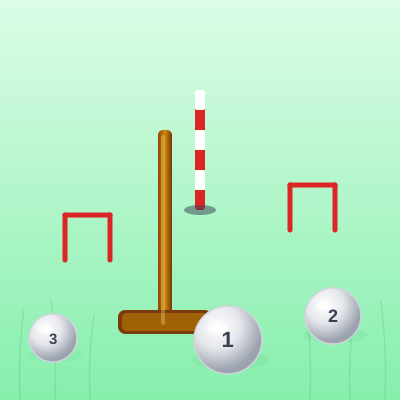
Two teams of five players each take turns hitting numbered white balls with a T-shaped mallet through three gates in sequence, then striking the goal pole in the center to complete a run.
The strategic core is the spark: when your ball touches an opponent's, you place your foot on yours and hit it, sending the opponent's ball flying. A well-executed spark can eliminate a scoring ball entirely. Gateball is often called "shogi on the lawn" for its deep tactical layers.
Equipment & setup
- Mallet — T-shaped; wood or synthetic head
- Balls — white, 7.5 cm diameter; numbered 1–10 (odd = Red team, even = White team)
- Gates — 3 U-shaped metal hoops, placed at fixed positions on the court
- Goal pole — a red-and-white striped stake in the center
- Court — official 15 m × 20 m flat lawn rectangle
Players & ages
- 5 vs 5 (10 total) is the official format; smaller informal games use 3 vs 3
- Popular primarily with seniors in Japan, but rules accommodate all ages
Rules
Minimal rules (just play)
- Red team (balls 1, 3, 5, 7, 9) and White team (balls 2, 4, 6, 8, 10)
- Balls are played in number order, 1 through 10, repeating throughout 30 minutes
- Strike ball through Gate 1 → Gate 2 → Gate 3 in sequence — 1 point per gate
- After Gate 3, strike the goal pole — run complete (+1 point)
- Spark: when your ball touches an opponent's, you place your foot on yours and hit it
- Sending the opponent's ball out of bounds disqualifies it (no more scoring)
- Team with the most points when time expires wins
Standard rules
- Each stroke must be made within 10 seconds (rule varies locally)
- Passing a gate backwards doesn't count
- Balls that go out of bounds return 10 cm inside the boundary
Official competition rules (WGU)
The WGU defines court size, ball and gate specs, and timing. The World Gateball Championships are held annually.
Tips for enjoying the game
Common beginner mistakes
- The mallet swing — unlike golf or baseball, Gateball uses a push-through downstroke, not a swing
- Losing track of turn order — always call out the number before each shot
- Wasting the spark — failing to use your extra shot after a touch is a significant loss
How to make it more fun
- Pre-game team strategy: decide which balls go first based on gate positions
- A clean spark that eliminates an opponent's completed ball gets everyone on their feet
- The 30-minute clock creates genuine late-game tension — watch the time
Age variations
- Kids: smaller court, wider gates, skip spark rules to start
- Seniors: walking pace, minimal physical demand, ideal for older players
- Competitive: regulation court, official timer, referee
Playing Gateball in Japan
- The Japan Gateball Union (JGA) has local chapters and runs beginner clinics and tournaments
- Large park lawns are the typical venue
- Official sets (mallet + balls + gates) cost ¥20,000–30,000 from JGA-certified suppliers
- Community centers and senior citizen clubs often have free intro sessions
Learn more
- World Gateball Union (WGU) — rules and World Championships
- Japan Gateball Union (JGA) — clubs, clinics, and tournaments in Japan
- Related: see also Croquet, Cornhole, and Pétanque